
Babylon By Choice

jeffrey-swanson-T72-kQyQxtA-unsplash.jpg

In 1965, four years before Neil Armstrong took a low-gravity step on lunar soil, my friend Dr. Martin Marty published Babylon By Choice. It’s a booklet about the mission of the Church, and in it, Marty makes two claims: 1) the new environment for Christian mission is urban, and 2) the basic reality of urban life is its secularity. Fifty years later, Marty’s voice reverberates all-round the Christian community. Popular evangelical pastor, Tim Keller, insists the “very models for ministry must become increasingly urban.”[1] Redeemer City to City, a ministry he co-founded, recently had an inaugural North American conference where they hoped to “accelerate and support gospel movements in North American cities.” Sean Benesh, former Developer of Urban Strategy and Training for TEAM, coined the word metrospiritual to capture the “urban-centric approach to faith and Scripture.”[2] Prominent evangelical universities are providing degrees, creating centers, and implementing new models of education that focus on the city. These all form the chorus that echoes Marty’s words; the city is the mission field of the Church.

Marty’s second claim is equally prescient and relevant to contemporary discussions among Christians. Erwin Lutzer’s recent book, The Church in Babylon, is one of many books preparing believers to engage a world that no longer supports decades of comfortable Christendom. These recent publications resemble the voices of Marty’s day, bringing forward the same posture that led churches to suburbanize and flee the city.[3] As Marty reports, the urbanizing world of the late 60s and early 70s saw a society where the influence of the Christian faith was rapidly diminishing, and churches were slow to adjust. Keller writes this about Western churches in the 70s:

“While many Christian leaders were bemoaning the cultural changes, Western churches continued to minister as before – creating an environment in which only traditional and conservative people would feel comfortable … All they preached and practiced assumed they were still in the Christian West, but the Christian West was vanishing.” [4]

Both the focus on the city and the fear of its influence reveal that Marty properly esteemed the significance and power of “Babylon,” an ancient city that now symbolizes all cities and their corruption. In his booklet, Marty challenges his readers to choose Babylon, to commit to a sort of “lovers quarrel” with it, to make it the Church’s home. The World Outspoken tagline, “The City We Make,” is yet another echo of Marty’s voice. Our project reflects a commitment to Babylon, a love for it. It also reflects a commitment to a future city, one “with foundations, whose architect and builder is God” (Heb. 11:10).

My goal in this article is to explain our mission to make the city, tell a different story, and contribute to the culture-making. Our urban-centric focus has generally caused one of three reactions. Some immediately feel our work does not include them because they do not live in a city or live in an urban community that doesn’t compare in size to cities like Chicago. Others are suspicious of our ideology, and they divide into two possible groups. They either suspect we are optimists promoting the creation of a utopia, or they suspect we are aligning ourselves with specific political and theological agendas contrary to the gospel. To these three communities, I’d like to provide a response by considering three question: 1) What is the City, 2) How does it work, and 3) Why should we choose it?

What is The City?

By asking this question first, I am not trying to be overly philosophical. The reason this question is even being asked is because of the resistance to the city and its ways. Most evangelicals (particularly white-evangelicals in the US) are still wary of urban places. Many Christians still tie the gospel to a rural mythology. They believe the myth that “only people in contact with the soil can have real spirituality.”[5] They think “the Christian message’s interest in developing real and authentic persons makes sense only in traditional societies and not in the modern city.”[6] We see this in the way they talk about spirituality. For these faith-people, God is a horticulturalist who made and cares for the natural world, and the city is a wicked construction of corrupted humans.

In Theology as Big as the City, Ray Bakke remembers an article entitled, “Why Evangelicals Can’t Survive in the City” (pb. 1966; one year after Marty’s booklet). The author of the article suggests the Bible is fundamentally a rural book that shows shepherds and farmers as God’s favorite people. According to the author, David was God’s chosen one while he remained a shepherd, but his life as king in the city corrupted him. The lesson presented in the article was simple: Christians should stay away from the city.[7] In a more recent example, Jen Pollock Michel writes this referring to the sin of man in building the Tower of Babel: “They reject the good gift of land and choose as a substitute the domestication of a city.”[8] Her comments suggest that building a city at all was a sin rather than connecting sin, the rejection of God and corruption of man, to the telos (i.e. purpose) of the city that was built. The problem with this mythology is that it misreads the book of Genesis, and ultimately the full arch of the Bible story.

We need a more complete image of the city. We see in these examples that many still see the city as the place of vice, violence, and evil. To this group, the city is only ever Babylon, the place of the Tower of Babel. Today there are others, however, who envision the city as Utopia, the place of power, recognition, and freedom. The first group seeks escape from the city, and the latter flocks to it. Neither vision captures fully what a city is, yet together they reveal the partial beauty and brokenness of it. To help us see an image that captures the city’s very real propensity to violence and its equally real power for fostering human flourishing, we must first recall the backgrounds for the words “urban” and “city.”[9]

Urban life recalls the Latin background of our language in the term urbs. To most thinkers this word represents “the world man builds for himself.” It is the largely physical side of man’s own creation. “Urban” refers to the form or structure of life. It is, so to speak, the apartment that man has to furnish.

The word “city,” on the other hand, carries the memory of the Latin civitas, a word that immediately throws the idea of civilization into our minds. Civitas refers to the psychic or mental and spiritual side of man’s world. It implies not the form of the city but the activity in the city. It does not represent the furnished apartment but the working and thinking of the people who live in the apartment.

Our image of the city needs to account for its two dimensions. The city is both the world we choose to build for ourselves and the spirit with which we relate to it, each other, and those transcendent realities we call goodness, truth, and beauty. The urban, meaning the conglomeration of buildings, streets, parks and plazas – the furnishings in the human apartment – is an agent in service to the city; it supports the city in forming the minds and spirits of its people. This reveals the first of two images I think account for the city’s complex dimensions. The city is an incubator for culture-making.

siarhei-plashchynski-6ORpnPQMTao-unsplash.jpg

The City as Incubator

In his day, Marty observed the power of media and entertainment in promoting a very urban image of life. He writes, “Truly, because of the power of mass media of communication [sic], the whole world is becoming a city.”[10] Keller, again a contemporary echo of Marty’s voice, similarly argues that globalization and the internet have strengthened and expanded the reach of urban culture, making it more difficult for rural areas to continue unaffected by the urban world. In 2010, Edwin Heathcote noted that cities like Laos were growing and absorbing smaller cities and suburbs in their growth. He observes that these bigger, “metacities” needed greater connectivity, and he writes, “digital networking has not, as was forecast, led to a decline in the city. Rather, it has led to an urbanisation [sic] of the rest of the planet.”[11]

My point is that it is no longer possible to ignore or distance ourselves from the influence of the urban world. The apartment is nearly fully furnished, and the only questions now are: what kind of world did we make and what does it do? “If the city is the world which man created, it is the world in which he is henceforth condemned to live. Thus, indirectly, and without any clear sense of the nature of his task, in making the city man has remade himself …”[12] We have to contend with the urban world as a real force capable of engaging all of us. Lewis Mumford, attempting the remarkable task of writing a history of “the city,” concludes this:

From its origin onward, indeed, the city may be described as a structure specially equipped to store and transmit the goods of civilization, sufficiently condensed to afford the maximum amount of facilities in minimum space, but also capable of structural enlargement to enable it to find a place for the changing needs and the more complex forms of a growing society and its cumulative social heritage.” [13]
— Lewis Mumford, The City in History

As I already stated, the urban world, increasingly large as it is, is an agent, a servant to its other dimension: the city. The structure is uniquely made to hold and promote the goods of civilization. Therefore, thinking of the urban as an incubator is helpful. The urban world is a node of cultural power. It captures and sustains the spirit of its citizens. It can do so for good or for the detriment of humanity. The urban world is as good as it is built to be, and that reveals its inherent flaw. It will only ever reverberate the character of its maker. In my studies of Daniel Burnham’s 1909 Plan of Chicago, I discovered the research of Kristin Schaffer. She argues that Burnham believed the urban world is:

An iconographic reservoir that is capable of inspiring belief in the larger social body and in one’s duty to it. Thus, the city is a physical as well as representational realm that organizes the life of its citizens and promotes them to social affinity and proper behavior in public spaces. The citizen would be instructed to be sure, in the schools, the day-care centers, the orphanages, and the adult citizenship classes given at the neighborhood park field houses, but the citizen would also be taught symbolically through architecture. [14]

With the incubator image still in mind, we should consider the second image for the city.

chuttersnap-PVQbeEr9-xU-unsplash.jpg

The City as Fire

The ancient Greek philosopher, Lycurgus, claimed the city was the only unit of government capable of establishing a relationship with the individual strong enough to make it (the city) a formative agent.[15] In other words, the city is of greater influence on the character of its people than the state or nation. This explains why people in cities like New York, Tokyo, Seoul, and London are likely to have more in common with each other than with the non-urban citizens in their own countries.[16] Remember, these global cities are connected to one another and are promoting (i.e. incubating) a similar form of life.

In a previous article, I argued that culture is what we make of the earth. It is what we make in two senses: 1) it is the stuff we produce from the natural resources around us (i.e. the urban apartment and all its furnishings), and 2) culture is the meaning, the sense, we make of the worlds that we create. This is where the name, World Outspoken, originates. Culture is the world we make and live in together. We already saw that this world is urban in design, and its built to foster human culture-making. Now, I want to turn our attention to the meaning, the sense we make of this urban world order.

The cultural world can be broken down into four spheres: story, space, community, and time; the most important of these being the story. Stories are foundational to human life. We cannot make sense of our actions without the stories that guide them. These stories, however, are not enacted in a vacuum with no regard to space and time. The city, then, is not merely a dense collection of buildings made of brick, glass, and steel. It is the setting, or space (second sphere), where a community of persons (third sphere) live out a story (first sphere) according to a specific rhythm of life (i.e. time, the fourth sphere).[17] Urban environments help us act out our stories.[18] They also serve as instructors for new community members, helping them understand the values implicit in the community narrative. The objectification of virtues – the work of making ideas and values concrete in objects – is part of the city’s program for the formation of its people. Values are embedded in narratives and narratives take form in places. The human spirit is externalized in stories that give shape to life and setting alike. To return to the original metaphor, the urban incubator is powered by the fire of the human spirit. The city dimension, then, is this fire.

In her classic book, The Death and Life of Great American Cities, Jane Jacobs uses this metaphor to explain what a city is. For Jacobs, a city is a large field in darkness being illuminated by scattered fires of varying sizes, each representing intense, diverse, and complex human community. As the community works for mutual support and benefit, they give shape to the “field” around them; their life together brilliantly reveals the necessary form for the space they coinhabit. As the community teems with flourishing people, a city is born. It is important to acknowledge that this fire is intended to benefit the citizen. It’s meant to illuminate a good way of living. As Aristotle once wrote, “Men come together in the city to live; they remain there in order to live the good life.”[19] The pursuit of this good life is the end of the city, the revelation of this fire. This image reveals three basic functions for the city that we can now explore in our next question.

How does The City work?

I will only briefly detail the functions of the city since many of them have already been described in the answer to the initial question. First, cities are places of human advancement. Human advancement is a phrase meant to capture the reality that cities are not full of poor people because they “make poor people, but because cities attract poor people with the prospect of improving their lot in life.”[20] Secondly, cities are places for technological advancement. Finally, cities are places that enable human cooperation.[21] Of course, these functions can and generally do become corrupted. The city can enable systems for human oppression, the development of technologies that result in human harm, and the cooperation of a society that sustains a city resembling Babylon. Park’s ominous warning is worth remembering: if the city is the home we build, it is the world we are condemned to live in together.

As the incubator and burning focal point for cultural power, the city maintains the basic functions of society. Political legislation is written in the city. Cultural trends begin in the city. Economic enterprise is run from the city; even the farmers travel into the city for their market. Its influence is felt emanating through the suburbs and out into the rural communities of the surrounding region. So, the culture we make in the cities of the world has the potential to shape whole regions for good (or evil). Therefore, we must choose the city. We choose to intentionally make the city according to a better, truer, more beautiful story than those that created Babylon.

Before moving to the final question, I want to address the secularity of the city. The truth is that the city runs on the interface of several stories. Immigrants move to the city with narratives from their home culture. The rich and the poor each present their own vision for life in the city. Religious groups proclaim their meta-stories, and the social elite and media outlets (journalists, entertainers, artists, etc.) channel stories directly into the family’s living room. For these narratives to coexist the city maintains a a variation of a secular, or non-religious, dominant story. The modern city is pluralistic. Secularity, as Marty notes, is the basic reality of urban life. This presents challenges to the Christian mission. However, there is no reason for Christians to fear this reality. Instead, we must adapt to and embrace the new context for Christian mission.

Why should we choose The City?

In the Bible, there are two important images for the city. I’ve introduced the first image already: Babylon. This ancient city was a display of power for its kings, who often boasted great conquests and war victories.[22] It was the symbol of their ability. It was an expression of boast. In City of God, Augustine presents the City of Man – an image synonymous with Babylon – as governed by libido dominandi (the lust for mastery). This lust to dominate others is a perversion of power. Indeed, Mumford notes that many of the cities of the ancient world grew into their full form on the parasitism of surrounding areas and the use of slaves. He argues that capital cities like Babylon expanded by imposing required tributes and “by bringing about a negative symbiosis based on [the] terrified expectation of destruction and extermination.”[23] Babylon, and all the cities after it, harbors this base abuse of power. Cities can and are the places of great injustice, severe violence, and deep-seated inequality.

However, the Bible has a second image for the city, an alternative that drives Christian mission. This city is called Zion. Just as Babylon is an image that captures a certain behavior, so too Zion is an image that drives a Christian ethic. This is vital to the Christian mission in the city, but we must be careful not to present our message as nothing more than a Utopian future. To present Zion as simply a hope for a future heaven will not suffice in the context of the secular modern city. Instead, Zion introduces a dual identity for the Christian in the here and now. In fact, I argue that Zion is the urban future for a present city that is inherent to the Church’s very character. Allow me to explain.

City on a Hill

Jane Jacobs’ image of the city as an illuminating fire resonates in one sense with the city-image in the Biblical story. Jesus connects the nature of the Church with the nature of the city by envisioning the Church as “light of the world … city set on a hill” (Matt. 5:14). The Church is the radiant-city. It stands in a fire that burns but does not consume, illuminates but does not destroy. In the darkness of the field, the Church is built as part of a city all-together good, beautiful, and truly conducive to human flourishing. In their life together as resident aliens and travelers, immigrants, the Church is given space and instruction to make their current place resemble a future urban place, one built by God (Heb. 13:14). The Church is God’s alternative to man’s failed attempts at building an urban world and the modern city’s plague of loneliness, rootlessness, alienation, and injustice.

In one provocative piece of writing, famed missiologist Leslie Newbigin argued for the possibility of a Christian government. “He contends that the logic of the cross should lead such a government to be non-coercive toward minorities, committed to the common good of all, and therefore could still allow a pluralistic society to flourish.”[24] I am by no means advocating for a Christian government or the literal construction of a Christian city, but Newbigin’s “logic of the cross” presents the way for Christian mission in the modern city. We should choose Babylon that we might reveal to Babylonians a way of life that fits their aspirations. For instance, people all over the world desire justice and societies of equality, but the cities they make are built on stories and uses of power that cannot engender commonwealth. This is essentially Augustine’s critique of Rome. In City of God, Augustine critiques another writer named Cicero for suggesting that Rome is, in fact, a commonwealth. He does this on the basis that justice is part of the very essence of a commonwealth. Augustine suggested, however, that Rome only created a semblance of justice. It is his contention that Rome, like all other earthly cities, is still inherently charged with humanity’s self-love and the libido dominandi.[25]

Conclusion

In 1965, before the world exploded into urban life, Marty concluded his booklet with a simple charge to the Church. He observed in his own day that the modern city “cut off” the Church from “the kinds of decisions in which basic life … is affected and formed.”[26]  Christian leaders and pastors are relegated to specialized roles in modern cities and kept from engaging more and more in the public elements of life. Marty notes that many conservative Christians have accepted this new place in the city, saying “that the only responsibility of the Christians toward the environment is to rescue and snatch people out of it.”[27] These same sincere Christians, observes Marty, “then turn around to criticize most vocally the secularizing of life to which they abandoned society and its people.”[28] Instead, Marty proposes a different way of engaging Babylon with the Christian message.

Because the pastors of the world are marginalized from many of the public and powerful functions of the city, Marty suggests the Christian lay person - the scientists, teachers, historians, artists, marketers, chefs, and bankers – are the necessary workers for Zion. They must carry on the Christian Mission and lead the exodus from Babylon to Zion. “They will be effective from the human way of speaking to the degree that they penetrate the varieties and definitions of urban life.”[29] Secondly, Marty challenges the Church to deep unity in a city of frayed relationships. “While “we” work in division, the city “closes itself off” without us.”[30]

World Outspoken is an echo of both moves in Marty’s charge. Our mission is “to inspire, train, and equip culture-makers speaking good news into the cities they make.” We focus on culture-makers because they are the leaders in Christian mission. We also work with Christians and non-Christians alike because we are committed to the common good of the cities of the world. Finally, our desire is that the city we make resemble the unity born from the death and resurrection of King Jesus. World Outspoken is the city we make.


Footnotes

[1] Timothy Keller, Center Church: Doing Balanced, Gospel-Centered Ministry in Your City, 8.9.2012 edition (Grand Rapids, MI: Zondervan, 2012).

[2] “Books | Sean Benesh,” accessed September 27, 2018, http://seanbenesh.gutensite.net/Books.

[3] For more on this phenomenon, see Eric O. Jacobsen, William Dyrness, and Robert Johnson, The Space Between: A Christian Engagement with the Built Environment (Grand Rapids, MI: Baker Academic, 2012).

[4] Keller, Center Church, 253.

[5] Martin E. Marty, Babylon by Choice: New Environment for Mission, 4th Printing edition (Friendship Press, 1965), 18.

[6] Ibid.

[7] Raymond J. Bakke, A Theology as Big as the City (Downers Grove, Ill: IVP Academic, 1997).

[8] Jen Pollock Michel and Katelyn Beaty, Teach Us to Want: Longing, Ambition and the Life of Faith (Downers Grove, Illinois: IVP Books, 2014), 83.

[9] What follows is an excerpt of Babylon by Choice (pg. 10).

[10] Ibid., 16.

[11] “From Megacity to Metacity,” Financial Times, April 6, 2010, https://www.ft.com/content/e388a076-38d6-11df-9998-00144feabdc0.

[12] Ralph H. Turner, ed., Robert E. Park on Social Control and Collective Behavior: Selected Papers, 2nd Print edition (Phoenix Books, 1969).

[13] Lewis Mumford, The City in History: Its Origins, Its Transformations, and Its Prospects (San Diego New York London: Mariner Books, 1968), 30.

[14] Kristin Schaffer, Introduction to Plan of Chicago, by Burnham and Bennett, First Edition (New York: Princeton Architectural Press, 1993), xiii.

[15] Burnham and Bennett., xii.

[16] Keller, Center Church, 155.

[17] Time can be understood as the plotline, or rhythm of life, for the story. Jacobsen suggests one could ask, in light of human life understood as the actions of people in a drama, “When are you” with regard to their position in the story (i.e. opening scene, climax, resolution). Each story lives according to a different rhythm.

[18] Note: Because cities are the physical settings for cultural narratives, they can be created with unique forms. In other words, cities have peculiarities and nuances just as people have peculiarities that distinguish their unique personalities.

[19] As quoted by Mumford, The City in History, 85.

[20] Sean Benesh, Blueprints for a Just City: The Role of the Church in Urban Planning and Shaping the City’s Built Environment (Urban Loft Publishers, 2015).

[21] Benesh.

[22] Genesis 10:8-10 identify Nimrod, a mighty man and hunter, as the founder of Babylon.

[23] Mumford, The City in History, 160.

[24] As noted by Keller, Center Church, 223.

[25] Augustine, Augustine: The City of God against the Pagans, ed. R. W. Dyson, y First edition edition (Cambridge ; New York: Cambridge University Press, 1998), xviii.

[26] Marty, Babylon by Choice; 61

[27] Ibid., 62.

[28] Ibid.

[29] Ibid., 63.

[30] Ibid. Marty is quoting Roger Schutz here.

Lessons From A Man Called Ove: A Story about Inclusion and Community

wos-man-called-ove.jpg

Some years ago, I was in the second round of interviews for a pastoral position with a significant church in Chicago. This church was in the process of launching several new campuses, and my neighborhood was their next target for a new site. They wanted this campus to have two pastors on staff that reflected the primary ethnic-groups residing in Logan Square: an older Hispanic community and a younger, millennial-aged white constituency. As is customary, I was given a few minutes to ask questions of my interviewers, and my first was this:

“Hispanics value the care of their elders. Your church has a younger membership, so how do you intend to serve the Abuelas and Abuelos and make them part of your community?"

The response was bewildering. The pastor reminded me that the church’s brand was younger, that it was part of their “DNA,” and he suggested that no plans would be significantly changed to serve or integrate the elderly. Inexplicable! A church interested in reaching, serving, and representing all of Logan Square wasn’t considering the longstanding Abuelo/a who sits on the porch every day to watch the neighborhood. The sad truth is his response reflects the real experiences of elderly people frequently ignored, even cast out, by the rapidly developing city around them. Thanks to Fredrik Backman, however, these experiences are set, named, and reconsidered in the fictional life of his original character, Ove, and his story exposes just how vital elders are to the city we make.

Introducing A Man Called Ove

Ove is the titular character of Fredrik Backman’s first novel. He is a man of principle who believes a thing should be done or abstained simply because its right. “Men are what they are because of what they do. Not what they say,” says Ove. He’s a misunderstood widower labeled a curmudgeon, and he’s forced out of society completely, left alone to contemplate his presumed uselessness and plan his suicide. This is Ove’s condition when the reader meets him. He’s alone “in a world where he no longer [understands] the language,” dejected, and preparing to take his life. The trope of the old hero forgotten by society and broken by an untimely lost is used by Backman to bring readers near to the experience of this bristly old Swede. Ove is a hero. But, Ove is lost.

In this story, as in others, the hero must be found and called back from his exile before the villains can be defeated. However, it is his calling and foes that reveal the unique insights latent in Ove’s story. Here are three of the many lessons learned from Ove and his neighborhood.

Seen and Known

It takes someone who knows the margins to bring someone back into the fold. Ove and his neighbors are living a fragmented experience of community when the story begins. Rune and Anita, Ove’s oldest friends, no longer speak to him. His neighbor across the street, Anders, is judged from a distance and suspected of being a dubious character. Where there was once a vibrant community of neighbors, there is now only echoes of an old life which only serve to further ostracize the characters. That is, until the arrival of a certain “crazy, pregnant foreign woman and her utterly ungovernable family.”

Parvaneh, an Iranian immigrant, moves into the neighborhood with her husband Patrick and their children and immediately restores life and laughter to its residents. She sees through Ove’s rough exterior, and her daughters quickly fall in love with their new “granddad” (or Abuelo).  Parvaneh is the force behind Ove’s reintegration, compelling him to help Anita and Rune, take in the stray cat fond of Ove’s home, and interact with Jimmy and the other young men of the row house street. Because of her, Ove becomes a handy-man, helping the “fools” in almost every house within a four-street radius. On one occasion Ove mumbles to his wife, “Sometimes it can be quite nice having something to get on with in the daytime.”

“The neighbors are saying he’s been “like a different person” these last days, that they’ve never seen him so “engaged” before."

All this teeming life is born from Parvaneh’s insistence that Ove return from his exile. She becomes like a daughter to the old Swede. Were it not for her, Ove’s gift would be lost to the world. Instead, Ove flourishes in his old age, and his neighbors benefit from his presence thanks to Parvaneh’s call.

The Dignity of Work

Ove frequently bemoans the new world of modern society. He hates credit cards, thinks the idea of retirement is flawed and unjust, and is shocked by the general lack of loyalty toward Saab, the only car manufacturer Ove trusts. “Nowadays people change their stuff so often that any expertise in how to make things last was becoming superfluous,” thought Ove. The lost of that expertise meant that Ove was viewed as a relic.

In an astounding display of blindness and injustice, Ove’s employer forcibly retired him. “This was a world where one became outdated before one’s time was up,” thought Ove. Many of his critiques of the world proved to be wisdom in the end. When Parvaneh successfully brought Ove back into community, she also revealed the importance of his skill for others. Beyond his technical and architectural skills, Ove helps young Adrian with his romantic woes and provides leadership for the community. The dignity of work and tradition are made clear through Ove’s story.

Resist. Together.

Ove and his wife, Sonja, were the first to move into their community. “Their understanding was that children should live in row housing developments among other children. And less than forty years later there was no forest around the house anymore. Just other houses.” The quiet backwater home became a city district, and they had drug dealers, young couples, and immigrants as neighbors. Ove lived to see the under-developed neighborhood come to age and grow old, gentrifying as a “parade of uppity real estate agents … patrolled the little road between houses … like vultures watching aging water buffalo.”

Gentrification done wrongly is a destructive force, and its effects are observed in Ove with accuracy. In a study of the Italian West End of Boston, Marc Fried observed severe grief in residents who experienced the loss of their homes.[1] It is not simply the loss of a habitation, but the memories that are grieved. Old buildings become monumental works of art. Ove experiences such lost. However, when Rune and Anita are facing the similar threat, Ove gathers the community in their support. The book reveals the remarkable power of a community that works together against systems of injustice.

One of the most riveting lines in the book is said by Sonja’s new principle and boss. When offering her the job at the local school, he says, ““There’s no hope for these boys and girls,” the headmaster soberly explained in the interview. “This is not education, this is storage.” Sonja, a hero in her own right, resists this notion and teaches her young pupils to read Shakespeare. Education, gentrification, homophobia, and generational bias are all confronted by Ove and his community. They do it together, and they overcome.

Life is a Curious thing

A Man Called Ove is a story about a hero resisting the systems of social change that empower wicked men to exclude the elderly, the weak, and the disabled. These white-shirted villains are city councilmen who believe they have the power to evaluate people and decide when they are only good enough to die. Our vision for the world can and should be shaped by Parvaneh’s reminder that the elderly are needed just as much by their communities as they are dependent on them to flourish. Ove himself reveals the dignity of work done well and the vitality of a world that enables the work of its elders. The entire community illuminates the tangibility of social injustice, and they encourage the reader to resist by pursuing another way of flourishing, one that commits to the well-being of those Abuelos and Abuelas that are often forgotten.


Footnote

[1] Emily Badger, “Why Trump’s Use of the Words ‘Urban Renewal’ Is Scary for Cities,” The New York Times, December 7, 2016, http://www.nytimes.com/2016/12/07/upshot/why-trumps-use-of-the-words-urban-renewal-is-scary-for-cities.html.

Disability and the City We Make: Including the Disabled

wos-dropping-aaron-off-at-residential.jpg

Culture-making is a communal enterprise. Culture is always made by, with, and for the community. Too often, however, we relegate the responsibility of culture-making to a sub-group of elite or exclusive people. We reduce culture to its popular and folk elements and depend on artists and media personalities to produce it. We reduce culture to social norms and values, depending on local educators and youth leaders to cultivate them in the next generation. We reduce culture to a set of systems and quarrel for more political power and agency. In a variety of ways and for a web of related-reasons, we exclude members, including ourselves, from culture-making and from contributing to the city we make.

Good culture-making, however, depends on the contributions of all community-members, reflecting the wide array of personalities, abilities, and skills found in the people. This includes the disabled (or “differently-abled”) among us. We recently asked our friend, Dr. Andrew Beaty, to help us consider the role of the disabled in culture-making and our responsibility as enablers making room for their contributions. Here are Dr. Beaty’s helpful insights on the disabled and the city we make.

wos-way-home-from-mental-hospital.jpg

Questions for Andrew

  1. How did you come to your vision for the disabled in our community?For me, it was a slow process. Growing up, my church had a couple of people with disabilities, but I never really interacted with them, and my school setting totally separated students with disabilities from the general school population. In my educational career, I did not get much information on how to serve or interact with those who have disabilities. However, in the first church I served after seminary, I was thrust into a situation where we had a couple families who had several kids with wide varieties of disabilities and I had to interact with parents, professionals, and various resources to learn how to include these kids into various aspects of our church’s ministry. Over the years, I also did community-based counseling for kids with needs in both public and non-public schools and in a state mental health hospital. Then, my wife and I adopted six children with a wide variety of special needs, and the issues became much more personal! This has opened doors for us to interact with people in conferences, in advocacy roles, in higher education, in the church realm, in school settings, in community organizations, etc… Each of those experiences enhanced my understanding of the struggles that both individuals and families encountered in every aspect of their lives. I began to understand that engaging with those impacted by disabilities was a “big picture” issue that impacts each of us in so many ways...whether we realize it. I’ve seen the incredible gifts that our communities are missing because we’ve placed labels on people that exclude them from “our culture,” and that is one of the issues that really motivates me.

  2. What role do disabled persons share in our culture-making?We don’t often take the time to think through how important those with disabilities were to Jesus. Think through all the situations in the Gospels where he healed those with disabilities…or even where He didn’t heal them.In the Scriptures, those with disabilities are seen from God’s view as being made in His image…just like those who are not disabled. In Paul’s descriptions of the Body of Christ and the giving of spiritual gifts (Romans 12; 1 Corinthians 12), there isn’t a footnote or exception that says that those with various disabilities don’t have the same access to the Holy Spirit, and in fact, Paul is quite clear that every part of the Body of Christ is important. We can’t function well when parts are missing. So, in the Lord’s view, those with varying abilities are considered part of the community and part of those building culture in their spheres of influence.Because the term “disabled” can cover so many different situations, it is hard to cover everything with one broad brush stroke, but everyone needs to be part of making our culture.

  3. How can the broader community make space for the disabled to flourish in their role?Perhaps one of the biggest areas that people can think about is how to focus on the word “ability” and minimize the “dis” part of the word. When we start out with the assumption that someone is broken or not able to participate, let alone thrive in our collective community, it becomes difficult to make that space. I went to a conference last year where Emily Colson explained that we need to move beyond giving those with different abilities token positions in society but to move towards including them in all aspects of life. At the conference and in her book, Dancing with Max, she often shares stories of how she and her son Max encounter situation after situation that cause others to stop and evaluate how someone with autism can participate in normal everyday activities like worshiping at church or attending a movie in a theater. Each of these situations provides opportunities for others to grow in evaluating how we either allow or restrict those impacted by disabilities to thrive.We’ve experienced both the positive and negative aspects of people’s interactions with our family as people have either squashed or encouraged our involvement in society. There are negative stories like the time one of our boys with autism screeched and cried for the entire ride on a train that had been a special treat for him… and I overheard people complaining that kids “like him” should never be allowed to be out in public where they ruin things for everyone else. We’ve also been able to participate in a basketball program at our church where nobody got upset that this same boy is doing cartwheels on the court instead of playing defense or that he runs off the court to hug his service dog when he’s supposed to be playing. The first response keeps us from flourishing, while the second one invites us to be participants in the broader culture.

    It can also be easy for people to erroneously believe that the role of helping others belongs to “somebody else”. I think we can go to the extreme of thinking, “I can’t invite someone in a wheelchair to lunch at my house, because I have steps that they can’t get up.” Then, we dismiss our role in serving others. However, there are ways that everyone can be part of helping those with disabilities flourish. Here are a few concrete ways that we can engage others: Offer to prepare a meal or even have a pizza delivered to a family to let them know you’re supporting them; instead of avoiding someone with a disability, go up and start a conversation...just like you would with anybody else; get to know someone with a disability and include them in conversations or activities that you’re already engaged in; offer to serve someone with a disability by being a buddy in a class at church; assist with projects like cleaning, building a wheelchair ramp, grocery shopping, or serving other needs; volunteer with an organization like Special Olympics or a support group for those facing disabilities; offer to provide respite care for parents who aren’t able to ask “the neighborhood jr. high babysitter” to watch their kids; or gather a group of friends who will work together on any of these ideas. The key point is to move from a position of fear and avoidance to one of fearless love and engagement with those who are different than you are.

  4. Can you share a story of a disabled person who is actively exercising their role as a culture-maker?Joni Eareckson Tada is an amazing example of a person who became disabled through an accident but who has subsequently turned what seemed like a tragedy into a ministry that has elevated the place of those with disabilities. When she was a teenager, she broke her back, and became a quadriplegic. After initially wrestling with her faith and what the future held for her, she started a ministry called Joni And Friends that helps those with disabilities be part of the culture and challenges the Church to view those with special needs as an important part of the Church and not just those on the fringes of society.They provide both physical assistance to those with disabilities through programs like refurbishing and donating wheelchairs for people who need mobility to be part of society. They have also done extensive work to prepare curriculum for churches to use as they wrestle with the biblical and theological aspects of suffering. Their family retreats serve families who are impacted by disabilities so that those with special needs can experience a retreat designed for them, and that also gives their caregivers some respite and encouragement.

  5. Where can we find more stories like this one?There are several books on the Joni And Friends’ website that have biographies of individuals and families who are using their disabilities to engage the culture in different ways. KeyMinistry.org also has links for various resources such as books and links to blogs that share the stories of others who are in the journey of working out how they intersect with society and culture in general. Many of our friends who are disabled or who have family members with disabilities would love to discuss how they view their place in culture; how they feel marginalized, but how they want to make a difference; how they are currently engaging in the culture; how they would like to do more at being part of society generally instead of living life with a particular label being their primary identifier.Again, if you want to raise the awareness of ways to engage those with disabilities, invite someone from Easterseals, March of Dimes, Autism Speaks, Special Olympics, etc… to come and speak to a group that you gather or that you regularly participate in.

  6. Do you think priorities or values need to change for the disabled to be better integrated in our work together? If so, which values do you think need to be confronted or reevaluated?As I mentioned earlier, our society seems to focus on the negative aspects of disabilities with the automatic assumption that a disability is bad. We often get responses that show that negative view with questions like, “What is his problem?” “Have you prayed that he will be healed?” “We’re so sorry you have a kid with so many issues.” “Why do you have to give your kids medications...can’t they be fixed by some diet or some ‘magical’ therapy?” These kinds of questions seem to resonate more with scriptural passages like John 9 where Jesus’ disciples assumed that just because a man was blind sin was involved. However, Jesus reminds his followers that God works through disabilities to bring His own glory.Another value that may need to change is the concept that each of my friendships needs to be equally beneficial to both people. When I view my willingness to interact with someone who has disabilities through the lens that it must be “worth my time,” my selfishness can hinder the ability of my friend to participate together with me. I get frustrated as a father because nobody wants to invest the time to hang out with my awkward junior high son who has several disabilities... even though I know it could be tough to engage him. BUT, then, when I’m given the opportunity to invest time with my friends who have disabilities, I find myself counting the cost to me instead of counting the blessings to my friends. And, I find that so easy to do... it’s not like it’s tough for me to ignore others... it’s right there in front of me. So, I know it’s hard to change our priorities and values, but it needs to happen if we ever want to change how we view those with disabilities.

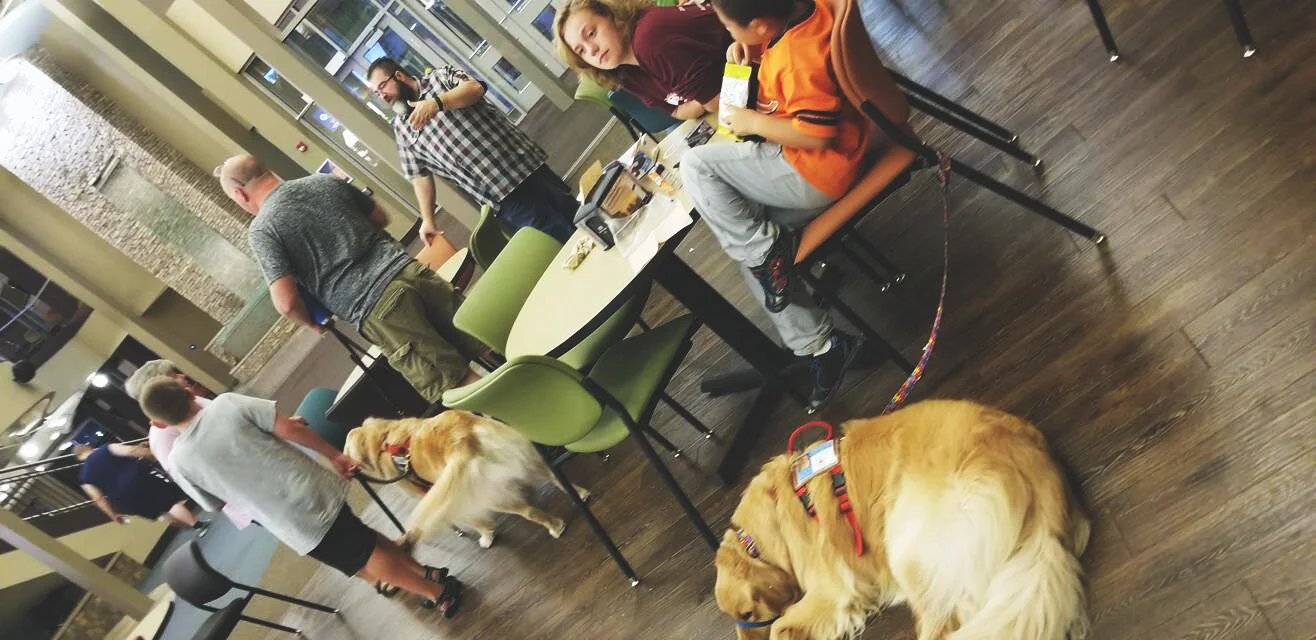
  7. Can you share a story of a community that has done this well?My church community is in the process of learning to do this well. We aren’t perfect, but we’re working to change our church and our community’s view of those with disabilities. For instance, here is a video clip of a recent special offering we took up to support Special Olympics in our area: Dollar Offering Testimony. We played this video in our services which also helps our community see that this is part of our normal life. Our church also has two people with disabilities that serve as greeters each week. They are part of that change showing that they have value and worth. We have moved from seeing those with special needs as the most dispensable members of our congregation to investing in sensory rooms, hiring a full-time pastor of special needs, training volunteers to work with wide varieties of special needs from birth through adulthood, and offering a support group that provides training and encouragement for families.Our sports ministry is still growing in what it looks like for kids with special needs to participate with their peers. We recently had a situation where, due to several elements, we were not able to allow a child with some extreme needs to attend summer camp. This caused a lot of frustration with the child and the parents, so we’re working through ways not to be put in that situation in the future. Even though I’ll brag on how our church is impacting our community, part of changing culture is realizing that you’re going to make some mistakes along the way and that you’ll have to ask for forgiveness and strive to do better the next time. Even though we’ve made many mistakes, our church’s population of children with special needs has grown by over 40% over the past year (we’re a church of about 6,000 in attendance on Sundays), which is an incredible statement that shows that families who have kids with disabilities are looking for communities that will include them and help them be part of the culture around them.

  8. Based on your ministry experiences, what pitfalls do you think should be avoided when trying to become an integrated community that cultivates flourishing disabled persons?There are a handful of pitfalls that I’ve experienced. One of them is thinking that it’s impossible to interact with, serve, and serve with the disabled until everything is perfect. If individuals and churches wait until everything is 100% ready to go, it will likely not get started. Start with where you’re at and improve as you go along. At the same time, there needs to be some training to understand the disabilities you will be working with. Another pitfall is thinking that providing one area of ministry for disabilities automatically fixes things for everyone. For instance, just because someone is signing the worship and sermon elements of a service does not mean that those who are deaf have the ability to attend children’s or youth classes where there isn’t an interpreter, nor does it mean that those individuals feel integrated into the broader community of the church unless there is a concerted effort to help them be able to interact with others. A third pitfall is believing disabilities are a result of someone’s lack of faith. Believe me, you don’t need to ask people impacted by disabilities if they’ve prayed... trust me... we all pray...a LOT! But, we would all appreciate your prayers for us to have wisdom as we navigate our lives that are different than many of our friends’! A fourth area that impacts the integration of the disabled is when caregivers are forgotten. Most of the families we know are lonely, and many fight major depressive episodes. Having a family member with a disability is relentless. The needs can be crushing, whether it is driving an hour or more each way to go to a medical specialist, needing to load a mobility scooter or a service dog into a van just to run errands, or not being able to find someone who is qualified to watch kids, so parents can have a date night. Don’t let the families fly under the radar.

wos-dinner-after-church-with-service-dogs.jpg
wos-dr-andrew-beaty.jpg

About Andrew and Moody's Program

Dr. Andrew Beaty serves at Moody Bible Institute—Distance Learning as the Associate Director of Faculty Development and Assessment, and as the program head for Disability Ministries. He has served families impacted by disability for over 30 years in local church and para-church ministry, and as a school counselor/therapist at a school for students with severe emotional, behavioral, and mental disabilities and those on the autism spectrum. He and his wife Karen have five biological children and have also adopted six children with special needs. They are active in the foster/adoptive and special needs communities as conference speakers, mentors, and cheerleaders for individuals, families, and churches who are working through how to best serve everyone.

Moody recently started a concentration that provides a biblical, theological, and practical foundation for equipping people to better serve those whose lives are impacted by disabilities from birth throughout their lives. An incredible team of individuals with backgrounds of serving those with disabilities from physical and occupational therapy, clinical mental health, various ministry settings, educational settings, and family involvement have collaborated to develop the four courses in this concentration so that people taking the courses will have a variety of perspectives infused throughout their studies. We have also worked with consultants from other national and international disability ministries to make sure that the courses address the needs that are being reported from those with various disabilities. These courses are available to both degree seeking and non-degree seeking students.

Montgomery

wos-montgomery01.jpg

“True Peace is not Merely the absence of tension, it is the presence of Justice.”

Martin Luther King, Jr.

The Cradle of the Confederacy and The Birthplace of The Civil Rights Movement

Cities, like people, have complicated histories. Their character can reflect apparent contradictions, but if we take them as a whole we see their beauty. Cities bear the marks of who we were, and in remembering, they give us the opportunity to decide who we will be in the future.  Montgomery is one of those cities. Its seal is a jarring reminder of paradoxical truths. Montgomery is both the “Cradle of the Confederacy” and the “Birthplace of the Civil Rights Movement.”

wos-montgomery11.jpg

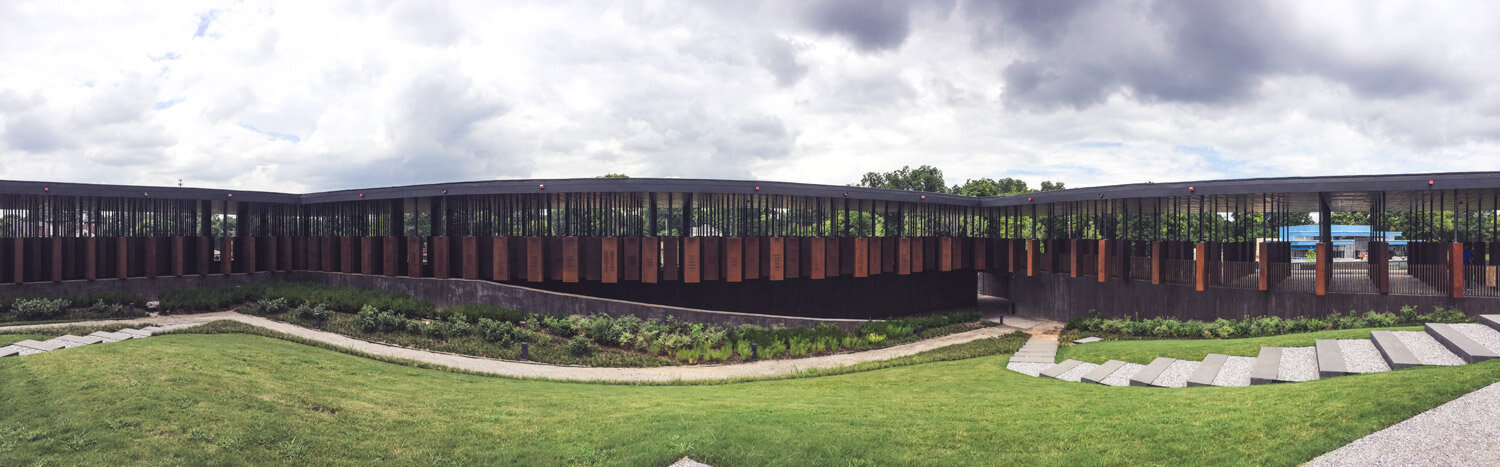
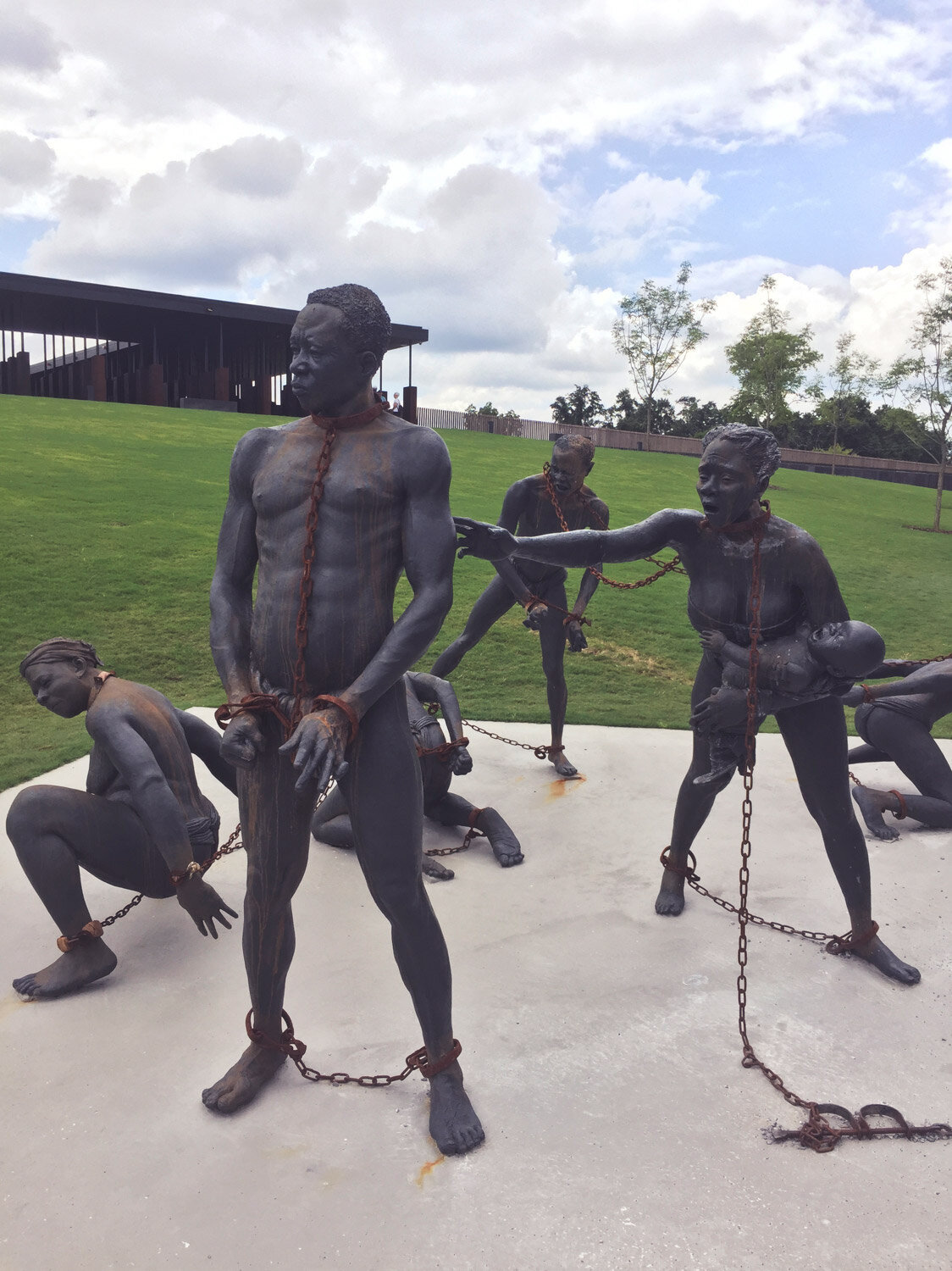
The city is still home to the First House of the Confederacy, but thanks to the Equal Justice Initiative (EJI), it now has the Legacy Museum and the National Memorial for Peace and Justice. The EJI is founded and directed by Bryan Stevenson, author of Just Mercy. They work to provide legal services to prisoners. We’ve been interested in their work for some time and recently visited their new public exhibits. Here are some photos that highlight the power of the memorial.

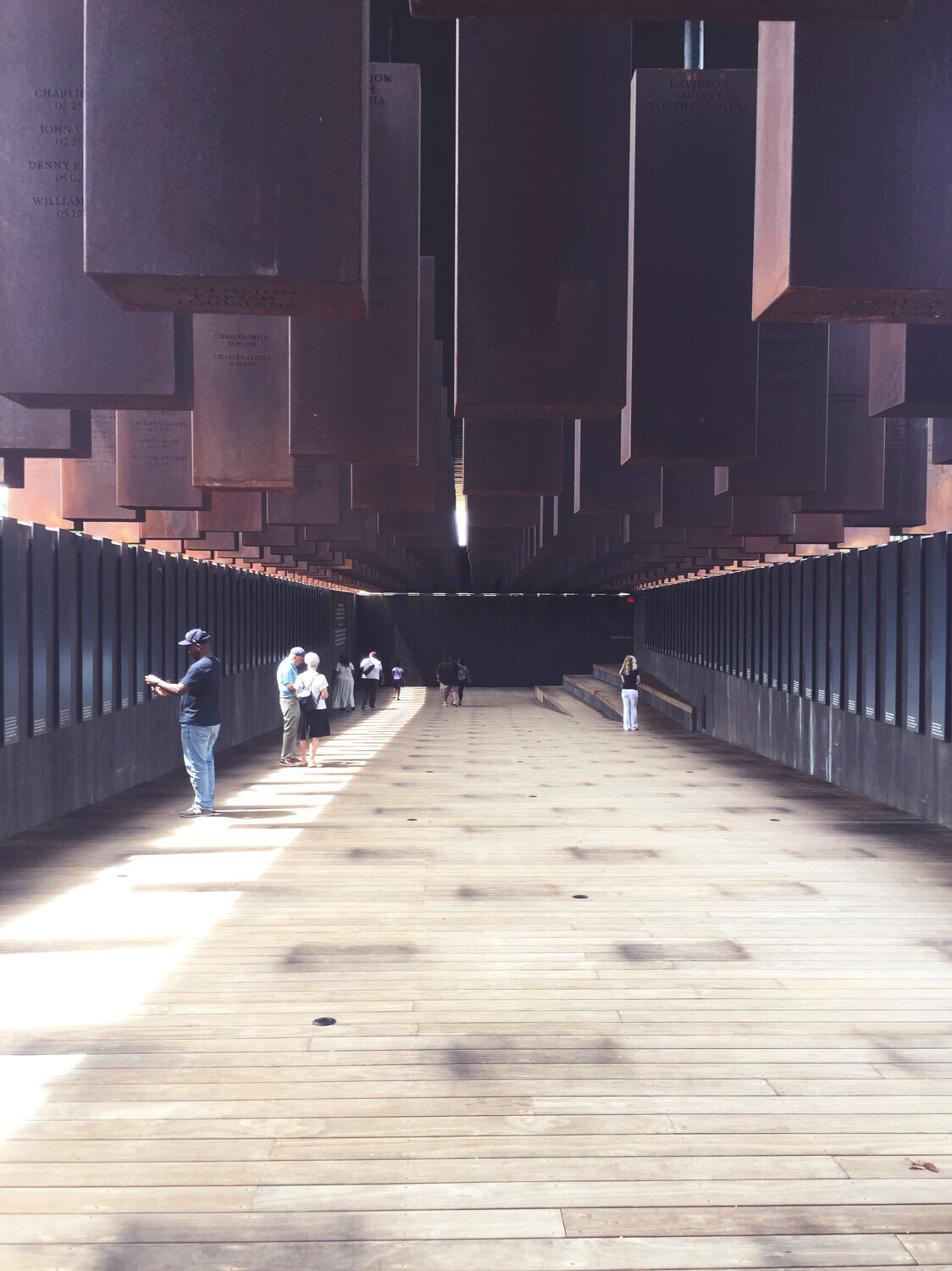
“The centerpiece of [the memorial] is a sprawling wood-and-metal open-air structure featuring 800 6-foot columns, each one representing a county where a lynching took place in the United States between 1877 and 1950.”1 The EJI worked over six-years to recover the history of the public murders, documenting 3,959 lynchings across the south.

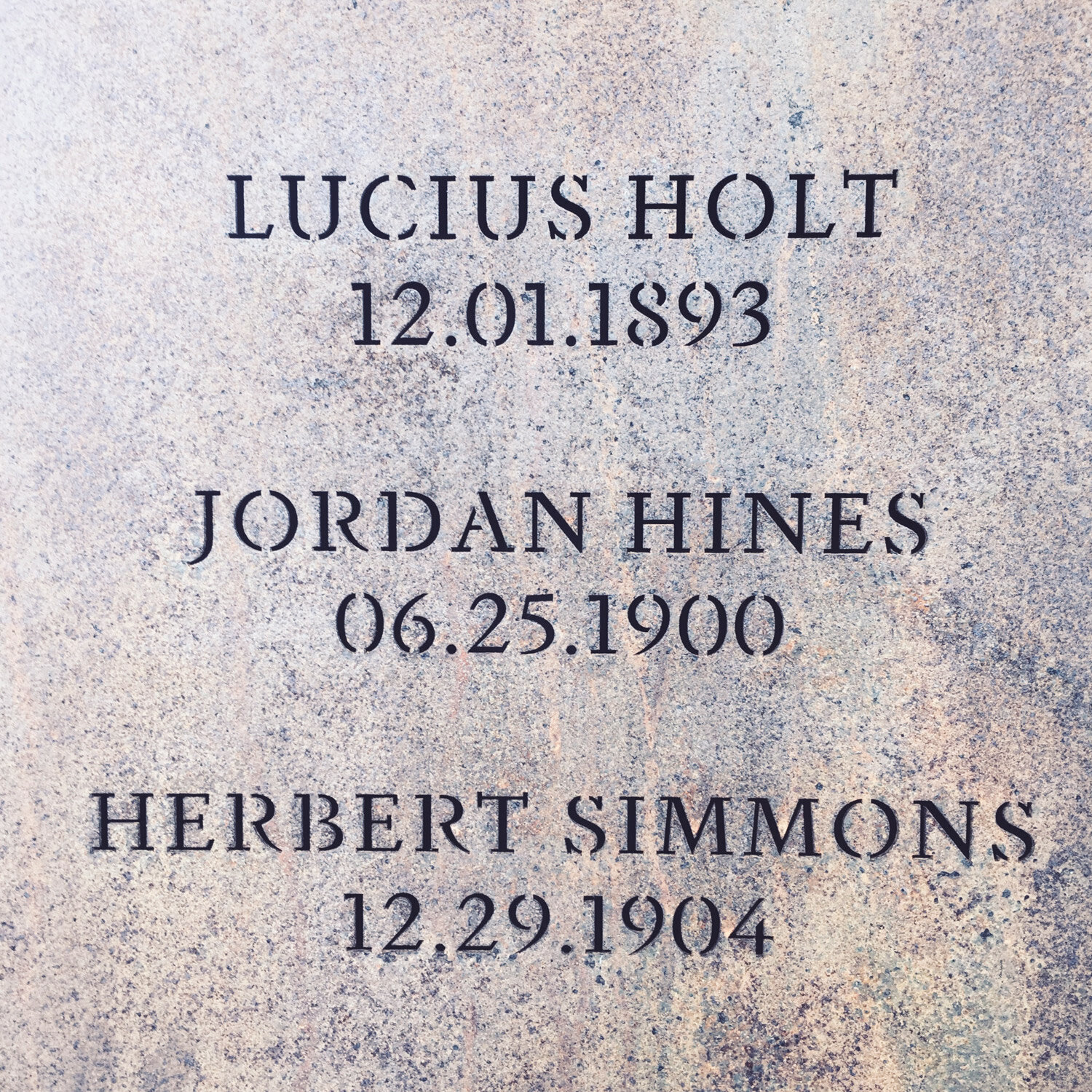
Etched in each of the 800 columns are the names of lynching victims. “None of the columns are telling exactly the same story—made of corten steel, an alloy that changes hue when exposed to air, they’ve each morphed to a different shade of brown over time.”2 Several times, the records are so incomplete, the column reads “Unknown” in the place of the name.

At the memorial entrance the columns are eye level. Victor Luckerson captures the effect of the memorial as one moves further into its heart. He writes, “As you wind your way through the memorial, the floor slopes downward and the eerie symbolism of a cluster of human-sized columns suspended by metal poles becomes more apparent. Eventually, the columns stretch too far in the air to clearly read the names, so the viewer can only assess them in aggregate. The terror of lynching becomes mass spectacle, as it was when it was happening across the South less than a century ago. The structure evokes the haunting photo of a mutilated black body hanging over a crowd of white onlookers, but turned upside down.”3

After looking at these pictures, consider the Town Fabric concept. Town Fabric is the quality of the city that distinguishes it as a distinct place for human interaction. Town Fabric is the setting-ness of the city. It distinguishes the city as a place for a particular story. It can be broken down into three essential functions, the first being exemplified by Montgomery. Town Fabric

  1. Creates settings for monuments

  2. Houses people and provides places for work and their private needs

  3. Shapes and defines the outdoor public spaces of a town/city4

wos-montgomery03.jpg

The first function highlights the importance of The National Memorial for Peace and Justice. Monuments and memorials are a product of civic art. The purpose of civic art is to “reinforce and communicate the layers of meaning that have accumulated within a particular city…”5 Making civic art is about two things: 1) creating monuments (i.e. works of art, often in the form of statuary, or buildings) that tell the story of the city and 2) creating settings (i.e. plazas, streets, and squares) that encourage the community to live-into the story. Monuments are those pieces of public art which concretize the story of the city. They gain their distinction from other fabric buildings in two primary ways. First, by their architectural vocabulary (i.e. height, scale, the use of grand style and other architectural details, and the quality of materials). Second, by their placement in the town fabric. Town Fabrics often set monuments on focal points of the city’s street design. In this way, “town fabric employs monuments to reflect and undergird meaning for a particular locale.”6 In this case, the memorial is set on a hill, overlooking the skyline of the small city. Montgomery is now cast in the shadow of lynching-history, slavery, and other acts of racial violence. The memorial encourages the community to remember with hope, courage, persistence, and faith.

The Town Fabric concept reinforces the importance of the city-setting in increasing the community’s ability to live-into the story of their culture. It also signals the connection between the city and memory. Through their fabric, cities retain the memories of those citizens that use, engage, and enact the story-set-in-place in their city. It is then up to the community to do in remembrance.

Quote written on end-wall of The Legacy Museum just above their parking lot.

Quote written on end-wall of The Legacy Museum just above their parking lot.

The EJI’s new public exhibits help us remember well and confirm that the only way to “transform culture” is to make new culture. Their memorial represents a counter-culture, a counter-narrative that confronts the southern story deeply entrenched in “The Cradle of the Confederacy.” In a state that still celebrates Confederate Memorial Day, Bryan Stevenson and his team are transforming their city. We couldn’t help but see resonance between their work and the story at the core of all just culture-making. Long ago, a dark-skinned King hung from a tree on a hill outside the city of Jerusalem, lynched despite his innocence. The story of his death and resurrection ushered in the possibility of a new city where justice and peace are realized. While they may not intend it, the EJI’s memorial points back to this King and forward to His city.


Footnotes

  1. Victor Luckerson, “‘Drenched in Blackness’: Pain and Truth in Montgomery’s Lynching Memorial,” The Ringer, April 30, 2018, https://www.theringer.com/2018/4/30/17300786/montgomery-lynching-memorial-equal-justice-initiative-bryan-stevenson.

  2. Luckerson.

  3. Luckerson.

  4. I am indebted to Eric Jacobsen for my understanding of town fabric (Eric O. Jacobsen, The Space Between: A Christian Engagement with the Built Environment, ed. Robert Johnston and William Dyrness (Grand Rapids, MI: Baker Academic, 2012).

  5. Jacobsen, The Space Between, 16. In particular, Jacobsen notes that civic art was the task of inculcating values in public settings. Civic art as a discipline is no longer practiced, but the work of city planners today still considers the use of civic art in organically shaping the city.

  6. Jacobsen.

  7. Sections of this article are from Seeking Zion: The Gospel and The City We Make, written by Emanuel (Ricky) Padilla. 2017.

Why We Make Culture

We don’t understand culture-making because we don’t really make culture. We make artifacts. Single artifacts like the refrigerator and systems like education (see previous article) are the products of human skill,1 and they are imbued with meaning and significance. They share in the storytelling of their makers; they become part of the dialog of the world, communicating and helping humanity re-imagine life on earth. Artifacts are the building blocks of culture. By making artifacts, humans make sense of the world we inhabit. We create a cultural world, a World Outspoken. Too often, however, we make with little to no reflection on the kind of world that would be truly good and beautiful. Even worst, we don’t consider the stories at the core of our making, and we dutifully live into stories that are destructive. Culture-making is an active use of power, and we fail to use our power well.

The Church has a tenuous relationship with both culture-making and power. There’s an elevated discomfort and awkwardness whenever Christian’s attempt to discuss either subject. My students are a good microcosm of this reality. Most of my students are studying cultural engagement, the response to and interaction with existing cultural products and systems. For those unfamiliar with these kinds of programs, forgive my technical explanation, but it will help later when we explore reasons for culture-making. Students in a cultural engagement program will take at least one course titled something like “Theology and Culture,” “Cultural Hermeneutics,” and “Christianity and Culture.” In such courses, H. Richard Niebuhr’s seminal book, Christ and Culture, frames the conversation. His work presents five “types” of Christian responses to culture. My students don’t fit perfectly into Niebuhr’s types, but we’ll begin by summarizing the “types” in my classroom to better understand the importance of culture-making and how it differs from traditional models of cultural engagement.

markus-spiske-624940-unsplash.jpg

Two Types of Students

Students in my courses divide into two types. The first wants to retaliate, to “go to war against the culture” for the sake of the gospel in public life. They want the city governed by “Christian principles,” and they have a hard time relating positively to any artifact of culture that isn’t created by Christians, particularly entertainment artifacts (movies, music, books, etc.). This type considers engaging culture mostly in political terms or retreating from culture in defensive compounds.

The second type is interested in operating in the cultural world alongside people pursuing justice and equality. In a way, this type is also “at war,” but the fight is rooted in different values; It’s a different fight. This type is listening with empathy to oppressed people and responding with action. They work alongside service groups, regardless of faith background, because they believe God is at work through their shared efforts with others. It is not that this group has forgotten or abandoned evangelism; it’s that this type of student sees a need for the Church to involve itself with the afflicted. If the first type sees cultural decay and retreats while pointing to the blots of mold in the culture, the second sees a different set of spots on everyone, Christians included, and extends a balm.2

wos-nick-karvounis-498374.jpg

Despite their differences, both types share the common assumption that right engagement with existing culture(s) is the only action available to Christians operating in the world. So, whenever I suggest that Christians empowered by the Holy Spirit should transform the earth and create new worlds rooted in the gospel, I inevitably have one or two students from either type who resist the idea. In response to my students and as a way of progressing the mission of World Outspoken, here are five reasons for culture-making. Again, before continuing, I recommend readers review what we mean by “culture” at WOS.

Five Reasons for Focusing on Culture-making

1) The Cultural Mandate

In The Social Construction of Reality, Peter Berger and Thomas Luckman make the fascinating observation that all animals live in “closed worlds.” Humans, on the other hand, have “no species-specific environment.” Humanity’s “relationship to [their] environment is characterized by world-openness.3 Mammals like Koalas and Pandas have limited habitats based on their biological makeup, but the entire earth is open to development as the human home. How is this relevant? It highlights the reality that humanity, from the beginning, had to cultivate, to create a world for their shared living. The earth is, in fact, open to humans in a way that it simply isn’t to any other creature. This, of course, forces questions on the human community. The mystery of this open world with all its possibilities compels us to ask: Where are we? Who are we? Why are we here? These questions direct us toward the existence of a transcendent, Divine being, and we begin to tell stories.

Christians believe the Bible makes this creative Being known in its first few pages. The Bible begins by telling us the story of God’s creative act. He made all that exists from nothing but His word. Then, at the climactic end of His work, He made man and woman “in His image,” so they may rule over all His creation (Gen. 1:26). He set the first couple in a garden and gave them the task of working (cultivating) and caring for the ground (Gen. 2:15). These three tasks: ruling, working, and keeping, are known as God’s cultural mandate for humanity, his appointed purpose for us. The story of the Bible invites us to see this world-openness as an invitation from God to share in making something more from the earth.

Cultures begin as stories. The astounding part of the Bible’s beginning is that God created, from His word alone, a good and beautiful world vested with potential and tasked us with developing it further. In other words, He commissioned us to make more culture. The key word here is "more." Remember, the first couple was set in a garden not an uncultivated, wild forest. God also used language, the connecting web of culture, to give them instruction, orienting them toward Him, the earth, and each other. Culture precedes the first couple. The first culture-maker is God. Made in God's image, we are tasked with continuing to share in His work by making in ways that reflect His character. Unfortunately, we don’t, but the mandate hasn’t been canceled. Culture-making is still the human purpose.

2) The Great Commission

The primary directive of all Christians is to preach the gospel, the true story of Jesus’ death and resurrection. This gospel reminds us that Jesus gathers to Himself a people that He then sends out to be witnesses, living testimonies of His power to transform what is broken and corrupted into something healed and new. Jesus introduces new cultural horizons to a corroded world. As in the beginning, the work of God precedes the work of His people. He sends His followers after him to “make disciples of all nations” (Matt. 28:19). To do this well, we must think holistically about what disciples are and what it means to “make disciples.”

Disciples are followers or students. They follow their teacher in all senses of the word. They follow by obeying his/her instruction, and they follow in that they imitate their teacher’s character. “Disciples best learn how to practice [beliefs] through paideia, an apprentice-based pedagogy that involves following the examples of (i.e. imitating) others who are further along.”4 This imitation-style of learning directly connects disciple-making with culture-making. People become disciples as cultural-memes get translated into their way of being.5 Disciple-making is more than “converting” people to Christ. Making disciples means “cultivating in [people] the mind of Christ, “teaching them to observe” the supreme authority of Christ in every situation (Matt. 28:20 KJV).”6 Remember, in the previous article, we noted that culture enables this cultivation.

jake-sloop-276538-unsplash.jpg

Culture-making allows us to care for the corporate dimension of disciple-making. We cannot disciple each person we encounter, orienting them correctly toward the good, beautiful, and true world available to them in Christ. However, by making culture, we extend our ability to give shape to the lives of our community. This does not mean that culture can save people. Individuals still need to share the gospel, but culture can help all people see more clearly the world enlivened by the gospel.

The cultural mandate and the great commission go hand-in-hand. Enabled by Christ and the power of His Spirit, we are once again sent to make as representative images of God. Dr. Vanhoozer reminds us that “the Church is thus not only the “people of the book” but also “the (lived) interpretation of the book.”7

3) Our Implicit Theology8

Already, this is a much wider vision for relating to culture. We tell stories and make as members of a cultural world, sharing in or damaging the work of God. Every artifact we make is embedded with our assumptions about our place, ourselves, and how life should be lived. These artifacts then communicate these assumptions to us and our community. In this sense, it can be said that culture is theology made concrete. Studying culture reveals that theology is communicated in two ways: Explicit and Implicit theology.

Explicit Theology is all that we teach, preach, write in doctrinal statements, pass on in catechisms, and teach in Sunday school curriculums. Explicit theology is our stated theology. It’s the explicit stories about God and the world. Implicit theology, however, is the subtle ways our culture reveals our stories and orients us to them. For instance, the refrigerator subtly communicates the theological belief that “humanity has the power to overcome natural processes.” The fridge is an artifact that reveals our implicit theology, our embedded beliefs. Note that if explicit and implicit theology are ever at odds, people will operate according to implicit theologies. For instance, I explicitly believe (this statement is proof) that the rate of food production and consumption in America is unsustainable and destructive. However, I haven't joined a CSA or another alternative food system. I still rely on the refrigerated supermarket. For now, the habits of culture overpower the ideals I value. If I’m going to make a change, I must consider culture-making; I must consider changing the culture that communicates an implicit theology I want to resist. "How” we do this is explained in the final point below.

4) The Longevity of Our Work

Simply stated: Culture has a longer shelf life than any isolated sermon or speech about anything from religious belief to food consumption. Christians who both reflect the gospel through preaching and culture-making, extend their work to future generations. The pastors in my classroom often wonder if I am supplanting their role as preachers with their role as culture-makers. I am not. Instead, I am arguing that, as preachers, they are uniquely positioned as storytellers to shape the culture of their congregations long after their ministries come to an official end.

In his award-winning novel, The Storyteller, Mario Vargas Llosa tells the story of a scattered Peruvian-Amazonian tribe known as the Machiguengas. The tribe has one member that connects them all, the storyteller. The storyteller is of sacred, indeed religious importance. The storyteller's job is simple enough: to speak. Storytellers' "mouths were the connecting links of this society that the fight for survival had forced to split up and scatter … Thanks to the storytellers, fathers had news of their sons and brothers of their sisters … thanks to [storytellers] they were all kept informed of the deaths, births, and other happenings in the tribe.”9 The storyteller did not only bring current news, he spoke of the past. He is the memory of the community, fulfilling a function like that of the troubadours of the Middle Ages. The storyteller traveled great distances to remind each member of the tribe that despite their separation, they still formed one community, sharing a tradition, beliefs, ancestors, misfortunes, and joys. The storytellers, writes Vargas Llosa, were the lifeblood that circulated through Machiguenga society giving it one interconnected and interdependent life.

The Machiguenga storyteller is “tangible proof that storytelling can be something more than mere entertainment … something primordial, something that the very existence of a people may depend on.”10 Like the Machiguenga storyteller, the preacher who intentionally speaks to shape his cultural world extends the life of his local congregation.

5) New Culture as Cultural Engagement

If forced to pick a “type” to identify with, I suspect most of my students would chose the “Christ transforming Culture” type from Niebuhr’s typology. I share my students’ disposition. The question for those interested in transforming culture is this: “Can the Church’s demonstration of the gospel change the world? If so, does this have more to do with changing human hearts or social structures, ideas, or institutions?”11

As a careful reader, Andy Crouch emphasizes the language in Niebuhr’s type: Christ transforming Culture. The transformation work is done by Christ, not the church.12 This sets us free from pressure and should inspire our boldest creativity. Our vocation is simply to be witnesses “and to be the embodiment of the coming Kingdom of God.”13 To bear witness and embody the Kingdom is to make new cultural worlds. The only way to transform the culture, to change our implicit theology, is by making more culture, displacing existing forms of culture.14 By making more culture, Christians create opportunities to invite people into a new world with new possibilities unseen in other cultural worlds.

Conclusion

World Outspoken exists to support Christian culture-makers seeking God's city. I’ve argued for the importance of culture-making as a way of continuing cultivation of earth, obeying the great commission, intentionally shaping implicit theology, extending the life of our work, and engaging existing cultures. Christians today will almost never make culture without incorporating elements of existing cultures. Indeed, this is the “already not yet” tension described by theologians. We are already in the new world, the Kingdom of Christ, but we are still residents of the old cultural worlds we inhabit. The local church makes as citizens of the world to come and as images of Christ in their resident world. My hope is that the Church would make with boldness and vigor.

Culture-making “power is “the capacity to define what is real.” The Church does this by enacting God’s word in particular times and places, for it is God’s word that defines what is ultimately real.”15


Footnotes

  1. “Artifact” is a unique word built from the Latin words for human skill (arte) and objects or goods (factum). “Definition of ARTIFACT,” accessed July 12, 2018, https://www.merriam-webster.com/dictionary/artifact.

  2. It should be noted that these types, like most if not all other types, are generalizations. Of course, there are exceptions to these rules, but these represent the overall themes present in my class discussions.

  3. Peter L. Berger and Thomas Luckmann, The Social Construction of Reality: A Treatise in the Sociology of Knowledge (New York: Anchor, 1967), 47.

  4. Vanhoozer, 7.

  5. Again, see our article, “What is Culture,” for more information on memes.

  6. Vanhoozer, Faith Speaking Understanding. Italics are my own.

  7. Vanhoozer, 2.

  8. The following section is developed based on ideas found in the following work: Nancy Ammerman et al., eds., Studying Congregations: A New Handbook (Nashville: Abingdon Press, 1998).

  9. Mario Vargas Llosa, The Storyteller: A Novel, trans. Helen Lane, First edition (New York: Picador, 2001).

  10. Llosa.

  11. Vanhoozer, Faith Speaking Understanding.

  12. Andy Crouch, Culture Making: Recovering Our Creative Calling, Edition Unstated edition (Downers Grove, Ill: IVP Books, 2008), 182. 

  13. James Davison Huner as quoted by Vanhoozer.

  14. I’m indebted to Andy Crouch for the ideas in this article. His book gave shape to my thinking here. Crouch, Culture Making.

  15. Vanhoozer, Faith Speaking Understanding, 8.

  16. Cover Photo by Tamarcus Brown on Unsplash

Caring for Words in a Culture of Lies

This article was originally published in the International Journal of Christianity and English Language Teaching (IJC&ELT, ISSN 2334-1866, online).1

wos-caring-for-words3.jpg

With appropriate urgency, Marilyn McEntyre begins her book by getting promptly to the point: “Caring for language is a moral issue” (p. 1). According to McEntyre, language-care should concern everyone, even beyond Christian English language educators, because the words we use and how we use them shape our way of being together. “Words are entrusted to us as equipment for our life together, to help us survive, guide, and nourish one another” (p. 2). McEntyre encourages her readers to resist the pressures poisoning the English language and to take on disciplines that, used correctly, will nurture it back to health. The pressures poisoning English are many: news media driven by corporate interests, technologies that encourage users to “be content to trade precision for speed” (p. 12), the loss of healthy discourse, and the widespread dependence on market language. The overall problem is that words have become “industrialized,” processed like food and emptied of their health benefit (p. 16). This cultural milieu affects both the instructor and student, and for this reason McEntyre’s book is a timely, prophetic call to steward words.

Summary

The book begins with a diagnostic of the current cultural context. McEntyre’s argument can be divided into two types. The first is a statistical analysis of the current state of language. Among the data points included, she notes the level of illiteracy and media intake in the U.S., and when appropriate, she pulls from her experience as a professor to confirm the data. Her use of anecdotal evidence continues throughout the rest of the book, providing compelling stories that support her proposals. Secondly, she argues for change in our practice by anticipating the potential outcomes if current language-use trends continue. Turning from diagnosis to strategy, McEntyre distills three actions necessary to restore and cultivate healthy language. Instructors must help students: 1) deepen and sharpen reading skills, 2) cultivate habits of speaking and listening that foster precision and clarity, and 3) practice poesis – “to be makers and doers of the word” (pp. 9-10).

McEntyre proposes twelve strategies for the recovery of the English language, giving attention to each in distinct chapters, and using them to support the actions listed above. The movement of the book is pleasantly simple, moving from strategies that are related to our affections to strategies related to language-rich rituals. These final three chapters are particularly stimulating because they confront the liturgies related to media and market speech. The book envisions a culture built from habits of language-use that challenge speakers to practice and play with beautiful words. English language educators will find in the final three chapters a theological orientation that roots good use of beautiful words in the Word Himself.

wos-caring-for-words.jpg

Commentary

Christian English language educators work in the intersection of what is and what could be. ESL students often need to make immediate gains (particularly adult learners), so instructors are pressured to teach functional English, that is, English that is useful in the workplace and market. Conversely, instructors have the opportunity to create new cultural patterns by forming the language practices of those assimilating to the English-speaking world. McEntyre’s book is dedicated to inspiring and even guiding instructors toward this latter possibility. For instance, she encourages her readers to teach students to “Love the Long Sentence” as a way of starving the impulse to indulge “our vulgar appetites for action” (p. 134). “Slowing down, for a contemporary reader, is a countercultural act. Nearly everything in the momentum of modern life urges us onward at an accelerating pace” (p. 133). Each of the “stewardship strategies” suggested by McEntyre is a countercultural move.

Readers may initially think McEntyre’s strategies are elitist, that the proposals are for the privileged. McEntyre herself is aware of this and treats this concern as it presents itself in each chapter. For instance, in “Tell the Truth,” McEntyre reminds the audience that demanding precision is not the same as demanding sophistication or even technicality. In fact, quoting from a wide variety of novelists, McEntyre reveals that precision often relies on understatement and is countercultural to the hyperbolic tendencies of media-speak. It is important to remember the culture McEntyre has in view. Media and market language dominate the major spheres of culture (such as education, politics, and the arts), and by these forms of English many are excluded from active participation in and agency over their community. In an article published immediately after the United States 2016 presidential election, it was reported that poetry was increasingly being used by people trying to make sense of social events. The elevated language of verse provided the solace people desired (Garber, 2016). It appears that the social context is such that the public intuitively recognizes the value of higher language. It is to this hungry group that McEntyre commends herself.

Caring for Words is beautifully written and stands as an example of the very practices it promotes. McEntyre quotes liberally from sociologists, novelists, and essayists, providing a bibliography of resources for instructors looking for tools to begin practicing poetry and teaching a love for the long sentence. The book will serve any instructor looking for long term strategies for English education and cultural transformation. In a culture increasingly lost for words, Caring for Words serves as a reminder of the essential language tools for communities of people. To the teachers, ministers, and speakers that McEntyre addresses in this book, the call for activism should be energizing and the strategies proposed are actionable in ways that transform the reader into part of the resistance, part of those refusing to let the English language perish, and with it our ability to be in community.


Reference

Garber, M. (2016, November 10). Still, Poetry Will Rise. The Atlantic. Retrieved from:

Footnote

  1. (2018) "Entire Issue," International Journal of Christianity and English Language Teaching: Vol. 5 , Article 1.
    Available at: https://digitalcommons.biola.edu/ijc-elt/vol5/iss1/1

What is Culture?

eddy-klaus-33079-unsplash.jpg

An Introduction to the Subject

At the beginning of each new semester, I ask students to define the word culture. Collectively, they produce a definition that covers the ideas they’ve heard from anthropologists and other intercultural thinkers. Some refer to culture as a system of beliefs, values, and ways of thinking that govern a group of people. Others suggest that culture is the customs, habits, and rituals practiced by varying communities. Still others will comment on the foods, clothing, music, and other products created by ethnic groups. In sum, all these things are captured in the word. Culture is a complex whole that includes and governs all of what students share in that initial discussion. The simplest way to summarize this matrix of objects and symbols is to say that culture is what we make of the earth.1

Culture is what we make of the earth in two respects. First, culture occurs when humans make a concrete change to the earth, producing objects (chairs, omelets, highways, symphonies, etc.) from the raw materials that exists therein. Second, culture is the sense we make of the earth; the system of symbols and meaningful signs that holds together and conveys our beliefs about who we are, where we are, and why we are here.2 In this second respect, culture is the world we make, the world in which we live. We embed in the products we create assumptions about our place, ourselves, and how life should be lived. These assumptions are passed down from generation to generation in the stories that undergird our cultural worlds. Culture, then, is a World Outspoken.

Besides defining culture by those objects, stories, rituals, and rhythms that make up its parts, some attention should be given to the history of the word itself. Culture was originally a “noun of process,” meaning it was a noun synonymous with cultivation.3 Culture referred to the process of working the ground to produce crops. Scientists still use the word this way in scientific labs when they refer to bacteria in a petri dish as a “culture.” Since the 18th century, however, the word is used metaphorically to refer to working, or cultivating, humans. Culture is now understood as the process of civilizing people.4

my-life-through-a-lens-110632-unsplash.jpg

What does Culture do?

Some of the functions of culture are implicit in what I stated already, but it is helpful to review the details. Culture has four primary functions: Culture communicates, orients, reproduces, and cultivates.5 To demonstrate the functions described in this section, I am going to include two examples. First, I will use the refrigerator as an exemplary object, a single artifact of human culture-making, that does each of the four functions. Second, to help demonstrate the way culture produces objects and systems, I’m going to explore the way education as an institution also does each function of culture. These two examples should provide enough grounding to help make sense of each function.

Culture Communicates

Every product of our culture-making communicates our assumptions regarding the meaning of life. Through these products, human communities make sense of the world and tell the story of a life well lived. However, culture doesn’t communicate explicitly but through subtle moves and suggestive images. Culture communicates metaphorically. According to one study, most people think eidetically, or in vivid pictures,6 and culture communicates directly to our imaginations by providing images that can guide our way of being.

How the Refrigerator Communicates

A refrigerator is “an appliance or compartment which is artificially kept cool and used to store food and drink.”7 It makes it possible for people to purchase and stock foods in bulk. It also preserves food beyond its harvesting season. For instance, strawberries are now accessible year-round rather than from April through June thanks, in part, to refrigeration. The fridge, as it is commonly called, “speaks” through its ability to circumvent the natural process of spoilage. In other words, the refrigerator proclaims that spoilage is no longer an insurmountable issue. People can have the foods they want when they want them. Of course, things still go bad in the fridge, but the subtle message remains: Humanity has the power to overcome natural processes.

All objects communicate, and the refrigerator is no exception.

How Education Communicates

In their seminal book, The Social Construction of Reality, Berger and Luckman argue that people develop their humanity in relationship with their natural and cultural environment.8 We are who we are, in large part, because of where we are from. Educational institutions play a major role in communicating an image of life well lived to children and youth. Through the lives of teachers, extracurricular programming, and even the aesthetic of places of learning, schools promote a view of future success. My Block, My Hood, My City (MBMHMC) serves as an excellent, real-world example of this point.

wos-blackboard-board-chalk.jpg

MBMHMC is a non-profit in Chicago providing youth from under-resourced neighborhoods with “an awareness of the world and opportunities beyond their neighborhood.” Partnering with local schools, MBMHMC takes students on educational explorations (i.e. tours) “focused on STEM, Arts & Culture, Citizenry & Volunteerism, Health, Community Development, Culinary Arts, and Entrepreneurism.”9 Their goal is to “boost educational attainment in spite of the poverty and social isolation” faced by these students.10 The results are remarkable. According to their website, students who take educational trips between the ages of 12-18 are 57% more likely to earn a college degree or do postgraduate work.

In a multitude of ways, education done well communicates that success is part of the future of every young learner.

Culture Orients

Culture embodies our hopes and concerns, so it reinforces certain moods and postures toward the world. These moods and postures are only part of the way in which culture shapes individual identities, providing scripts and roles that people live into. It also answers life’s central questions, namely, who are we, where are we, and why are we here. With images and stories communicating directly to our imagination, culture orients our emotional response to the world around us. It profoundly affects our view of beauty, it provides a logic for discerning truth, and teaches certain tastes for what is good. Culture is a teacher. Culture shapes character.

How the Refrigerator Orients

I’ve already mentioned the way in which the refrigerator changes our view of produce and spoilage. It fosters a different orientation to the seasons, making many people completely unaware of the farmers work and harvest schedule. The fridge shapes our perception of food production, increasing the distance between production and consumer. It is also capable of distorting our understanding of sustainable quantities. An empty fridge communicates a compelling message about wealth and security. For this reason, grocers keep their fridges stocked with gallons of milk and eggs. Though not alone in orienting humanities consumption habits, the fridge plays a role in orienting the consumer identity.

How Education Orients

The film adaptation of Wonder depicts the orienting power of education beautifully.11 Wonder is a story about Auggie, a boy born with facial differences, and his family struggling with the transition to a mainstream school. Mr. Brown, Auggie’s teacher, begins his first day of class by teaching the students the meaning of the word precepts. Precepts “guide us when we have to make decisions about really important things,” he tells the class. The monthly precept is meant to help students answer questions like, “Who is it that I aspire to be?” For the remainder of the film, the precepts guide the students as they navigate their identities, bullying, what it means to be a good friend, and what it means to have courage. By the end, the community is changed and Auggie has friends he never dreamed of having. Mr. Brown’s precepts framed the transformation of the students and the characters they became.

Culture Reproduces

In On Beauty and Being Just, Elaine Scarry claims that one of the objective qualities of beauty is that it begets more beauty.12 Beautiful objects inspire the production of other beautiful objects. Such is the way of culture. Culture constantly extends from person to person, generation to generation, through contact with “memes.” A meme is “an element of a culture that may be considered to be passed on by non-genetic means, esp. imitation.”13 Today, most people think a “meme” is strictly a piece of media shared from person to person through digital communications like social media, but a meme can be a piece of clothing, song, book, etc. Any imitation, or replication, of a cultural product is a meme. Like genes (the biological counterpart of a meme), memes are heritable. Culture begets culture.14

How the Fridge Reproduces

naomi-hebert-188443-unsplash.jpg

The refrigerator’s “accessible food whenever” story now extends to accessible food wherever. Today, people can purchase refrigerators for their vehicles, making it possible to travel with perishable foods. Mini-fridges are common in college dorms and office workspaces. The fridge is now a staple of the Western cultural world, and all these variations of the fridge are memes of early refrigeration machines. These memes extend the story communicated by this object.

How Education Reproduces

A recent article on the Los Angeles Lakers illuminates the benefits of what the organization refers to as “The Los Angeles Lakers’ Genius Series.” Like the educational explorations of MBMHMC, this series consists of in-house presentations and field trips to meet with influential people in other fields of work. The objective of this series is to inspire and challenge the young Lakers team to pursue success in new and creative ways. In other words, the organization hopes players would take an interest in becoming like (i.e. imitating) the speakers they meet. Through these meetings, the Lakers organization is hoping to replicate the likes of The Rock, Elon Musk, and others.

The “Genius Series” supports the argument of Professor Emeritus Frank Heppner of the University of Rhode Island. In a blog expressing his concern with education technology and the shift to online modes of instruction, Professor Heppner asks, “how are we going to INSPIRE students, especially the non-traditional ones?”15 Heppner is of the mind that education is really two simultaneous processes: 1) the process of teaching/learning and 2) the process of inspiring/being inspired. The latter process is the primary avenue for cultural replication. Even Heppner himself confesses, “From [my professor] Stebbins, I learned what it was like to really love the thing you study--and I eventually followed his example.”16

Many people can point to a teacher/professor who profoundly inspired the person they became. People try to replicate the beauty, magic, and wisdom of their instructors, and in this way, people become memes of the educations they received.

Culture Cultivates

The ultimate outcome of culture’s work is the corporate cultivation of the human spirit. In other words, culture is capable of giving form to the spirit of whole communities. For this reason, some scholars have referred to culture as theology incarnate. Through its conversation with the human imagination, through orientation toward the good, true, and beautiful, and through its replication in persons, culture has the potential to shape communities beyond the present. Culture can till the human heart and mind for the good or ill of generations.

How the Refrigerator Cultivates

background-business-clean-811101.jpg

It is important to state upfront that not all objects cultivate in equal measure. Cultivation is the process by which whole societies are shaped, and some objects do this to greater degree than others. The car or smartphone, for instance, have immense cultivating power, and they move to the center of cultural worlds that are created around them. We make roads for the car and garages to store them. We have shows to highlight them. Entire cultural systems are created to sustain our use of the automobile. Likewise, we make room in our lives to accommodate the demands of the smartphone.17 While the refrigerator does not have the same potency to cultivate, it still influences society. As part of the cultural world created by the refrigerator, the modern supermarket increasingly includes items from previously inaccessible regions of the earth. This use of the refrigerator cultivates society’s desire for foods beyond their geographical reach. Put differently, because the refrigerator can keep foods as they travel long distances, society cultivates a varied and diversified appetite.

How Education Cultivates

Education, if it continues to be a required part of society, shapes generation after generation with the promotion of its vision of success. Like the refrigerator, however, there are degrees to which education cultivates. MBMHMC seeks to fill a gap in the cultivation of young people in impoverished communities of Chicago. Communities with struggling educational systems simply cannot provide the same expansive vision of the future that stronger systems offer. For this reason, education is typically a hotly debated subject of political interest. It is both an engine that cultivates the future and the picture of disparity between communities.

Conclusion

When my students begin their study of culture, their definition is generally either vague or narrowly focused on ethnic distinctions. My goal is always to ground culture in objects and symbols they can identify and engage. More than that, however, I want them to learn what culture is, so they can be expert culture-makers who bear witness to the Kingdom of God. Indeed, that is the goal of World Outspoken: to teach people to make culture as a way of seeking the city of their hopes. Culture communicates essential messages about place, people, and life. It orients communities toward moods and postures, and it replicates itself from generation to generation, cultivating whole societies. I’ve provided two examples of culture to illustrate these functions: the refrigerator and education as an institution. Through these examples, the Outspoken Community learns to “read” culture. Now, with a bearing on culture, we can make with confidence.


Footnotes

  1. While Andy Crouch deserves credit for the basic structure of this definition, I’ve replaced the word “world” from his original sentence with the word “earth.” I am using earth to refer to all that naturally exists on our planet without the influence of humanity. World, however, refers to earth and all that humanity creates to promote, sustain, and make sense of their lives together in community. Because of the last clause in this definition, it is worth noting that earth has many worlds an individual can inhabit. Andy Crouch, Culture Making: Recovering Our Creative Calling, Edition Unstated edition (Downers Grove, Ill: IVP Books, 2008).

  2. “What Is Culture? | Mars Hill Audio,” May 14, 2018, Link.

  3. D. Stephen Long, Theology and Culture: A Guide to the Discussion (Wipf & Stock Pub, 2008).

  4. Through history, “civilization” can refer to wicked practices by colonial conquerors. I’m not, here, ignoring this heavy history but rather attempting to use the word for its original meaning. There are many ways in which “civilizing” has been carried out horrifically, and I even explore the subject in greater detail in Seeking Zion. Acknowledging the baggage of the word, I’d ask readers to consider that cultures can civilize (develop people) in very evil and/or good ways (often doing a mixture of both).

  5. Each of the following sub-sections is my understanding of Dr. Vanhoozer’s thoughts on the functions of culture. Kevin J. Vanhoozer, Charles A. Anderson, and Michael J. Sleasman, eds., Everyday Theology: How to Read Cultural Texts and Interpret Trends, Annotated edition edition (Grand Rapids, Mich: Baker Academic, 2007).

  6. Nancy Ammerman et al., eds., Studying Congregations: A New Handbook (Nashville: Abingdon Press, 1998).

  7. “Refrigerator | Definition of Refrigerator in English by Oxford Dictionaries,” Oxford Dictionaries | English, accessed June 27, 2018, Link.

  8. Peter L. Berger and Thomas Luckmann, The Social Construction of Reality: A Treatise in the Sociology of Knowledge (New York: Anchor, 1967).

  9. “How MBMHMC Works,” My BLOCK MY HOOD MY CITY, accessed June 28, 2018, https://www.formyblock.org/how-it-works-1/.

  10. “MBMHMC For Educators,” My BLOCK MY HOOD MY CITY, accessed June 28, 2018, Link.

  11. For those interested in the book, I’ve cited it here: R. J. Palacio, Wonder, 1 edition (New York: Knopf Books for Young Readers, 2012).

  12. Elaine Scarry, On Beauty and Being Just, Reprint edition (Princeton, N.J. Oxford: Princeton University Press, 2001).

  13. Vanhoozer, Anderson, and Sleasman, Everyday Theology.

  14. Note: Not every aspect of culture is beautiful, but even distorted (or "ugly") culture reproduces. For this reason, it is important to strive for beautiful rather than distorted culture.

  15. “When I Grow Up, I Want to Be Just Like My iPad | Tomorrow’s Professor Postings,” accessed December 13, 2017, Link.

  16. “When I Grow Up, I Want to Be Just Like My iPad | Tomorrow’s Professor Postings.”

  17. For the curious reader interested in knowing more about the power of the smart phone and other technologies, I’d recommend the following book: Sherry Turkle, Alone Together: Why We Expect More from Technology and Less from Each Other, Expanded, Revised edition (Basic Books, 2017).

Do In Remembrance

wos-rememberance.jpg

Introduction

“Every single one of us is a little civilization built on the ruins of any number of preceding civilizations, but with our own variant notions of what is beautiful and what is acceptable”. These words, penned by novelist Marilynne Robinson and articulated by Gilead’s protagonist, the reverend John Ames, provide a helpful analogy for the way that memory works to form our present selves. It is precisely the memory, interpretation, and evaluation of our past “civilizations” and the ways that they interacted with the world in which they existed that provides the necessary material to build our current “civilization” which will be under construction until eternity. As our memories help to form us, they also impact the way we form the world around us. Our memories inform the ways we construct our systems and build our cities.

Of course, there are faithful as well as irresponsible ways to remember, and the integrity of our civilization depends, in part, on the quality of the material used to construct it. Memories which faithfully, honestly, and constructively reflect the realities which were once their present are quite useful and burst with potentiality for the present and the future. John Ames, in writing his own memories for his son, hoped to form him into a particular kind of person. However, the reader gradually becomes aware that Ames does not always remember well and thus, his own formation is also compromised. In the end, there is redemption for the old preacher, and this redemption speaks of the hope that Christ might work even our faulty remembering together for the good of those who love him.

Sacramentality in Gilead

In the ruins of the old church building, a young John Ames received half of a biscuit, blackened with ash from his father’s hands, and he took it and ate it. A now elderly John Ames recalls this moment in a letter to his young son to be read when he is older and his father is dead and gone. The aging reverend remembered the moment with his father and the half of a biscuit as a kind of communion, a eucharistic moment, and in turn, the moment has truly become for him, sacramental. This recollection of a moment of spiritual and relational intimacy between father and son against the backdrop of singing saints rebuilding their broken edifice would become more than a fond memory; it would result in an entirely altered hermeneutical lense through which to remember the past, act in the present, and hope for the future. But this is just the way it is with memory. There is a creative power in the act of remembering that is illustrated beautifully in Marilynne Robinson’s Gilead. As John Ames anticipates that twinkling of an eye when he will put on imperishability, he considers eternity and cannot bear the thought that we might forget the beauty of the world and the drama of this life once we are beyond it. Robinson writes in the voice of the narrator, “In eternity this world will be Troy, I believe, and all that has passed here will be the epic of the universe, the ballad they sing in the streets.” Ames believes that eternity will, at least in part, consist of remembering humanity’s past and thus engages in a sacramental act of remembrance in the form of a letter to his son. Robinson’s Gilead illustrates that the act of remembering is meant to be an act within time which not only anticipates the remembering of this life that we will do in eternity, but is also meant to form the interpretation and embodied performance of the present.

The plain beauty of the Iowan prairie provided the setting for much of Gilead. This plainness allowed Robinson to draw out the wonder of nature and to consider at length humanity’s interaction with the natural world. In this way, Gilead is a very ‘earthy’ book. Even the sacramental language in the novel seems to emphasize the temporal and human qualities rather than the lofty and eternal realities to which they point. Baptism, significant in its imaging of our union with Christ in his death, burial, and resurrection, is taken up by Robinson, through John Ames, to highlight the way that water makes this eternal reality temporally meaningful. It is the cloak and shimmer of the water dripping off of the Baptists, or the electrifying touch of the Congregationalists’ wet hand that makes the difference for Reverend Ames. Likewise, the chief eucharistic symbol in the novel is the half of a biscuit covered in soot presented to a young Ames by his father. Earlier in the story, the elderly Ames would be made to sip water out of a honeysuckle flower by his young son, conjuring images of a congregant sipping wine from a cup in the hands of an administrator of the elements. This eucharistic meal has an earthly quality to it which is not meant to diminish the eternal significance. These glimpses of love, provision, and joy between fathers and their sons is meant to enhance our understanding of our participation in things which are in many ways, too lofty for us, the things that we do in remembrance of Christ.

The very act of remembering is just such an ordinary phenomenon in Gilead. The narrator zips back and forth between memories of the past, musings on the present, and thoughts of the future. These thoughts of future are sometimes expressed as thoughts of his own eternal future once he puts on imperishability, sometimes they are thoughts of the temporal future of the loved ones he will leave behind. Other times they are the thoughts of an even further future, in which he and his loved ones will be united in eternity. It is in this ultimate future that the reverend Ames cannot imagine that “we will forget our fantastic condition of mortality and impermanence, the great bright dream of procreating and perishing that meant the whole world to us.” This hope of eternal remembrance carries significant implications for the way we think and move in the present.

Memory as Formation

In “Memory and Reconciliation: The Church and the Faults of the Past”, the Roman Catholic church considered the task of evaluating history for the purpose of present and future reconciliation and ethical responsibility. In a portion of the paper dedicated to the historical and theological judgment, the authors work to disaggregate the process of ‘historical hermeneutics’ or, the interpretation of history. They write, “The past is grasped in the potentialities which it discloses, in the stimulus it offers to modify the present. Memory becomes capable of giving rise to a new future.” The act of remembering is formational. The fact that we are able to be formed into different kinds of people because we remember, gives rise to new possibilities for the future. In other words, “The encounter with the past, produced in the act of interpretation, can have particular value for the present, and be rich in a “performative” efficaciousness that cannot always be calculated beforehand.” It not only matters that we remember; how we remember is of crucial importance. In Gilead, and perhaps in our world too, the act of remembering carries implications that ripple into eternity.

Seats at the Table: Jesus’ response to Nietzschean Power

hunter-newton-FQe4hjBlcPE-unsplash.jpg

A friend recently sent me a video where John MacArthur was asked to give a “Biblical and Christ proclaiming view” on the events of Charlottesville. While I am in no position to critique MacArthur for his response, I think his comments were broad theological statements rather than a direct response to Charlottesville. No doubt others will have opinions about this video, but I just want to give the question a second look considering the discussion we started two weeks ago about “power.” What does the Bible tell us about the display at Charlottesville? Is the Bible capable of reorienting the world so that “power” isn’t grasped for with such violence and coercion?

Two weeks ago, I concluded my own thoughts on Charlottesville with a brief definition of privilege. “Privilege is the ongoing benefits of past successful exercises of power” (Crouch, 150). It’s important to remember that privilege is neutral. That is, privilege is neither good or bad, and it is usually invisible. Privilege can originate from oppressive or benevolent acts of power. Privilege can even be shared for the benefit of another. Just go back to my story about Steve if you want an example. In his book Playing God: Redeeming the Gift of Power, Crouch makes a distinction between neutral (though potentially dangerous) privilege and status. His definition of status is as follows:

“Status — at root, “where you stand” –is about your place in line. It is about the human drive to be ranked above another, to be counted more worthy than another … Status is about counting, numbering, ranking and ultimately excluding … We rarely have any control over where we land in these rankings; they are assigned based on realities that long preceded us. Status is by definition a scarce resource … Status is rarely anything but dangerous” (Crouch, 156–7; italics are mine).

Jesus and the Status-Obsessed

Though I suggested previously that the protestors at Charlottesville were more concerned about privilege than power, I think status is an even more precise term for what the alt-right group wants to retain. To that end, to the pursuit of status, Jesus spoke directly. Luke tells of a day when Jesus went to dine in the home of the ruler of the Pharisees (Lk. 14:1–24). Pharisees were the religious elite of the day, and they enjoyed a great deal of status. One historian wrote, “They had the greatest influence upon congregations, so that all acts of public worship, prayers, and sacrifices were performed according to their injunctions. Their sway over the masses was so absolute that they could obtain a hearing even when they said anything against the king or the high priest” (quoted by Unger in his entry on Pharisees, 998).

Given that this was the home of this elites’ leader, no doubt only the “supreme” Pharisees were in attendance. Jesus observed them as they took their seats at the table to dine and noticed that they worked their way around the room trying to position themselves in the places of honor. Every greeting was calculated, ever step intentional, every smile was a mask hiding their anxiety about their place. The Pharisees wanted their seat to reflect their supposed importance. In the middle of all the networking and posturing, Jesus gives this advice:

“When someone invites you to a wedding feast, do not take the place of honor, for a person more distinguished than you may have been invited. If so, the host who invited both of you will come and say to you, ‘Give this person your seat.’ Then, humiliated, you will have to take the least important place. But when you are invited, take the lowest place, so that when your host comes, he will say to you, ‘Friend, move up to a better place.’ Then you will be honored in the presence of all the other guests. For all those who exalt themselves will be humbled, and those who humble themselves will be exalted” (Lk. 14:8–11, NIV).

At first, it seems Jesus is giving the Pharisees a new trick-of-the-trade, the kind of advice expected from Dale Carnegie or Tony Robbins. We know that can’t be the case because of what Jesus says to/of Pharisees in other instances. “The teachers of the law and the Pharisees sit in Moses’ seat … But do not do what they do, for they do not practice what they preach … Everything they do is done for people to see … They love the place of honor at banquets and the most important seats in the synagogues … Woe to you, teachers of the law and Pharisees, you hypocrites!” (Matt. 23:1–13). If Jesus is so strongly against the Pharisees status-hungry posturing, there is no way He is telling them how they can more easily obtain status. Instead, Jesus is making a powerful point about status. Status should be dismissed into the hands of the master of the meal. In other words, status should be disregarded, for honor, the recognition of one’s power and dignity, is never taken but bestowed.

If the Pharisees heard Jesus and missed his point, I’d imagine they all raced to the worst seat at the table, turning their eyes to their host waiting for him to assign the proper seating arrangements. That would be a sad sad scene, if that was in fact what happened, but Jesus’ next words suggest he stopped them just before they moved to reposition themselves at the table. This time, He directs Himself to their host:

“When you give a luncheon or dinner, do not invite your friends, your brothers or sisters, your relatives, or your rich neighbors; if you do, they may invite you back and so you will be repaid. But when you give a banquet, invite the poor, the crippled, the lame, the blind, and you will be blessed. Although they cannot repay you, you will be repaid at the resurrection of the righteous” (Lk. 14:12–14, NIV).

Jesus’ words reveal the naked truth about this entire dinner. The guests were only present to either gain more or demonstrate their existing status. To be invited to the house of the ruler of the Pharisees to dine with the most influential and popular new religious leader, Jesus, was sure to boost their profile. And, all the guests there were looking to elevate in that way. But, there host was playing the same game. If they were invited to that dinner with Jesus, it was because the host believed he was gaining some leverage on them by having them there that night. The entire event was a display of Nietzschean power dynamics (see description in my previous article) played out by people competing for their own interests, for their own power, for their own status.

The Dinner Table and Charlottesville

Unfortunately, many people, including the alt-right protestors, vie for status. In fact, anyone who works in an office setting with any number of meetings has likely seen a microcosm of the posturing on display at that dinner with Jesus. It’s no surprise that books like Survival of the Savvy: High-Integrity Political Tactics for Career and Company Success are growing in popularity, even in Christian institutions. Note the first word in that title: survival. In the last office I worked for, this was the dominating sentiment. Meetings were often perceived as miniature Hunger Games where uneasy alliances were made in hopes to survive and retain one’s status at the table. This pathos is at the core of the protest in Charlottesville, but the world does not have to be this way.

Someone asked me, after reading my previous post, to comment on the counter-protestors. My hope is that this exploration of Luke 14, power, and status starts to make my position clearer for everyone. My suspicion is that some counter-protestors still live in a world where power is a limited resource exchanged in zero-sum transactions. Success for any counter-protestor who believes this might look like a reversal of roles, where the underprivileged, low-status, and disempowered assume all the status available to today’s elite and use it to dominate space. This is no victory for anyone! And here is where Jesus’ response becomes most important.

After calling out the guests and host, Jesus transports them to a greater banquet by telling them a story. In this narrative, a man gave a magnificent banquet and invited many, but by the time the meal was prepared, guests made excuses and did not attend. Each excuse Jesus retold was rooted in the acquisition of new wealth, either relational or monetary. In frustration, the host of the banquet commands his servant to bring the poor, the crippled, and weak. This had already been done, so the servant is commanded to compel people on the streets to come to the banquet because there was still plenty of room at the table. At this banquet, the real world is clearly envisioned for Jesus audience to consider. There is room sufficient at the table for the wealthy and poor, for the strong and weak. This banquet host gives no regard to previous status, but simply makes room for the dignity of everyone who comes to the meal as invited guests.

Conclusion

The seminary I attended had a meeting dedicated to discussing issues of reconciliation called Mosaic Gatherings. I’m very proud when I think of these gatherings because of one particular story. While the group of students sat discussing privilege, the minority students were dominating the conversation. A white student asked with sincere consideration, “What place at the table do I have to talk about this issue?” The conversation turned, to my surprise, to the acknowledgement that this student belonged in the conversation along with his minority peers. Only together could Christ’s church be made visible in this small group, and only together could their power multiply for the service of others. It was a powerful moment.

There is a vision of the world that suggests power is limited, and people must fight to control it if they are to retain their dignity. Jesus promises a different way around “the table” all together. In the world He creates, power is multiplied and servants are honored. His people disregard their own status and have no problem taking the lesser seat at the table, for this makes room for others to flourish. His people make connections with the weak, knowing this does good and not harm to everyone. While he didn’t know it, a Pharisee trying to clear the air after Jesus’ uncomfortable speech was right when he said, “Blessed is everyone who will eat bread in the Kingdom of God!” (Lk. 14:15).

Indeed! Blessed is everyone who leaves the Nietzschean world for the world of Christ.


Does Justice have to be a Zero-Sum Game?

Alejandro Alvarez/News2Share, via New York Times

Alejandro Alvarez/News2Share, via New York Times

A Question for the Protesters at Charlottesville

“You will not replace us!” shouted the torch-bearing crowd of white men and women who marched on the University of Virginia over the weekend. Mr. Kessler, the event organizer, said in an interview that his goal was to “de-stigmatize white advocacy so that white people can stand up for their interests just like any other identity group” (italics mine). Both Kessler’s comments and the crowd’s declaration struck me as a deeply emotive commentary on justice and privilege. It appears, from their words, the protestors believe that current practices of affirmative action and diversity initiatives are mostly at their expense. In supporting the increase of power for a particular minority group, this country is taking, indeed stealing, the power of the majority. The alt-right marchers want with visible protest to retain their power. “You will not replace us!”

The events of this weekend prompted a question I’ve discussed with one of my conservative white friends. We’ll call him Steve. To be clear, Steve would never have participated in nor does he share the ideology of the protestors in Charlottesville, but together we’ve discussed the assumption underlying the weekend’s protest. I’ve asked Steve a question I now ask in response to the protester’s angry shouts: Does justice have to be a zero-sum game? In other words, do initiatives to provide power for one group always result in the reduction of power for another? If so, are these initiatives truly just? Is that what justice demands?

Early this summer, I read Andy Crouch’s magnificent book Playing God: Redeeming The Gift of Power. Much of my thought here originates in my engagement with Crouch’s book. I’ll be quoting it, and let me say in advance that you should consider reading the book for yourself. I hope to represent his ideas well, while also developing my own position in response to Charlottesville. I don’t pretend to give a definitive treatise on this weekend’s events but to frame them around the question I believe is at the core of what transpired. Some people fear they are in jeopardy of losing a good thing: power. Yes, power is a good thing, and the fear of losing or not having it has led many to acts of desperate violence. That is what I think we saw this weekend, and the conversation around power is a good and necessary one.

Crouch’s book begins with an exploration of definitions of power. He notes that many of us assume the proverb, “Power tends to corrupt and absolute power corrupts absolutely” (Crouch, 44). While power is a corrupting agent, many of us still think it necessary for existence. However, we believe this to be true in a very Nietzschean way. Friedrich Nietzsche wrote:

“My idea is that every specific body strives to become master over all space and to extend its force (its will to power) and to thrust back all that resists its extension. But it continually encounters similar efforts on the part of other bodies and ends by coming to an arrangement (“union”) with those of them that are sufficiently related to it: thus they then conspire together for power. And the process goes on” (as quoted by Crouch, 46).

The events of this weekend exist in a Nietzschean world. They make sense if we believe power is limited and space must be mastered by one body forcing out another. The uneasy union described by Nietzsche was on display in the alt-right crowd, a mix of KKKs, Neo-Nazis, and White Supremacists. For the time, their interests are “sufficiently related,” so together they marched for power. “You will not replace us” reveals that this collection of people believes it is being “thrust back.” They are, in their view, literally losing ground, and the Robert E. Lee statue that inspired the march is their proof. Thus, they use force (or, in their view, “power”) to regain their space. But, what if Nietzsche was wrong about power? What if it isn’t a corrupting force that should be wielded to dominate all space? What if the Nietzschean world isn’t at all the real world?

Redefining Power

Nietzsche’s vision of the world requires force, coercion, and assumes a limited amount of space and resources. It also assumes that all exchanges of power, a word that in this framework is synonymous with force, are zero-sum transactions. Zero-sum transactions are transactions where one person’s wealth increases by exactly the amount decreased in the wealth of the other person involved in the exchange. Exchanges of money are easy examples of zero-sum transactions. When making a $50 purchase, my wealth decreases by that amount while the person I am buying from is $50 wealthier. The total amount of wealth stays the same, and the only change is its distribution. While this mode of transaction defines the exchange of money, it is not a functional description of power transactions.

Crouch argues true power transactions are positive-sum transactions. Rather than use his example, let me reintroduce Steve.

Steve and I met in college. At first, I thoroughly disliked the guy, thinking him an obnoxious upper-middle class white guy who was clueless. Through a series of unexpected connections, Steve and I became close friends. I learned that he wasn’t at all who I believed him to be, and when we graduated from college my connection to him was a saving grace. I grew up in a family with no money management skills. My parents often spent more than they had, never kept an accurate budget, and often guessed at their ability to maintain payments on major expenses. I grew up learning those habits, and it made my time in college significantly more difficult. Steve, on the other hand, grew up in a family that taught him a great deal about financial planning and how to maintain economic health.

In my last semester, I landed a job that would pay me more than I had ever made. The prospect of managing that money while still properly handling my school debts terrified me. So, I called Steve and proposed to pay him (a zero-sum transaction) to teach me how to manage money. After discussing it, we agreed on a small amount and worked on managing my money together for 6 months. Today, at the age of 27, I have more saved for retirement than either of my parents, I am nearly debt free, and have a relatively healthy financial life. At the start of our friendship, Steve had significantly more power than me by simple means of his cultural and educational background. He grew up with a wealth of knowledge inaccessible to me through my more limited connections. However, in teaching me to manage money (a transaction of power) my power was greatly increased while his was completely undamaged. The overall power of financial stewardship was multiplied not just redistributed. This, like any other form of education, is an example of positive-sum transactions.

This suggests something about the nature of power. Power is not a force meant to be applied to gain and defend “blood and soil.” Power is also not synonymous with violence (Crouch spends some time dismantling this view promoted by C. Wright Mills in the book The Power Elite, 133–39). “Power is the ability to make something of the world… a universal quality of life; Power is for flourishing” (Crouch, 17, 37). True power multiplies capacity and wealth. In other contexts, we accept this idea more readily. For instance, the book Multipliers: How the Best Leaders Make Everyone Smarter, a best-selling book on management and leadership, posits as its central thesis that the best leaders (known in the book as “multipliers”) make the people they lead smarter. Their teams increase their capability of solving harder problems and adapt to changes more quickly. In contrast, the diminisher (the term used for poor leaders) “see intelligence as static” (Wiseman, 19). Most of us can quickly think of such leaders in our work experience. We can recall the leaders that empowered versus those who assumed we were incapable. Indeed, in discussions on leadership we seem to recognize the positive-sum quality of power, and we desire for more leadership of that ilk; leadership capable of making all of us more powerful.

Power, Trust, and Love vs. Poverty, Fear, and Hatred

The distinction between true power and the Nietzschean version of it deepens on two more points. True power and the multiplication of it doesn’t come free. “There is a kind of suffering required to enter into the virtuous circle of creative power, and the suffering is required of both student and teacher” (Crouch, 42). When I approached Steve about my money problems, I had to confess a deep need and reveal the poverty, not only economic, of my upbringing. As my teacher, Steve had to endure patiently the times I called him after foolishly spending my money on unnecessary purchases. The point is that true power was developed within the context of a trusting relationship.

Secondly, my acquisition of power was only possible through love. Like Crouch, I know how silly this sounds, but it isn’t silly when compared to the events of this weekend. We are much more capable of acknowledging the presence of hate than of love. The events of this weekend were, at base, motivated by hate, a deep desire to impoverish another for one’s self-benefit. In contrast, Steve acted from love, the desire to empty oneself to make room for the full flourishing of another. “Love transfigures power” (Crouch, 45). Crouch goes on to write:

“The power to love, and in loving, to create together, is the true power that hums at the heart of the world. The power to conspire, dominate and eventually become single, isolated, lonely god is lifeless and ultimately powerless. True power comes from the very creativity and love that Nietzschean power would extinguish” (Crouch, 52).

Both love and trust guide power to its proper end. I referred to the diminishers earlier as “poor leaders.” I think it’s important to say something about poverty. As I said earlier, a series of unexpected connections led to my friendship with Steve. Those connections enriched my life and gave me more power. The same is also true of Steve. Through me he gained access to others from which he can learn and whom he can teach. “Poverty is the absence of linkages, the absence of connections with others” (quote from Jayakumar Christian, as quoted by Crouch, 23). The “diminisher” and the alt-right crowd have this in common. They are both impoverished by their belief in a static amount of power in the world. This belief keeps them from loving and trusting relationships with the “other” in their world. As Crouch reminds us:

“Because the ability to make something of the world is in a real sense the source of human well-being, because true power multiplies capacity and wealth, when any human beings live in entrenched powerlessness, all of us are impoverished” (Crouch, 19).

Conclusion

While the protestors believe they are protesting the loss of power, I believe they fear a loss of privilege. “Privilege is the ongoing benefits of past successful exercises of power” (Crouch, 150). Privilege is, as Crouch notes, indifferent, if not often blind, to whether the original acts of power were creative (true power) or oppressive (Nietzschean power) (Crouch, 153). Steve bears witness to another way, a different world, one not ruled by the beliefs of Nietzsche. In the world occupied by Steve and me, there is freedom. Steve, indifferent to his privileged status, humbly taught me to count my pennies rightly. Given my line of work, it’s possible I may one day exceed Steve in wealth. We both don’t worry about that because we know it means there is simply more power for us to pay forward for the flourishing of yet another. In this, we see a glimpse of justice. So, does justice have to be a zero-sum game?