What's in a Name? A Personal History

What's in a name - Still (1).png

My maternal grandfather was born in 1895 and my grandmother, his wife, in 1916. They both died before I was born but I heard about them from my mother, Andrea. My grandmother, I gathered, was a sturdy woman, a loving and responsible mother of 13 with little patience for backtalk. My grandfather, it seems, was a warm and well-liked gentleman with kind eyes, soft hair, and the fair skin typical of those on the island with Carib blood. Although unrelated, both were Lavilles, indicating some French influence either through ownership or marriage. Both were Roman Catholic. Despite knowing all of this, I only recently learned their first names. Della and David. For whatever reason, their names were never given, and for 27 years I never thought to ask.

I’m not sure what prompted the realization that I never learned their names. It may have been my studies in historical theology. The study of history often results in a desire for tangible personal connection with the past. The names of countless strangers, their geographical and cultural settings, their dates of birth and death, all become crucial windows for meaning, however opaque. Skipping across the centuries in search of ideas and their consequences, the names of people in their times and places remind us of our finitude and our mutuality, of our own relationship with the dirt and our bond with those who have already returned to it.

In the historical study of race, though, it is dangerous to care for names. Necessary, to be sure, but dangerous. So many names lost, so many others denied. So many, as Ellison knows, invisible to the eyes of history.[i] My grandfather was not born in the United States, but he was born during that period of U.S. history called the nadir. This period began upon the failures of reconstruction immediately following the Civil War and is considered by many historians the worst period of anti-black racism in our history. From 1877 well into the 20th century the terrors of mob violence and lynching, Jim Crow segregation, and various expressions of white supremacy flourished. Hatred, violence, and death reigned. Meanwhile, in the room of a home somewhere in a village on a small island in the Lesser Antilles, a baby was given the name David.

Long before the nadir in the U.S., the racial economy was in development on a global scale. No later than the 18th century in the Caribbean, “black” Caribs were already distinguished from “yellow” Caribs, Kalinagos distinguished from Garifunas and Taínos. Enlightenment racial schemes already exported to the indigenous people of the Greater and Lesser Antilles. To some degree classification is unavoidable, especially as people groups strive to maintain their own cultural particularity. But the seeds of a vile pigmentocracy were already being sewn, whiteness already laying claim to preeminence. What was at stake, the true commodity, as Willie Jennings notices, was the power to name.

*   *   *   * 

Grandma Clementine

Grandma Clementine

My only living grandparent is named Clementine and her late husband’s name was Harold Hubert Hazelwood Yorke. While my other three grandparents represented France, Harold represented the British side of the colonial contest for Dominica. They named their son, my father, Anthony Roosevelt Yorke, and he gave his name, in some form or another, to all of his children. Harold was born in 1919 and Clementine in 1930. Again, both were born in the Caribbean. Harold was born the same year that the 19th amendment passed in both the House of Representatives and the Senate of the United States. Fully ratified by all states in 1920, the 19th amendment was a step toward recognizing the inherent dignity of women. Unfortunately, Harold hadn’t gotten the memo. The few stories I heard of my paternal grandfather involved his mistreatment of his wife and family. My grandmother faced what Kimberlé Crenshaw calls intersectionality—the cross-section of her identities as black and as a woman which forms a complex matrix of oppression. But Clementine was a praying woman. A Baby Suggs type, holy.[ii] And several of her children, including my father, became answers to her deepest prayers.

Not every generation is an outright improvement on the one before. If it were, the world would be utopia by now. Still, because of Clementine’s prayers, Anthony is a better husband and father than Harold was. When I got married I wondered if I would be a good husband and, eventually, a good father. My grandfather, after all, passed down not only a name but genetic information. What limitations, thought patterns, or propensities did we share? Which insecurities were ours to manage? And which of these would I pass on to my own children? Then, about a hundred years after Harold was born, and about 2500 miles away, my wife Chelsea and I faced infertility.

*   *   *   *
Mike+%26+Chels.jpg

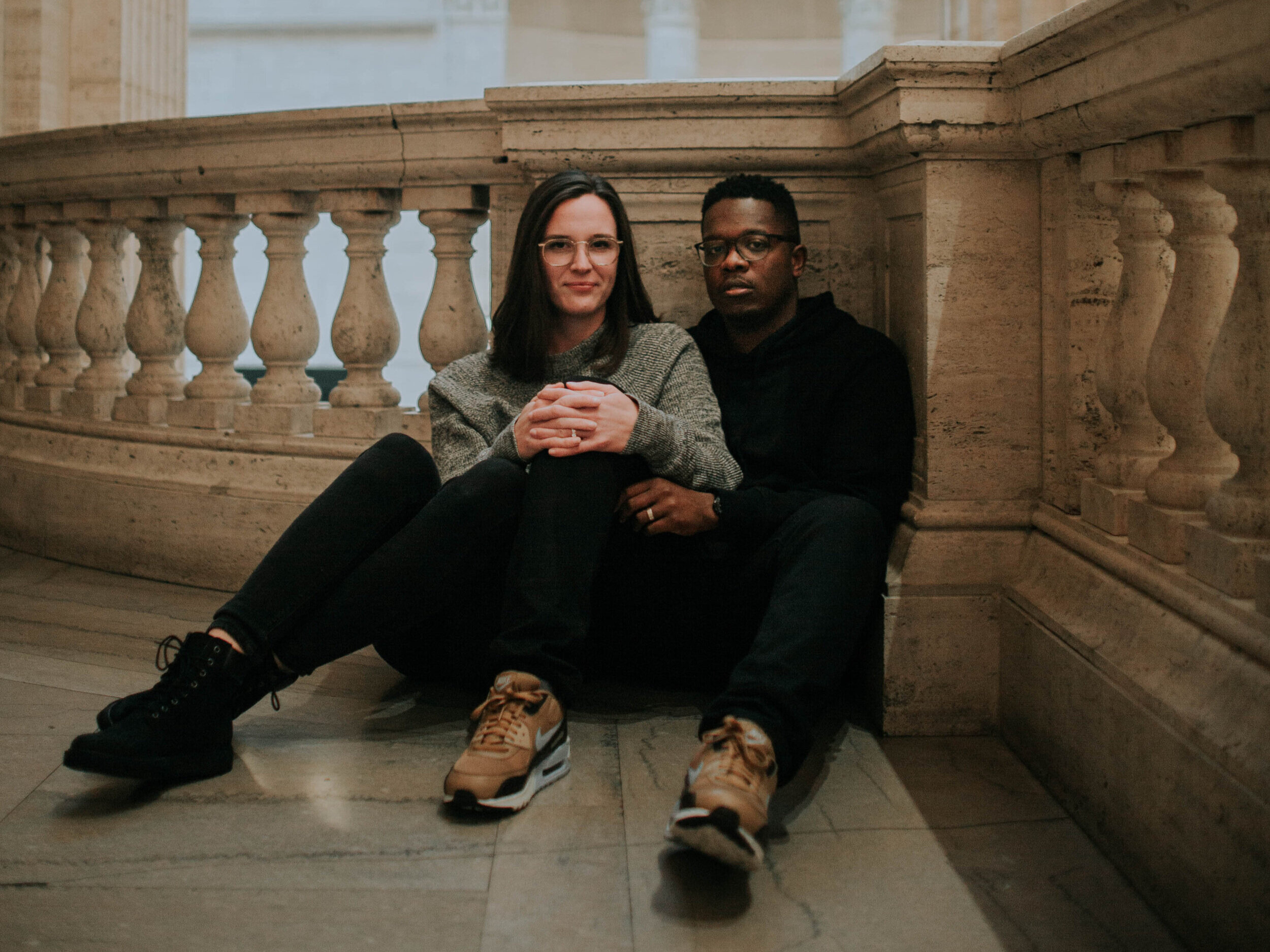
Chelsea and I constitute what our racialized world names an “interracial” relationship. It is a tragic-redemptive name for particular kinds of coupling. On the one hand, the names, in our case “black” and “white,” point to and reiterate the same biologically essentialist logic that provides the foundation for white supremacy. While skin pigmentation is, no doubt, a function of biology, the names “black” and “white” are not reducible to biology alone. They must be observed through the prism of history. The names mark levels on what Jennings calls an “abiding scale of existence” that places whiteness on top and blackness at bottom. Whether we recognize it or not, these names still function this way. The pigmentocracy is no longer as explicit as it once was; few people in our day use names like “quadroon” (one quarter black) or “octaroon” (one eighth black) to describe themselves. But the gap between the names, what Eddie Glaude calls the “value gap,” remains alive and well. If you don’t believe it, imagine a “black” neighborhood. Now imagine a “white” neighborhood. For either, don’t think of the exceptions. Now choose where you believe you will have access to adequate levels of safety, comfort, and opportunity. To be said to be participating in an “interracial” relationship, then, carries insidiously racialized connotations. It subconsciously signifies the impossible coming together of fundamentally disparate realties. It is tragic.

On the other hand, the names “black” and “white” point to and reiterate identification with particular communities. Especially for racialized minorities, this self-identification points to what Ian Haney Lopez calls “community ties,” familiarity with and concern for the interests of one’s community of origin. Understood through the lens of community ties, “blackness” does not signify the bottom of a racial scale of existence, it signifies dignity, strength, and participation in a beautiful community of people bearing the imago Dei. It signifies those who have gone on existing, and beautifully, despite every effort against them. Historically and sociologically speaking, the community to which “white” identity points has been the community of the oppressor, the community who took the power to name themselves and others. Those who are named “white,” then, have the difficult task of reckoning with this identity, of bearing the name, while working to dismantle its meaning and renounce its power. In this way, to be said to participate in an “interracial” relationship may be understood as redemptive. It may represent a supernatural work of reconciliation between communities who have redefined, relinquished, and/or redeemed the names they were given or that they gave to themselves. It may represent submission to the power of God in Christ by the Spirit to name, rename, and redeem for God’s own purposes.

This latter sense of the name “interracial” was, and is, the case for Chelsea and me. And we looked forward to thinking through this complex identity for and with children who would represent physically what we now understood about our relationship. A kind of visible sign of an invisible reality. In this context, the verdict of infertility named not only our inability to have biological children; it also suggested the improbability of naming a new way of being in society, a new way of relating to one another in a racialized world. So, Chelsea shared in the longing of Sarah, Rachel, Hannah, and Elizabeth. For these women of canonical fame, longing for children proved to be holy longing; they desired to participate in the story of redemption to whatever degree they understood it as such. On this side of Pentecost, we long to participate in the redemption of a society ravaged by those who would claim the ultimate power to name. The redemption itself has already occurred and is occurring, however improbable. Even improbability kneels in the presence of God; dry bones come to life. Even a virgin could become theotokos, mother of God.

*   *   *   *

Chelsea had learned some years before of embryo adoption. In truth, Chelsea and I decided independently, even before we dated, that we would someday adopt children. Upon marriage, we thought of it as a future endeavor, something to pursue after starting a biological family. Somewhere in the midst of our grieving the verdict of infertility, though, the memory of adoption returned. In waves, over time, joy and hope returned, too. Our conceptions about family and biology challenged, we took heart again. Ultimately, we pursued embryo adoption, in which the embryo of a donating family is carried and delivered by the adoptive mother; the child grows in the womb and is delivered by the adopting mother but carries neither of the adoptive parents’ DNA. In the United States, there are currently over a million embryos in cryopreservation. Over a million embryos waiting to be named.

From their biological father’s side, the embryos that Chelsea and I adopted are half Kenyan. Because of the “one-drop” racial logic of the U.S., they will be racialized as black even as they are simultaneously racialized as mixed.[iii] Our children will change our names. We will now be mother and father. Further, I will be named a “black” father and Chelsea, a “white-mother-of-black-children.” These names carry complex meaning and emotion, in fact, the same tensions inherent in the name “interracial couple.” Tragic-redemptive.

It is tragic that one effect of racism and socio-economic disenfranchisement on black families has been the paradigm of the absent black father. Tragically, this hasn’t resulted in proportionate praise for the paradigmatic strength and resilience of black mothers. It is tragic that the narrative of black male absenteeism has become, for many, the cause and not an effect of socio-economic disenfranchisement in black communities. The blame is shifted and all responsibility for social action is placed back onto the black community. It is tragic that the fetishization of black men and black children by white women is an historical reality and has even become a trope in popular culture. It is also tragic that many women named “white” who happen to love men named “black” and parent children named “black” and/or “mixed” may be seen to perpetuate this fetishization.

It is redemptive to know that the active, present, loving, sensitive, strong black father is not an anomaly. It is redemptive that countless men and women across the country and across the world have always fought on the side of anti-racism without reduction. It is redemptive that countless interracial couples around the globe lean into the complexity of their joining, bringing all of their names with them, and considering together what kind of world our children should inhabit.

From their biological mother’s side, our child(ren) are part Cajun. The name Cajun is laced with racial history. French Canadians born in Louisiana during the late 18th and 19th centuries increasingly felt the need to distinguish themselves as “white” in contrast to those French Louisianans with darker skin, those who came to be known as Creoles. This racial distinction predictably and increasingly corresponded to socio-economic disparity. While the names in themselves—Cajun and Creole—do not inherently point to race, they have been made to conform to modernity’s racial logic.

Still on their biological mother’s side, our child(ren) are also part Honduran. Honduras, like many Caribbean islands, is paradigmatic in the colonial and neo-colonial history of the west. It is what O. Henry named a “banana republic,” a socio-politically unstable community. These banana republics were exploited for their rich natural resources, their societies forced to yield to capitalistic visions of time, space, and relating. Honduras’s prolific land attracted “namers” who would try to bring the land into submission; it would become what Pablo Neruda called “America’s sweet waist.”

It will be our task as parents to pass down what we know of these histories, in all of their beauty and complexity because our child(ren) will be named “mixed,” and this name will be truer than the namers know. It will seem as though our child(ren) are the mixture of Chelsea and myself—and they will be that, too—but they will be so much more. They will be the mixture of the stories of Africa, South America, the Caribbean, Europe, and the United States. They will be the mixture of the past and the present, of already but not yet. They will be the mixture of histories with History. Ultimately, they will be the mixture of human sinfulness and redemptive grace.

*   *   *   *

This is the reason that the Son, eternally begotten of the Father, took on the name Jesus in a particular time and place. Submitting himself to Mary and Joseph, the God-man allows himself to be named and to grow in favor with both God and people. In his ministry, Jesus exercises his own power to name—Simon is named Peter, servants are named friends. Not knowing sin himself, Christ took the name “sin” so that many might have the name “righteous.” Upon his resurrection Jesus instructs his disciples to baptize into the name of the Father, the Son, and the Holy Spirit. And by the power of the Holy Spirit, the followers of Jesus are named the Church, sinners are named saints, those who were once not a people are named a people for God’s own possession. For this reason, Christ has been given the name above every name. Christ has assumed, and therefore, redeemed humanity’s power to name which was broken at the fall. This power has been abused by those who have the name Christian, but there is redemption for this, too.

So, our child(ren) will have names. They will have names which identify them as individuals who bear the divine image, each one a “Thou” existing alongside others in what Martin Luther King Jr. named an inescapable network of mutuality. Names signifying particular finite lives in time and space for whom the infinite God, in Christ, opened eternity.

And the names will be given by us, their parents. Not in domination, but in love. This given-ness points to our contingency, to our dependence—along with all of creation—on God for life, breath, and being. It points to our unity with those who came before us and it means that we carry their lives and stories with us. We carry the names we’ve been given. This, after all, seems to be the point: that because of the love of God in Christ, it may be a beautiful thing to name and be named.
DSC_3277.jpg

About Michael Yorke

Michael Yorke holds a degree in Historical Theology from Wheaton College Graduate School in Illinois. He thinks and writes at the intersection of race, history, and Christian theology with a view toward a liberative and antiracist future. He is married to Chelsea and their first child will be born in December.


Footnotes

[i] Ellison, Ralph. Invisible Man

[ii] Morrison, Toni. Beloved

[iii] According to Winthrop Jordan, “In this country, the social standard for individuals is superficially simple: if a person of whatever age or gender is believed to have any African ancestry, that person is regarded as black. Basically, by this social rule, a person was, and is, either black or not. Any person of racially or ethnically mixed descent who has some ‘Negro blood’ has been or still is regarded as ‘colored,’ or ‘African,’ or ‘Negro,’ or ‘black,’ or ‘Afro-American,’ or ‘African American’—whatever designation has prevailed by convention at the time.”

Works Referenced and/or Consulted

Bantum, Brian. Redeeming Mulatto: A Theology of Race and Christian Hybridity

Carter, J. Kameron. Race: A Theological Account

Crenshaw, Kimberlé, et al. Critical Race Theory: The Key Writings That Formed the Movement

Ellison, Ralph. Invisible Man

García-Johnson, Oscar. Spirit Outside the Gate: Decolonial Pneumatologies of the American Global South

Glaude, Eddie S. Democracy in Black: How Race Still Enslaves the American Soul

Jennings, Willie James. The Christian Imagination: Theology and the Origins of Race

Jordan, Winthrop “Historical Origins of the One-Drop Racial Rule in the United States”

Kendi, Ibram X. Stamped From the Beginning: The Definitive History of Racist Ideas in America

Lopez, Ian Haney. “Community Ties, Race, and Faculty Hiring: The Case for Professors Who Don’t Think White”

Morrison, Toni. Beloved

Raboteau, Albert J. A Fire in the Bones: Reflections on African-American Religious History

Does Righteousness Have a Color Scheme?

Does Righteousness.png

Editorial Note: Remember, a theology of clothing and a modest spirit are not solely a woman’s issue. The principles discussed below are also applicable to men, and we encourage our male audience to consider their role in this conversation as culture-makers.


It wasn’t until moving to Ecuador for a teaching assignment that Chicago born Latina, Jacqui[1], saw firsthand that modesty is understood differently culture to culture. Surprised by the way women dressed when attending church, she realized that even while Latina, she was raised with an American perspective of modesty. “When I think ‘what does modesty look like in the Christian US,’ it’s covering yourself,” Jacqui explained. “But more specifically it’s covering the shape of a woman’s body.” Jacqui is mestiza, representative of the children and grandchildren of immigrants who find themselves caught between the cultural values of their heritage and the American values in which they have been raised. Jacqui had sensed this tension but living in a Latin culture outside the US for a couple years helped her begin to sort out these differences and gave her a fresh perspective on modesty.

“For Latins,” she explains, “it’s not about covering the shape but about covering the skin. Whereas, in the US, it’s more about covering the shape of your body.” What she saw in Ecuador rang true in her personal experience, as she identified in times of celebration, like a graduation, her family reverted to a Latin understanding of modesty, focusing more on covering one’s skin than shape. This cultural difference affected how Jacqui saw the Super Bowl half-time performance, and she thinks it is this cultural tension that contributed to the heated dialogue that followed. “I think that’s why at the Super Bowl a lot of people in the Latin community were upset when people said it was scandalous.”

Jacqui’s experience is an example of the diversity in modesty principles that exist in US churches today. While the loudest voice on the topic of modesty might be the white evangelical one, our churches are filled with believers from a variety of cultural contexts and ethnic backgrounds. First and second-generation citizens, mestizas/os like Jacqui, are in the process now, more than ever, of working through their cultural identity and understanding how it informs belief and practice as a follower of Jesus. In explosive debates, like the ones seen online after the Super Bowl half-time show, Christians can easily talk past each other, forgetting a fundamental yet complex difference we all have—context.

In February, the we published “Too Soon to Talk About Modesty” and the response was overwhelming, prompting constructive conversations in the WOS community and beyond. This article proposed we first talk about being clothed in the righteousness of Christ, before developing a practical theology of clothing. But what’s next? This month I sat down, virtually, with four Christ-following women who have thoughtfully developed their own relationship to clothing. Representing a variety of ages, ethnicities, cultural backgrounds, and church contexts, the experiences of these women tell a broad story, one that acknowledges the influence of culture and ethnicity on our relationship to clothing. God has given us the Word, the Spirit, and Biblical community as three means of pursuing wisdom—whether deciding what to wear, who to marry or what career to follow. What do we do when we disagree on what is modest? Clothing, as a cultural artifact, as well as a physical covering, tells a story. Some would say the story a Christian’s clothing should communicate is the gospel. Or at least, clothing should not hinder the gospel. The beauty in expanding our perceptions of modesty is that it opens us to reflecting the robust diversity of the Church and her people.

A Story of Cultural Identity

Wife, mother, First Lady, and professional, Shay is a woman who loves the Lord and loves fashion. In living life and doing ministry within the evangelical church, Shay has experienced firsthand the cultural differences in being a Christian and relating to clothing. “The issue of Christianity and modesty,” Shay shared, “really does come from a white evangelical background, and a very conservative background.” Coming from the very background Shay names, I listened intently to what she shared. Looking at an issue through the lens of another is the first principle of humbly seeking unity in the Church. Shay continued, “So women of color like myself, black and brown, as we come into the church, we are always taught that we have to look a certain way and act a certain way. But for many of us, we honor culture and race, we honor who we are and where we come from, and all the different pieces that make us, us. Even how we are raised and our personality types. And that is always a struggle, when churches say, ‘Hey, you’re welcome,’ but then I come in dressed in my sweats or my J’s—'Sorry, women don’t dress like that.’”

Cultural differences lie not only in how we cover our shape or skin, but in style. In attempting to define modesty, conservative evangelicalism has also dictated style, which isolates those from non-white ethnicities and cultural backgrounds. Rachel echoes a similar sentiment. As a church planter in Chicago, Rachel has spent time through the years reflecting on her cultural identity as Puerto Rican, with being a modest, yet fashionable, woman of God. “Too often we are not sensitive enough to someone else’s culture,” Rachel reflected. “We may want them to be part of our church, but we want them to assimilate into our culture. But if you want someone as part of your church…you will want their culture as well. And not say, “Come but leave your culture behind.’” Shay and Rachel point out that our clothing tells a story of our cultural identity. This piece of someone’s story is hindered when modesty is made to be a universal standard. But there is no universal standard.

A Story of our Uniqueness

Broadcast journalist Lecia was raised with a British/Caribbean cultural understanding to dress up for church, as a sign of respect. Residing in Florida where it is common for congregants to gather on Sundays in shorts, Lecia prefers to wear dresses and jewelry, yet humbly acknowledges that her clothing preferences are preferences. “Where do you find that middle ground? First of all, I acknowledge that it’s not a universal standard, so I realize I am not going to please everyone in what I wear.” Lecia emphasized the need to consider a social setting when making clothing choices and asks trusted friends for advice when she is unsure. However, she isn’t burdened by trying to be modest and doesn’t care if she is dressier than most. “Clothing is like an art and your body is the canvas,” she said, laughing that quarantine had been limiting her opportunities to dress up. “Dressing isn’t about drawing attention to specific body parts…it’s expressing your passions and your personality.” While seeking to be modest, Lecia sees clothing for what it is, a storytelling artifact that communicates the many facets of a person to the world around them.

Each woman interviewed listed numerous aspects of a person that influence clothing choice: body type, age, cultural background, church context, style preferences, personal comfortability, setting, and personality. Approaching the topic with a ministry mindset, Rachel expressed caution for those who try to develop rules or guidelines for modesty. “It’s such a multi-faceted conversation,” she mused. “I find myself leery of setting some kind of standard, that everyone then thinks, ‘This is God’s standard.’ We all would love to have, at our core, standards to follow so we could either look good or judge someone else or say we did it, but it was never like that for God. He was about our heart.” Raising her own daughter, and modelling Christ-likeness as a church leader, Rachel’s relationship to clothing is definitely on her mind. But her perspective is wisdom driven—not rule based. “There’s also the aspect that I want to do as Galatians 5 says—if I live by the Spirit, I will walk in step with the Spirit and bear the Spirit’s fruit in my life,” she explained, pointing back to scripture. “How do I do that? Well, let me ask questions that probe my heart, and get to the root of why I wear what I wear, and why am I choosing this.” This perspective rightly defines clothing—as an element everyone interacts with, that for the believer, needs submitted to Christ as any other area of life does. This perspective does not elevate clothing to what it is not—the telltale sign of a Christian’s character or righteousness.

Shay summarized it well: “Righteousness never had a color scheme, a style, a corset, a big baggy hoodie. It’s a manner of life that God has called us to live.” Clothing both covers and communicates. Just as the righteousness we wear communicates Christ to the world around us, clothing communicates the uniqueness of each person’s story, the diversity of our backgrounds, and the many pieces of our contexts. Getting practical with modesty starts with wisdom and continues with learning to love the Body of Christ in its many stripes and colors, baggie hoodies and all.

[1] All names of interviewees changed for privacy.


Emily_Fall_2019.jpg

About Emily C. Alexander

A first generation college graduate of a rural working class family, Emily C. Alexander recently completed her undergraduate degree in Ministry to Women at the Moody Bible Institute. Emily lives in Chicago where she enjoys long walks admiring architecture and pondering theological and sociological issues. Her hope is to impact the lives of women and the flourishing of the church through thoughtful theological engagement.

Too Much or Not Enough

Too Much.png
The distance between one person and another is really a story.”
— Karen Figueroa, The Mestizo Podcast, Ep. 2

I don’t remember what I said. Whatever it was, it made an impression on him. He pressed again, asking, “Where did you learn that?” “I don’t know,” I responded. “It’s just something we say all the time back home.” “I haven’t heard that since my Abuela died years ago,” he said, speaking more to himself than to me. It was as if he was reliving a memory; he was transported somewhere else. So was I. He was an elder at the church I recently joined in Chicago, a Puerto Rican who spent nearly the entirety of his life in this city.  I was new to Chicago, returning to the Midwest after a decade in Central Florida. Whatever I said, sent him from the city to the Island, but the words didn’t have the power for a joint trip. I landed just short of the island. Close, but not close enough.

The irony of this exchange is that it endeared me to this elder. It made me an insider, someone who understood the “old tongue.” He made a habit of inviting me to Sunday meals where his wife cooked “a lo antiguo.”[1] Arroz con gandules. Carne guisada con arroz y habichuelas. These were contidiano (ordinary) in my house growing up. What was not ordinary was the impression it made on this elder. Apparently, he was surprised to see a young man still eating this way. I wasn’t used to being treated like I was “authentically” Puerto Rican, yet there I was each Sunday being celebrated by a man and his wife for doing simple things like enjoying tostones.

In Chicago, with this elder, I was celebrated for being “more authentic” than some of the other Puerto Ricans in my generation. To my shame, I reveled in the admiration. Back in Florida, where an estimated 34% of Osceola county’s population identified as Puerto Rican and a large portion of these residents are recent arrivals from the Island, I was never “authentic” enough. My Spanish sounded learned in comparison. My taste for traditional Puerto Rican dishes was refined, but my rhythms, my “flow” was never quite right. Pero en Chicago, I was to my peers what the Ricans in Florida were to me. I was “authentic.” Or, at least, in the eyes of this elder, I was close enough.

Distancia y Dynamica

The Mestizo Podcast is a project that came with an emotional risk. I was nervous about publishing content from a uniquely Latina/o perspective and how that would be received. For my white peers in evangelical academia, I worried it would turn them off to the content, but the greater fear was related to how my Hispanic peers would receive it. Would it be welcomed as an answer to prayer? That was my hope. I prayed regularly for an outlet for conversations about interstitial identities. Experience taught me, however, that whomever starts these conversations gets evaluated, measured against the listeners’ perceptions. For some, I would be too Hispanic to be relevant. For others, I wouldn’t be Hispanic enough. I would be perceived as too white, too Americano, “de afuera” (from the outside). Exiled from one. Not welcome by the other.

During the second episode of the show, Karen Figueroa said, “The distance between one person and another is really a story.” I wondered weeks later about the amount of distance a story could cover. Could a story really tie the two generations of Hispanics together? Could it bridge the distance between Florida and Puerto Rico? In my experience, your proximity to the Island defined how Puerto Rican you were. How often did you visit as a kid? Did you live there at any point? Were you born there? Did you speak Spanish? If so, how was your accent? These questions represented the hermeneutic for deciding your Puerto Rican-ness. But Karen made me wonder, could a story relativize the island? Could narrative beat land the way paper covers rock?

A recent chat with a friend brought these questions to greater focus. After making a joke about the phrase “sin pelos en la lengua”[2] not making sense to me, we debated the image and origin of the phrase. She reminded me that these kinds of expressions are “formed en los barrios de la isla por gente con mucha oralidad.”[3] Then she concluded by saying that the idiom is not meant to be convenient for “gringos” or “una generación que no está conectada a ese contexto.”[4] Admittedly, the joke may have offended her as an Island-born Puerto Rican. In our chat, I felt I was perceived as an outsider mocking something I couldn’t understand. I felt I was perceived as lacking the connection that led to understanding. That may be true, but there is also another possibility. Is my connection strictly related to my physical distance to the Island, or is it possible I am connected via something else?

Oral Cultures and Exiles

In his Nobel-prize-winning book, El Hablador (The Storyteller), Mario Vargas Llosa tells of a young man named Saul, who abandons Peruvian society to become an Hablador of the Machiguenga. The Machiguenga is a tribe that lives as scattered family camps across the Peruvian-Amazon rather than live together as one complete community. In this unusual, dispersed way, the Machiguengas claim the entire forest as theirs, each family taking up their own corner of it and moving as food would require. Only one person traveled from family to family connecting them together. El Hablador.

For the Machiguenga, the storyteller is of sacred, indeed religious importance. The storyteller’s job was simple enough: to speak. “Their mouths were the connecting links of this society that the fight for survival had forced to split up and scatter… Thanks to the storytellers, fathers had news of their sons and brothers of their sisters … thanks to them they were all kept informed of the deaths, births, and other happenings in the tribe.” The storyteller did not only bring current news; he spoke of the past. He is the memory of the community, fulfilling a function like that of the troubadours of the Middle Ages. The storyteller traveled great distances to remind each member of the tribe that despite their miles of separation, they still formed one community, shared a tradition, beliefs, ancestors, misfortunes, and joys. The storytellers, writes Vargas Llosa, were the lifeblood that circulated through Machiguenga society, giving it one interconnected and interdependent life.

The Machiguenga storyteller is “tangible proof that storytelling can be something more than mere entertainment … something primordial, something that the very existence of a people may depend on.”

Vargas Llosa’s book highlights the importance of the story for exiled portions of a people group. What makes the Machiguenga a single people isn’t their proximity to a center or place of origin. There is no required pilgrimage for the Machinguenga that reinforces their identity. The story, and their regular submersion in it, is what makes every member, even those born on the outer limits of the jungle, part of the tribe. For persons like me, this makes sense as an explanation of my identity. Yes, as my friend rightly noted, Puerto Rican phrases come from an oral culture, but many of us US-born Puerto Ricans understand that far more than we are given credit. We know that our Rican-identity is rooted in this oral tradition. We aren’t Puerto Rican by the simple fact of an Island birth. Our identity relies on something more complex; it relies on our live connection to the oral tradition – stories, bombas, dichos, bailes, poesías, and even phrases like the one I lightheartedly teased. Like the people of Israel in the Old Testament, we are a people because of a shared narrative.

Generational Responsibility

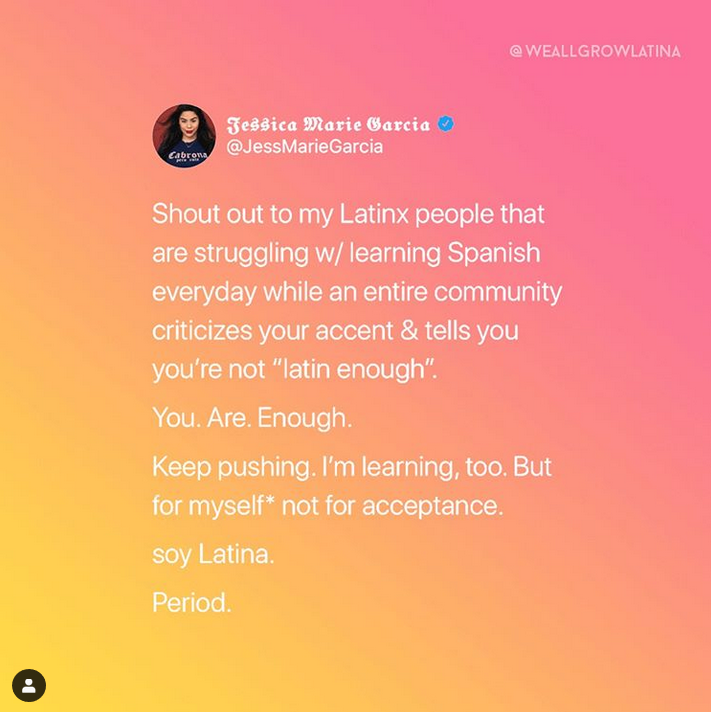
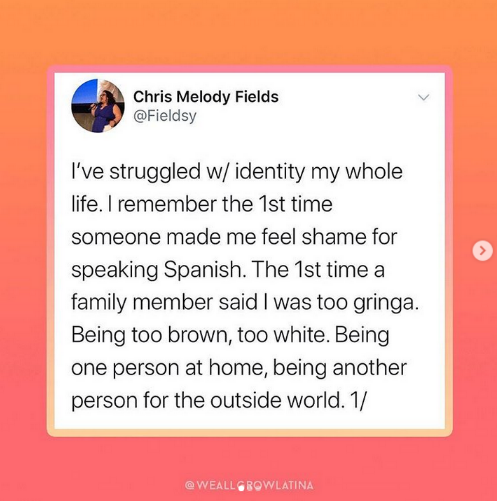
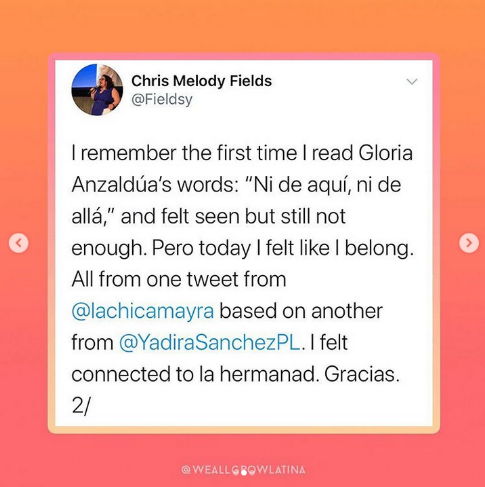
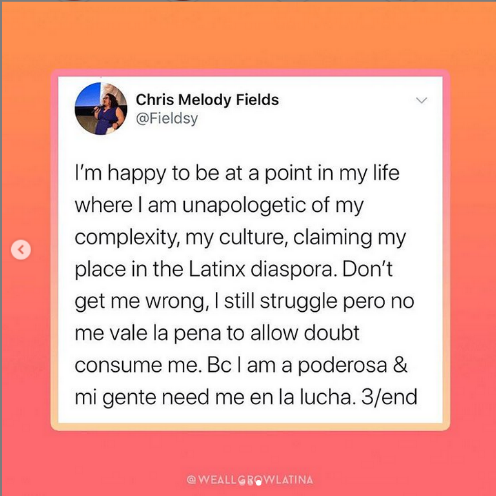
Many of my Chicago friends who identify as Puerto Rican don’t speak Spanish. For a long time, I put on airs because I did. This is typical among 2nd and 3rd generation Hispanics, to judge and be judged. Those who rank higher on the Puerto Rican-ness scale usually take on the role of gatekeeper, withholding the right to claim certain parts of Puerto Rican identity from others lower on the scale. There are so many stories about the pain caused by this kind of intercommunity conflict. Here are just two snapshots of how it makes the non-Spanish speaker feel.

Both tweets reflect infighting between LatinX people based on judgments about what it means to be LatinX. There are myriad reasons why this kind of conflict continues, and some are legitimate and worth addressing; the colorism in our community primary among them. However, there are also several reasons why linguistic ability should not be held against the diaspora’s children. As Gina Rodriguez, star of Jane the Virgin, stated, many parents refused to teach children Spanish, hoping they would lose the accent and be offered greater opportunities in the “white world.” Learning Spanish was not an option. It was discouraged.

I sympathize with parents who made this tough decision in hopes for a better life for their children. They could not foresee the way the Hispanic community would boom and gain influence today. Of course, this is one of many possible reasons for the loss of the language and culture. I am not accusing parents or blaming them for this loss. An individual’s flourishing (or diminishing) ability to access their cultural resources is in large part affected by the community. If the immigrant generation made a mistake by not passing the language down, there is still enough time and resources for it to be restored by the community. Once more, this is where the Machiguenga teach a vital lesson. Cultures survive because of storytellers not gatekeepers. We need a new way forward in the restoration and preservation of the Latinos’ community wealth, one that removes the judgment and includes the diversity of the diaspora’s children. We need more Habladores and fewer gatekeepers.

Galatas and the First Gatekeepers

Again, a gatekeeper is someone who “takes it upon themselves to decide who does or does not have access or rights to a community or identity.”[5] Gatekeepers may do this intentionally or by instinct – an impulse taught to them by the culture. I acted as a gatekeeper in my hubris about speaking Spanish. Whether with the intention of keeping the culture “pure” or the instinct to establish their standard, gatekeepers devalue “other’s opinions on something by claiming they’re not entitled to the opinion because they’re not qualified, … [or] a part of a particular group.”[6]

One of the earliest accounts of cultural gatekeepers is the small letter included in the Bible as the book of Galatians. The conflict that inspired Paul to write this letter was the arrival of Jewish believers to the region of Galatia. These new arrivals argued that non-Jewish Christians had to adopt Jewish practices and customs to truly belong to the people of God. Paul wrote with passion, reminding the church of his past as a zealous follower of Jewish tradition. He writes, “I was advancing in Judaism beyond many of my own age among my people and was extremely zealous for the traditions of my fathers” (Gal. 1:14). Like the generational ranking that happens among LatinX people today, Paul was highly ranked as a Jew among Jews, yet he relativizes the Jewish Law by reminding the church of the essential element that identifies them as Christians – the gospel.

Paul is an Hablador. He knows the stories and focuses on the central narrative that ties this people together as one. Paul acknowledges the wisdom of the Law but presses the point that the Law was insufficient. It is faith in Jesus Christ that makes them sons and daughters of God. “There is neither Jew nor Gentile, neither slave nor free, nor is there male and female, for you are all one in Christ Jesus” (Gal. 3:28). The good news of Jesus’ death and resurrection births a mestizo Church. It also enables a new form of relating between mestizos. “Since we live by the Spirit, let us keep in step with the Spirit. Let us not become conceited, provoking and envying each other” (Gal. 5:25-26).

The gospel is a unique story in that it has the power to birth community across disparate and even enemy groups. Paul’s argument is also instructive for people within the same group. Puerto Ricans in the diaspora already know the importance of storytelling. While we may not understand every practice nor practice every custom, Habladores like Paul help us stay connected to them. They also help grow the story’s community to include the diaspora’s experience. Among young US-born Latina/os, there are some recording our history, researching our dances, and writing new poetry. These represent a collection of new Habladores, storytellers who bring new life to the older generation, demonstrating that the culture isn’t dying. The culture has always been close to the diaspora, not because of their proximity to the Island, but because of their rehearsal of the stories.

Profile+Pic.jpg

About Emanuel Padilla

Emanuel Padilla is President of World Outspoken, a ministry dedicated to preparing the mestizo church for cultural change through training, content, and partnership development. He is also an instructor of Bible and Theology at Moody Bible Institute. Emanuel is committed to drawing the insights of the Latina/o church for the blessing of the wider church body. He consults with churches on issues of diversity, organizational culture, and community engagement.


Footnotes

[1] Trans. - Old school or traditional.

[2] An expression that generally means, “When you’re so blunt not even hairs could soften the words.”

[3] Translation: “formed in the hoods of the island by people with an oral tradition.”

[4] Translation: “a generation that isn’t connected to that context.”

[5] “Urban Dictionary: Gatekeeping,” Urban Dictionary, accessed May 24, 2020, https://www.urbandictionary.com/define.php?term=Gatekeeping.

[6] “Urban Dictionary: Gatekeeper,” Urban Dictionary, accessed May 24, 2020, https://www.urbandictionary.com/define.php?term=Gatekeeper.

Soy Tu Madre. I See You.

1.png
Because I’m your Mom, it counts the most, because I know you the most.”
— Isabel in Wonder

I remember the first time I felt seen by my mom. It was a random Saturday when I was seven or eight. “A girls’ day,” she called it. I don’t remember all the details of that day. I know we had lunch out, and likely went shopping, possibly buying some new clothes for me. It is the feeling that stayed with me—the feeling that I mattered. Being a middle child of six, and the only girl, my Mama knew I needed to be known, she knew I needed to feel seen.

In the 2017 film Wonder, America’s beloved Julia Roberts plays Isabel, an ordinary Manhattan mom who gives up completing a master’s thesis to homeschool her special needs son, Auggie. Wonder begins as Auggie starts a new and terrifying journey—middle school. For the first time Auggie and his family learn to navigate friendships with children who often cannot see past Auggie’s physical differences. Being seen and known by his family gives Auggie the courage to go to school each day, but being unseen (ignored) and unknown leaves his older sister, Via, swimming in isolation as she starts high school. In the film, Isabel’s growth as a mother is not about rediscovering her life or finishing her education, as one would expect. It is putting to practice what she already does so well with her son—learning to see and know her teenage daughter.

In a post-modern, justice and truth driven Christianity it can be easy to overlook a hidden task force for God’s kingdom that quietly, and often thanklessly, works each day shaping and changing culture. This task force? Mothers and grandmothers—the women who birth and raise children to know and love God.  Mothers as culture-makers is not a new concept, but an ancient, biblical one, reflected in the abuelita theology of the Latinx church.

Abuelita theology elevates the influence of women in the passing on of faith. Dr. Miguel A. De La Torre defines abuelita or “kitchen theology” as an understanding of the role mothers and grandmothers take in the “transmission” of beliefs and practices in the Latinx community.[1] This informal education happens in the most ordinary place—en casa. Latina scholars Loida I. Martell-Otero, Zaida Maldonado Perez, and Elizabeth Conde-Fraizer highlight the importance of this home environment, in their book, Latina Evangélicas. Latina theology is deeply rooted in the “’womb’ of daily life.”[2] More than a set of correct beliefs or practices, abuelita theology is an approach to faith formed within the community of a marginalized people, and is consequently rooted in “lo cotidiano,” the struggles of the day to day life historically faced by US minorities. Abuelita theology cannot help but be practical, as the effects of poverty and discrimination necessitate a livable faith.

In his new book, Brown Church, Robert Chao Romero suggests the Exodus story reflects the strength and influence of matriarchs.[3] The beginning chapters of Exodus reveal God’s people in a precarious place. Enslaved in Egypt, the Israelites population growth and potential power was concerning to Pharaoh. He commanded the Hebrew midwives to kill male infants as they assisted in deliveries. Fearing God, these women continued to help Hebrew mothers successfully birth their sons. As the Israelites grew in numbers, Pharaoh declared to all people that male Hebrew infants should be thrown in the Nile. Exodus 2 introduces us to Jochebed, a Hebrew mother: “The woman conceived and bore a son; and when she saw that he was beautiful, she hid him for three months.” Jochebed allowed her son to live. Three months later she submitted him to God’s sovereignty by placing him in a basket in the river, and dispatching her daughter to watch and wait. Moses was found, given favor, and raised in the house of Pharaoh. Later in his life, he would become the deliverer God had ordained for His people.

We are left to wonder what Jochebed saw in her son. The word translated “good,” or also “beautiful” in Exodus 2:2, does not give us a clear understanding of her thinking. In Stephen’s speech to the Sanhedrin in Acts 7 we learn that Moses was “lovely to God.”[4] Did Jochebed have an inkling of her son’s future purpose? Did God reveal his set-apartness to her? Or did she simply see and know her child, and that was enough. In both the darkest adversity, and the daily struggle as a member of a marginalized people, Jochebed influenced the world through her motherhood. The future of God’s people was secured by the faithful obedience of many women—and one mother who saw her son.

I am tu madre Quote graphic.PNG

Joechebed’s story introduces the power of “lo cotidiano.” It is in the struggle of life that Jochebed’s choices as a mother take shape. Romero explains how this daily struggle is typified in Latinas: “Though many may look down upon our mothers, tías, and abuelas for their daily commutes on the bus, travails in domestic and factory work, exhausting familial responsibilities, and faithful church participation…it is precisely in the daily rhythm and grind of lo cotidiano that unique theological and epistemological understandings flow.”[5] This daily grind, lived out by every mother, is amplified in the life of the stay-at-home mom. The home becomes that “womb of daily life” that allows the child and mother to experience a reciprocal relationship of seeing and being seen.

Mothers and abuelas en casa create environments where the lives of children matter. In daily conversations, responses, sacrifices, and challenges, mom becomes a disciple maker and the children the disciples; the home is a safe space of shared experiences. Through this day in-day out proximity, stay-at-home moms create with their children a unique opportunity to both shape and be shaped. A mother sees her child each day in present circumstances, but as Jochebed and Isabel, also with a heart full of future hopes. Out of love, knowledge, and hope mothers speak into the lives of their children with the intent to shape whole and holy people. This relationship is reciprocal, as children also see their mothers up close. This allows space for immediate questions and conversation, as a child watches mom deal with “lo cotidiano.” This vulnerable relationship, when embraced, also sharpens the mother’s conviction and character. In the most mundane moments—over diaper changes, tearful shoe tying, math homework, fights over music choices, marital disagreements, and requests for forgiveness—mothers model godliness and shape the next generation of the Church, while also experiencing growth themselves.

In abuelita theology, the Latino community gifts the global church with theological language—words and imagery to honor the critical role of mothers and grandmothers in the propagation of the Christian faith and the strengthening of the Church. Possibly, like me, you expect women to cultivate an identity outside of being a mom. The progression of time and culture have shown us that women can successfully raise a family and pursue education or a career. I have this conversation with friends often: how we are eager to bring truth to our cultures, build the church, and share the gospel with our communities, but we also want to have strong families. As culture-makers who are working from the ground up to bring the beauty, justice, and wonder of the Cross to the world, we can lose sight of our strongest ministry partners—mothers.

In a concluding scene of Wonder, Julia Robert’s character Isabel attends her daughter Via’s play. Forgetting her glasses, Isabel strained to see Via enter the stage. Determined not to miss this special moment, Isabel took her husband’s glasses and watched the entirety of the play leaning forward to see her daughter perform. Shocked by the talent and beauty of her own child, the glasses did more than allow Isabel to see Via act, they helped Isabel realize she had not been truly seeing her daughter. It was finally being seen by her mom that gave Via the confidence she needed to face the world outside her home. Isabel and Via were changed and so was the world around them through their strengthened relationship.  

Today we stop to honor motherhood—the women, mothers and grandmothers, who have birthed and shaped our lives. Theirs is a faith defined by labor and sacrifice, and a love that chooses to see and know as God sees and knows. While many of us labor as pastors, teachers, writers, artists, advocates, thinkers, and activists, trying to make new the world in which we live—these women labor alongside us, creating and nurturing life that is new, young, and vulnerable. Today we stop to honor the women who see.

IG Madre - You See-2.png

About Emily C. Alexander

A first generation college graduate of a rural working class family, Emily C. Alexander recently completed her undergraduate degree in Ministry to Women at the Moody Bible Institute. Emily lives in Chicago where she enjoys long walks admiring architecture and pondering theological and sociological issues. Her hope is to impact the lives of women and the flourishing of the church through thoughtful theological engagement.


Footnotes

[1] Hispanic American Religious Cultures, De La Torre, 347.

[2] Latina Evangélicas, Martell-Ortero, et. all, pg. 6.

[3] Romero, 211

[4] Acts 7:20

[5] Romero, 317

Should It Stay or Should It Go?

Should it stay or should it go_.png

As humans, our history is marked by wounds of the past. We fight one another. We exploit one another. We kill one another. Our history is shaped by human injury; so, it makes sense that in a retelling of this history we would perpetuate injury. Injury begets injury. History-telling always runs the risk of aggrandizing someone’s story at the expense of another’s. That is the tension that exists between history and injury. This tension can even find its home in tangible spaces. Today, that tension found a home at the sites of many U.S. monuments. One of these homes is in Brandenburg, KY.
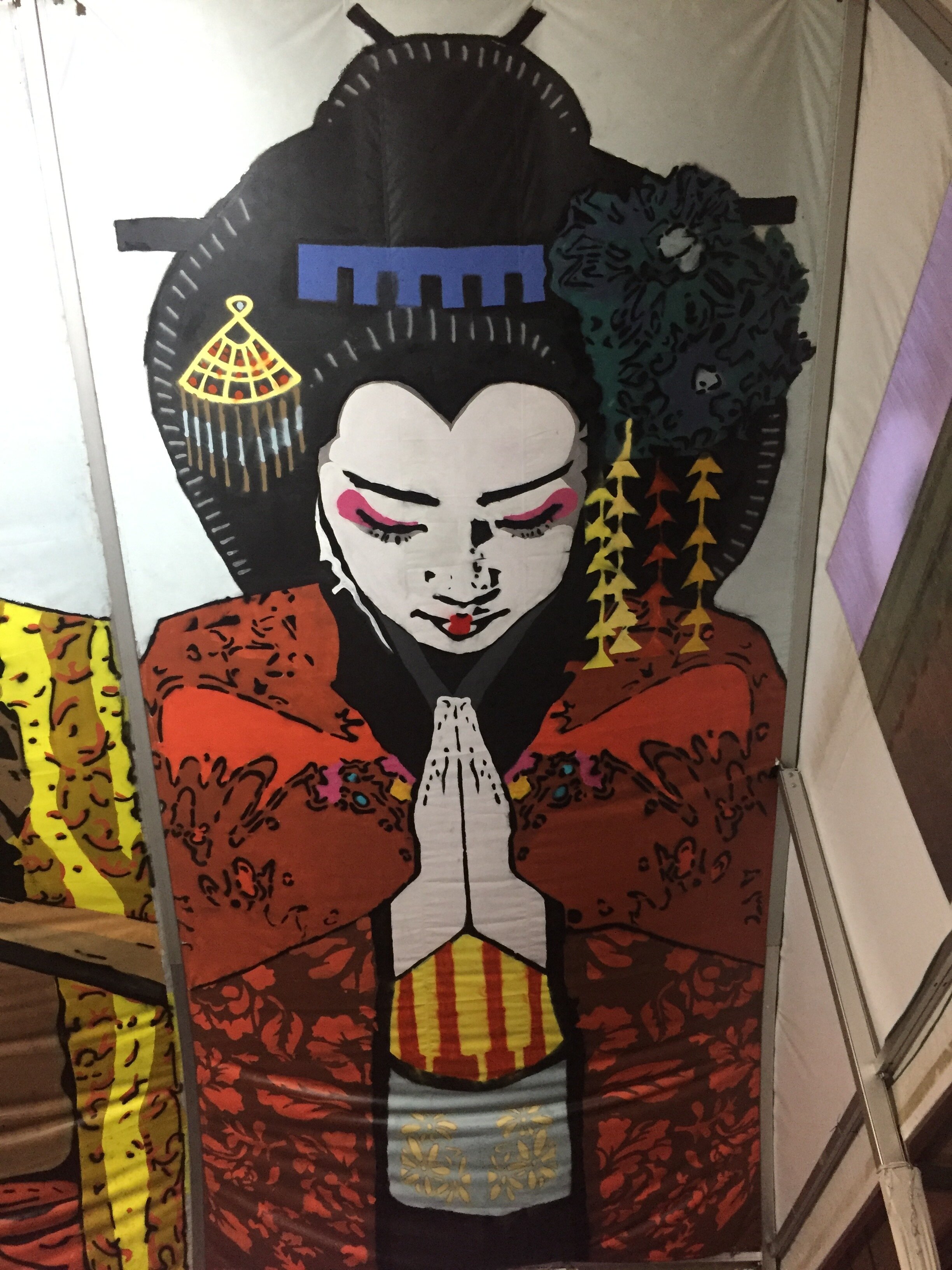
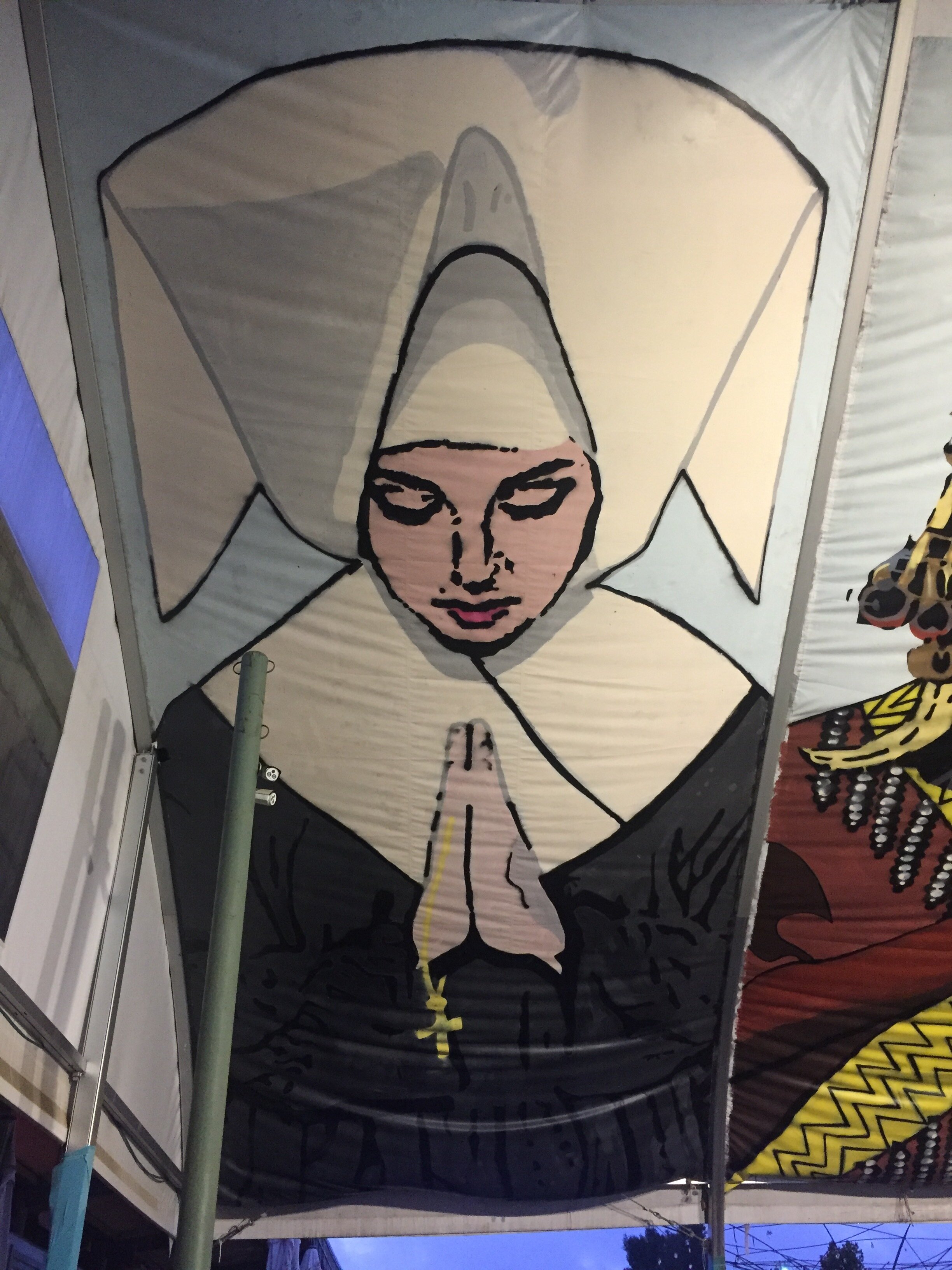
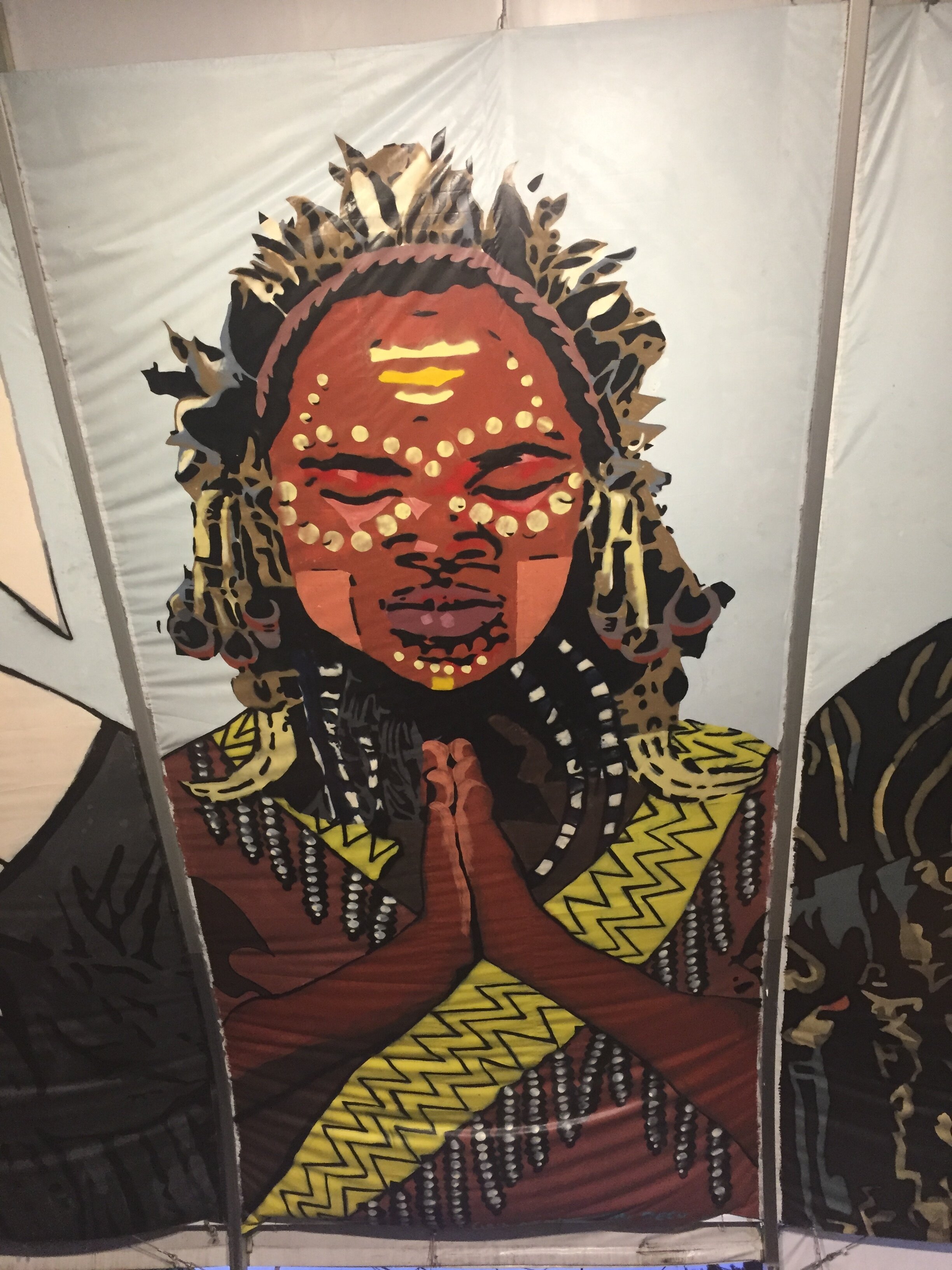
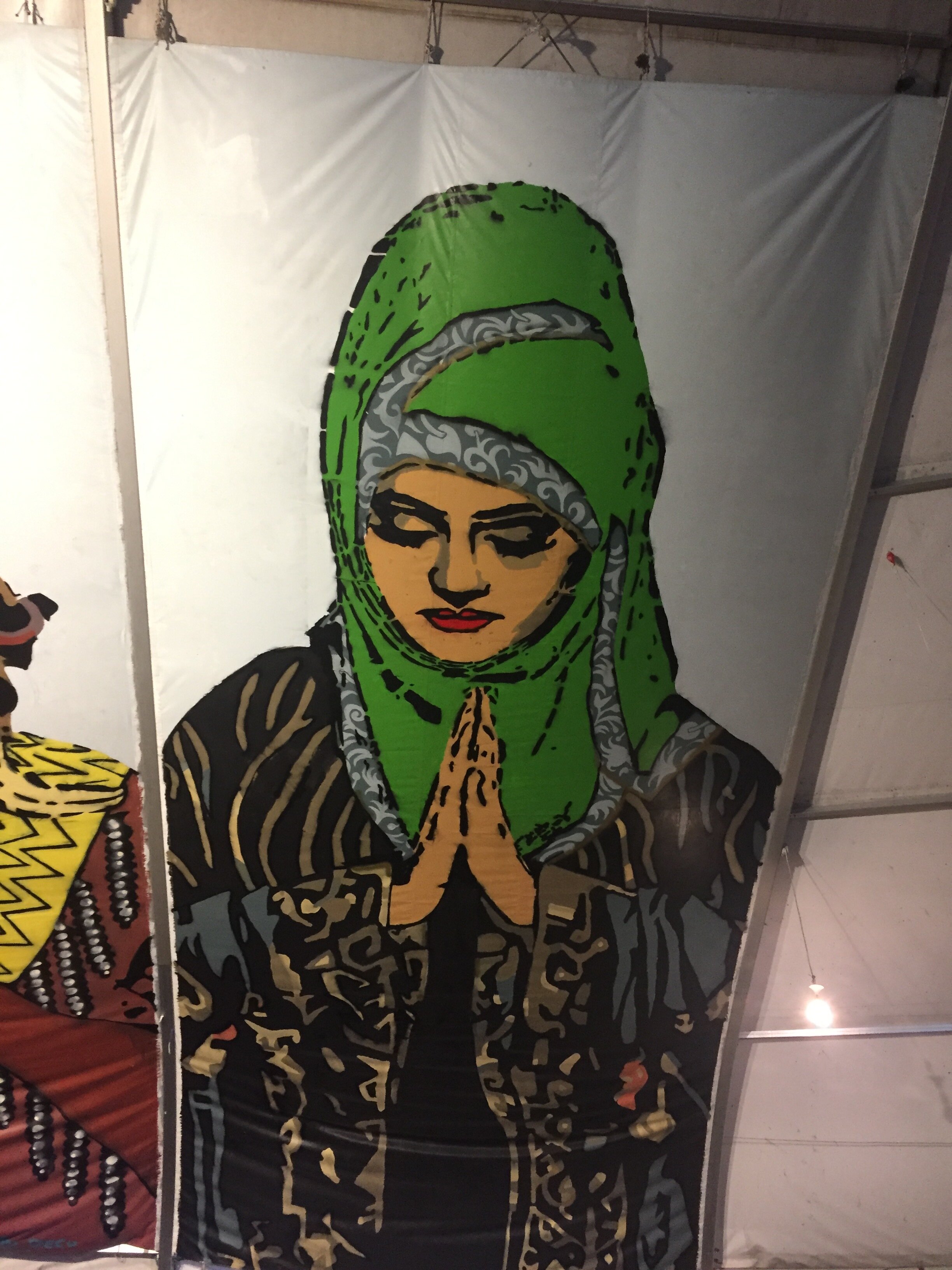
DSC_0128.JPG

“On April 29, 2016, Louisville announced the removal of the Confederate monument, but attorneys stopped the city by filing a temporary injunction to stop demolition, and a lawsuit.”

– “New Monument History” Plaque in front of “Our Confederate Dead” statue in Brandenburg, KY.

“Our Confederate Dead” monument, which once stood in Louisville next to the Ohio River, is now situated about 45 miles south of the river in Brandenburg. The plaque, quoted above, stands in complement to two others. The one mentioned has a heading that reads, “New Monument History,” which tells the story of the new placement of the old monument. The second contributes a haunting echo of history by commemorating a quote from Basil Duke, a Confederate General Officer, on the folly of forgetting history. And the third, a plaque titled “Southern Causes for the Civil War,” offers a 248-word proof of the South’s motivation for entering the Civil War. In the shadow of that monument, all three plaques—not yet 5 years rusted—make clear that we are still fighting remnants of a war that ended 151 years ago. As the third plaque alludes, the Civil War was a war of sentiment.

I still remember my first time hearing the history of the Civil War explained to me by someone not from the South. It was like being told of a new war, one that was completely different from the Civil War that I had learned about. Having grown up in Florida, under the careful tutelage of southern evangelical curricula, my understanding of the Civil War was that it was a war of rights and not of slavery. Slavery was a footnote to the overall question: Who gets to enforce the rights of a man—God himself or man’s governing body? In fact, when reading the “Southern causes for the Civil War” plaque, it was like being reintroduced to an old memory. The plaque reads,

“Northern abolition movements with a goal to end slavery threatened to undermine the entire southern economy and culture free from northern interference, the south under pressure from the aristocratic plantation owners, seceded from the United States and formed the Confederate States of America.”

According to the South, the North has painted over (or overwritten) the true economic and political issues behind the war with a manipulative picture of an evil slave state. The sentiment of the South is that they and their confederate kin are misunderstood, and the story of their fight is unfairly eclipsed by a history of slavery. Granted, it is quite hard to fit all that on one plaque, but this sentiment cannot be overlooked. Here is a history marked by injury. However, this injury is multi-faceted. What is not portrayed on this small plaque, is the exploitive reality of a South built on the backs of slaves. This an obtuse and glaring omission, which explains the contention of the very existence of the monument. For understandable reasons, the African American communities in the South want this monument torn down. Which brings us to our question: Should monuments like “Our Confederate Dead” stay or go?

Ghosts of the Past

Before we venture into the ethics of monuments, perhaps it is best to first ask: What are monuments? Why do we build them? What is their significance?

Should it stay or should it go_-1.png

The monuments in our parks that we tend to overlook are not unassuming artifacts. Monuments capture history that we believe merit our remembrance in a significant, permanent way. Presumably, we create monuments to share memories with the generations that follow us. Built in stone, iron, or some other precious element that we believe can stand the test of time, we erect our monuments with the intent to provide a witness to history, but not just any history: our history, our nation’s history, our land’s history. Or at least, that is what we could hope for in our monuments. Through monuments, we attempt to speak beyond the grave. In a way, our statues surround us like ghosts begging to tell us a story.

We fashion our monuments with respectable facades, all so that we can bring resolve to the actions of our ancestors and expound their sentiments in hopes that they will still be relevant in the future. That is what I hear in the whispers of Southern Confederate statues, a plea to remember them in a perspective that regards their own inclinations and their own sentiments. I hear a cry of a people who never had the chance to publicly mourn the loss of their dead. The fallen confederate soldier wants to be remembered as having died a death that had purpose. This is indicative of a South that argues that it fought a war righteously regardless of its accused sins.

I think it is difficult for the South to dismantle its monuments because she has not yet grappled with her loss, both the loss of her dead and the loss of her conviction. Herein lies the problem; The South remains in limbo. She has not nursed her wounds. She continues to replay them over and over again like a trauma not processed. To nurse wounds would be to recognize them, and she has not quite reached that level of awareness because the world moved on after simply indicting her of her sins and leaving her destitute. While the work force she had was obtained by exploitive means, once the South lost the war, she had not a penny to her name and no means in which to gain it back. The South had nothing left but injury and history. So, she built monuments, erected legends, created myths to make it bearable to move forward in a new world.

This is history marked by a wound that was never dealt with, and now the buried grief resurfaces as generations pass and questions begin to be asked. There are other parts of the South’s history, not just the Confederacy’s, that have not been dealt with. Drowned out by the pleas of the dead proud confederate, is the forgotten cry of disenfranchised black slaves.

There must be a better way to build monuments that honors all of our histories and allows all of us to grieve the loss and the injury perpetuated on our kin.

Should it stay or should it go_-2.png

Rest in Peace

In Washington DC, there is a memorial dedicated to the Veterans of the Vietnam War, which is arguably one of the most controversial wars of our modern day. The erection of a Vietnam Memorial caused a public outcry, and to add to the controversy, the architect chosen to design the memorial was an Asian-American.[1] Maya Lin, who was at that time 21-years old and unknown, created a stir in DC as she designed a memorial to look like what many could only describe as a wound in the earth.[2] Lin was attentive to everything from the material (black granite with a polished finish), to the way the names were displayed (chronologically by the deaths of the veterans and not alphabetically), to the way the memorial stood (sunk below the ground). She did all this so that we as a country could be attentive to the wound of that war. On the 35th anniversary of the memorial, then acting President Obama said this of the memorial:

The Vietnam Veterans Memorial has changed the way we think about monuments, but also about how we think about sacrifice, and patriotism, and ourselves. Maya’s pieces have changed the landscape of our country and influenced the dialogue of our society, never more profoundly than with her tribute to the Americans who fell in Vietnam by cutting a wound into the Earth to create a sacred place of healing in our Nation’s capital.

I am a daughter of immigrants. This land I grew up in does not know my family line. My family’s history in the United States is young. When I look up at most monuments in this country, I have no ancestral blood tied to it. There are, however, some monuments that do hold more weight to me as an Asian-American. The Vietnam Memorial is one such monument. A monument dedicated to a country’s fallen for a war of interference in a land nearer to mine echoes the sentiment of the third plaque from the statue of “Our Confederate Dead. The difference is that Lin’s monument, with all its raw ugliness, brings into greater focus the pain of warring sentiments and the human loss we create by our sins against one another. She allows the dead to truly rest by making us, the living, contend with the past. To her, monuments are more analogous to scars, in that they should be reminders of a past injury that have healed but forever marks us.

I believe that what Maya Lin’s monument provides for us is a better way forward. Her monument is a reminder that wounds can only heal if allowed to be exposed to air and sunlight. Moreover, it is strong proof that it is important to allow all parties of conflict and injury to have their say in the way we portray history. Imagine what the monuments in the South could look like if we had both Confederate descendants and African American kindred in open dialogue and empathetic construction. I think, if we employed both collaborative imagination and gracious sympathy more often and more earnestly, the monuments in our country could look much different.

It is time to restore our US monuments in a way that honors all parties. A collaborative restoration. Perhaps it is audacious, but I believe that in our world there is enough physical space for all of our dead to rest in peace, but only if the living are willing to fight for it.

The absence of a narrative in which people of color are recognized for the contribution to society is dangerous because it leaves unquestioned the dominance of white people of the planet today, thus tacitly endorsing the notion of white superiority. People of color receive no credit for being an essential, although coerced, part of the development of the modern world.”
— Carl Anthony, Earth-City, 2017
 
jelyn-04.jpg

About Jelyn Leyva

A Second-generation Filipina born in Tampa, FL, Jelyn Leyva graduated Moody Bible Institute in Chicago on May 2017 with a Bachelor’s degree in Women in Ministry and an Interdisciplinary in Theology. She is currently in Los Angeles, CA pursuing an MDiv at Fuller Theological Seminary with her emphasis in Christian Ethics. Having lived in various places in the US, Jelyn’s interest lie in the complex history and multi-ethnic life of the Protestant Church in the US. Her hope is to serve this church and its many colors with the consideration of traditional and contemporary theological scholarship.


Tips To Moderating Quality Virtual Meetings

image001.jpg

With COVID-19 creating a global stir, many of us are having to resort to the internet to connect us for our group meetings. Perhaps, you are already well-versed in the medium of virtual meetings and have often used Google Meets, Zoom, BlueJeans, etc., but when it comes to moderating you feel anxious about facilitating a quality conversation. Having moderated various virtual meetings and webinars, I have worked to compiled a list of tips that have worked for me in virtual space. These are tips on how to moderate quality virtual meetings.

  1. A WARM VIRTUAL WELCOME

     Say hello to everyone by name as they log in. Not only is this a way to offer a warm welcome, but you also do this as a kind of Video and Mic check. Let your members know if you can or can’t see their video feed and or hear their sound. If you cannot hear or see them, troubleshoot with each individual.

    Quick Tips:

    Never assume that your members know or are familiar with the platform. Take the time to walk through every detail and be use visual language when doing it.

    Example

    “Hello, ______. Thanks for logging on. Happy to have you here. Would you be able to me a quick wave (to check their video) and a “hello” (to check their audio)?”
     “Tim, I see your video is not on. Would you be able to drag your mouse over the icon of a camera and click on it? It looks like a box with a triangle, and should be in the bottom right hand corner. [express where the icon is in your respective platform].

  2. ORIENT YOUR GROUP TO THE PLATFORM

    Invitation Correspondence before the meeting

    When you type that first email to invite your group to your meeting, walk through every detail. You may want to login beforehand and ask yourself: “What are the steps I am taking to get onto this virtual meeting?” And then type them up step-by-step. Virtual meetings are not intuitive for everyone! You don’t want to alienate or make someone feel incompetent just because they do not know how to type in a meeting code, turn on their camera, etc. Take additional care in that first email invitation. Be sure to communicate that you will be available up to 30 min before the meeting to help with any set up questions and add a work/cell phone number that they call, just in case they are still struggling the day of the meeting

    Example

    You can find at the end of this handout, a copy of an Email Correspondence for a Google Meet event. You will want to adapt this to your respective platform.

    Quick Tips:

    Find ways to help alleviate your group member’s anxiety by making yourself available! There is nothing more frustrating than dealing with new technology without guidance.

     Orientation in the Initial Meetings

    Take about 15 minutes of your first few meetings to orient your group to the platform by explaining the functional pieces of the platform. You will want to make sure they know how to mute, turn their camera on and off, and utilize whatever chat function is available.

    Example (adapt to your respective platform)

    “Here in Google Meet you will have access to a few functions. You will find at the bottom of the screen three circular buttons with icons in them. The one on the left with the icon of a microphone, will give you control of your computer mic. Clicking this, will allow you to mute and unmute yourself. The middle circle button, is a red phone icon, clicking this will make you exit the meeting. You will want to avoid this until the end of the meeting. The right circle button with the icon of a camera, will give you control of your computer’s camera. Clicking this, will allow you to turn on and off your video feed. For purposes of our meeting, I ask you to keep this on so that I can see your head nods and/or thumbs up. However, if you are uncomfortable with this, or don’t have access to a camera, know that that is okay! I will just ask those of you without a camera to utilize the chat function. Speaking of chat, on the upper right-hand side, you will see a button, that looks like the chat square similar to the icon used for text on your phone. When you click this, you will open the chat box. We can use this to chat to one another throughout the meeting.”

  3. SET VIRTUAL GUIDELINES FOR YOUR CONVERSATION

    You might consider yourself a loose and “freestyle” leader, however in virtual space a looser moderating style might eventually leave your group members confused and talking over one another. As the moderator you control the conversation. In virtual meetings, it is much harder to pick up on visual cues and body language. In face to face conversation one normally turns their head towards the person of whom they wish to address. Also, in in-person meetings we oftentimes open our mouths and/or point in someone’s general direction as they are speaking to express that we would like to respond to what they are saying. In virtual space, these bodily cues do not translate well, but there are ways that you can implement more virtual friendly cues and behaviors that will substitute to function similar to our in-person bodily cues.


    Make your group aware of the communicative obstacles of this medium.

    It’s hardly a secret that virtual meetings are not the same as face to face! Sometimes it is hard to put a finger on exactly why that is. We might not be aware of what we are losing in virtual space, like unspoken body language and understood addressing glances. So, In encourage you to make your group aware to this fact. This explanation can look very similar to what I wrote above.

    Regardless of how you feel. Make sure to be positive about this medium. If you are not happy or excited about virtual meetings your group will follow suit. Explain to your members, that while you recognize the obstacles, that you are certain that the medium will feel relatively seamless if you and you group decide to agree to follow certain guidelines.

     Delegate, Delegate, Delegate!

    Lay down your guidelines.

    Your guidelines are the new adaptive behaviors and virtual cues that you request of your members to keep a general rule of order in the meeting. You decide what this looks like as a moderator.

    For consideration, here is a list of some general guidelines that I apply and request to have followed in my group meetings:

    • When you are not speaking mute your mic. This keeps white noise at bay, it also helps in keeping members from speaking out of turn and over one another.

    • (Quick tip: In most platforms, it is also indicated when someone unmutes, and so you can use this as a moderating cue that someone wants to speak.)

    • Don’t speak over one another or interrupt one another. If someone is talking and you would like to make an interjection make it known by either lifting your hand so that the moderator can see you want to speak, and/or typing that you would like to follow up in the chat box.

    • As best, as you can let the moderator know you want to speak. Even if it is just by raising your hand. The moderator will make sure to be diligently watching your video feeds and the chat comments, so as to delegate conversation in a way that everyone has their turn to speak.

    • Examples:

      o   I saw your hand, Jane. Did you have something to add or a question?

      o   I saw your unmuted your mic, Tim. Did you have a question?

      o   I see your question in the chat, Kim. Did you want to expound on that?

      • Address one another by name. In general, when you are speaking, especially in response to someone, make sure to introduce your response by addressing that person. (e.g. “Jim, I like what you said. I have a clarifying question in response…). We don’t have the body cue of a turned head to know who is addressing whom. So just address one another by name.

      • Affirm one another. If someone said something really good, and you want to affirm it but don’t know how to translate that virtually, give a very animated and muted nod, and/or put it in the chat box. (e.g. “Yes, I definitely agree, Jane!”) 

Quick Tips:

Don’t be afraid to be a bit stern in the beginning. Making sure everyone is following your guidelines ensures a quality conversation for all your members. 

In the beginning, you may find some of your group members not abiding your guidelines. That’s okay, just make sure to swiftly correct them, remind them that following the guidelines ensures a quality conversation for all your members, and that you do not want anyone to feel out of place or like they are not being heard. Don’t be afraid to respectfully correct people.  

Example

“Hey Jim, thank you for your comments. However, Jane was speaking. Let’s agree to let people finish what they are saying before we speak. Remember, if you would like to respond, just give us a wave or shoot us a comment in the chat box, and we’ll make sure that you get your chance to speak after the person speaking.

FINAL COMMENTS

Technology is amazing. We are now able to connect with one another from all over the world! I know that even in this medium it can still feel a little disconnected, especially compared to the in-person meetings many of us prefer. Virtual meeting can feel a little foreign at first, but if you are conscious of the ways that the medium is different and find ways to adapt and accommodate to the differences, you will soon find yourself at ease and comfortable with Virtual Meetings. You may even find for yourself and your group other benefits utilizing this virtual medium, that you might not otherwise have in a more in-person setting.

When approaching Virtual Meetings: Be optimistic! If you are excited your group members will follow suit. Shared optimism among people, be it virtual or in-person, is what really ensures quality conversation.


jelyn-04.jpg

About Jelyn Leyva

A Second-generation Filipina born in Tampa, FL, Jelyn Leyva graduated Moody Bible Institute in Chicago on May 2017 with a Bachelor’s degree in Women in Ministry and an Interdisciplinary in Theology. She is currently in Los Angeles, CA pursuing an MDiv at Fuller Theological Seminary with her emphasis in Christian Ethics. Having lived in various places in the US, Jelyn’s interest lie in the complex history and multi-ethnic life of the Protestant Church in the US. Her hope is to serve this church and its many colors with the consideration of traditional and contemporary theological scholarship.

Cover Image

Job Leyva. March 2020. “Connecting in an Era of Social-Distancing”

For the Abuelas en el Barrio

Corona Virus Post.png

This week many church leaders made the hard decision of going virtual these upcoming Sundays. More so, it was made clear through official statements made by the World Health Organization (WHO) and the US Center for Disease Control and Prevention (CDC) that we have not yet reached the height of medical or financial devastation in the US or the world. Many are getting the sense that things are going to get worse, before they get better.[1] Anxiety and fear are pervasive among our friends, family, and congregants.   

Only a short scroll through social media makes it appear that we as a country have lost a sense of cordiality and neighborliness. The videos of people stampeding over one another to grab rolls of toilet paper would seem comical, if not contrasted to the images of our elderly standing in a picked-over grocery aisle empty handed. In times like these the Church must ask: “How do we respond faithfully during this pandemic?”

Moving to a virtual format is a valuable first step, as it recognizes the need for “social distancing” to keep safe the most vulnerable of our communities. However, while this is a good first step, I would argue it is still simply just the first step of a potentially long journey. A good next step is to reflect on our society’s current actions and rhetoric and ask, “What do these tell us about how we understand our world”?

“Every Man for Himself” | Counteracting an Economy of Scarcity 

john-cameron-zxsab1OdEsU-unsplash.jpg
Then the Lord said to Moses, “I will rain down bread from heaven for you. The people are to go out each day and gather enough for that day. In this way I will test them and see whether they will follow my instructions.”
— Exodus 16:4

The sense of not having enough, or eventually coming to a place of not having enough is arguably what is driving the mania that has people flocking to the stores to buy items in bulk. The anxiety of not enough is a tell-tale sign of a culture that exists in an economy of scarcity. These mentalities and sensibilities don’t just happen overnight, they come from years of formation. Within Western culture, individuality is a virtue. It is good to look out for yourself. While this comes with benefits, like the ideals of democracy and of individual voice, it also comes with pitfalls.

The Christian faith has a history of counteracting the economy of scarcity. In the wilderness, the people of God had to submit to vulnerability, believing that God would provide day by day. And despite disproportionate collection, “some gathered much, some little,” (Ex. 16:17) God always made sure his people had enough. In fact, it was the hoarding of goods that produced rot (Ex. 16:20). Unlike the rest of the world, ours is an economy of enough.

If we are going to make it through this time, with some semblance of sanity and good-will, it is incumbent upon the Church to innovate and implement systems that counteract the current economy of scarcity. This could look as simple as encouraging your fellow congregants and friends to take only what they need to last them for the next two weeks at the stores, in order to reduce hysteria and defy this sentiment of scarcity.

We find that acting based on scarcity eventually produces scarcity. The economy of scarcity is a self-fulfilling prophecy. When individuals decide to take beyond their need, someone else suffers disproportionately. This is currently reflected by the desperate positions of many of our elderly.

“It’s okay, I’m low-risk.” | Learning How to Honor Lola

anete-lusina-rFKBUwLg_WQ-unsplash.jpg
But if anyone does not provide for his relatives, and especially for members of his household, he has denied the faith and is worse than an unbeliever.
— 1 Timothy 5:8

It has been made common knowledge that the most vulnerable of our communities in this time of pandemic are our elderly and those with pre-existing conditions (e.g. those with auto-immune disease, going through chemo, etc.). So, while it may not seem like the disease poses a significant threat to you or your immediate family unit, the same is not true for everyone in your congregation. We must ask ourselves always how we are actively seeking to honor everyone, especially the most vulnerable of us.

In the Filipino culture, it is very common for elderly family members to live among younger generations in the same household. Intergenerational contact is normative; one household could hold up to four generations. The idea of leaving Lola (Abuela) by herself or in a nursing home, is a relatively foreign concept. In addition to this, the elderly in your “barangay” or “barrio” are also met with a great deal of respect. Thus, the well-being of the elderly is naturally taken into consideration. Now, this does not mean that there is no anxiety of scarcity in Filipino/as, but in days like these I find myself reflecting on my culture. I am compelled to stop and consider the ways that my heritage teaches me how to love my community, especially the Lolas and the Lolos of them. 

When writing to Timothy, Paul makes a seemingly indicting statement that to not provide for relatives is paramount to denying the faith. This seems almost counterintuitive to the scarcity mentality that I just described, especially since many are hoarding with their families in mind. Keep in mind that the Biblical context was perhaps much more similar to intergenerational contexts, like that of the Philippines, and less like our Western, individualized contexts. In a Filipino culture, we would read this to apply to the most vulnerable in our family units. Therefore, every action we take during a communicable pandemic is taken with care and always takes into consideration our Lola and Lolo at home.

The Church can learn a valuable lesson from its Filipino members during this crisis. We must prioritize and give special care to not just our elderly, but our most vulnerable brothers and sisters. We must not operate based on an assumption that most of us are "low-risk," but rather keep in mind that among us there are thousands of people, seen and unseen, who are especially vulnerable to this illness. Because we are a body, a family, that includes people who are vulnerable, we are compelled to protect them with our actions as best we can. The Body of Christ must be conscious of every member, including our Lolas y Abuelas. As one Body our identity, and thus our “risk,” is always absorbed in the whole of our community.

What Does It Take to Be a Neighbor?

john-cameron-JWEwaHqSAHU-unsplash.jpg

When the world is in crisis, it is easy to feel overwhelmed and lose sight of our immediate context.

In times like these, I almost feel like the lawmaker who asked Jesus the question, “Who is my neighbor?” This question, of course, inspired Jesus to tell the parable of the Good Samaritan. What I often forget is how economically prodigal or reckless the Samaritan Man was in response to the hurt stranger on the side of the road. He poured out oil and wine, expensive commodities, to address the man’s wounds, and he paid for the man’s accommodation and any other possible costs. The Samaritan was lavish in his care for a stranger. At the end, Jesus asked his initial inquisitor: “Which of these do you think was a neighbor[...]?”

To which the inquisitor answers, “The one who showed mercy.”

In truth, neighborliness finds its fullest expression when we not only consider the needs of the most vulnerable, but when we consider their needs more important than our own. Ministry at this time cannot simply end at accommodating a mandate of “social distancing,” it must venture on into neighborly acts.

Going virtual is a meaningful first step for many churches, but there is more work to be done. Many church leaders in my area have taken it upon themselves to mobilize the healthy and able in their churches to assist their most vulnerable. They have asked those in their congregations who are over 60+ and most at risk to contact them directly with a shopping list and have made plans to find shoppers for them during this time. This is an innovative way to counteract the anxiety of scarcity, create opportunities of intergenerational partnership, and actively pursue the act of neighborliness. The Church needs more innovative ideas such as these.

What are the ways that you can be a neighbor today for those who are most vulnerable? If you are already living out neighborliness, share them with us using #WOSNeighbor #forAbuela!

Jesus asked: “Which of these do you think was a neighbor[...]?” The expert in the law replied, “The one who showed mercy.” Jesus told him, “Go and do likewise.”
— Matthew 10:36-37
jelyn-04.jpg

About Jelyn Leyva

A Second-generation Filipina born in Tampa, FL, Jelyn Leyva graduated Moody Bible Institute in Chicago on May 2017 with a Bachelor’s degree in Women in Ministry and an Interdisciplinary in Theology. She is currently in Los Angeles, CA pursuing an MDiv at Fuller Theological Seminary with her emphasis in Christian Ethics. Having lived in various places in the US, Jelyn’s interest lie in the complex history and multi-ethnic life of the Protestant Church in the US. Her hope is to serve this church and its many colors with the consideration of traditional and contemporary theological scholarship.


Footnote

[1] “Coronavirus: Over 1,000 Cases Now In U.S., And ‘It’s Going To Get Worse,’ Fauci Says,” NPR.org, accessed March 19, 2020, https://www.npr.org/sections/health-shots/2020/03/11/814460233/coronavirus-1-000-cases-now-in-u-s-and-it-s-going-to-get-worse-fauci-says.

Too Soon To Talk About Modesty

Too Soon 5.png

I was a little surprised when the believer’s relationship to clothing came directly in the cross hairs of conversation following the Super Bowl Half-Time show in February. Issues of Latin culture, pop culture, sensuality, sexual purity, and modesty contributed to a charged conversation. World Outspoken’s Emanuel Padilla chimed in with an article addressing many of these issues, raising important questions about the Christian’s perspective of modesty in relation to culture. Initially, I believed my surprise was rooted in a Christian modesty ethic which framed my thinking to expect “the world” to have a different relationship with clothing than my own. Then I read Lauren F. Winner’s Wearing God and realized my relationship to clothing had shifted—no longer primarily formed by a cultural modesty ethic (Christian or otherwise) but something more.   

Modesty conversations are not new to the church and arise frequently when believers make an effort to draw distinctions between Kingdom culture and ungodly elements of world cultures. This theology of “worldliness” is found frequently in fundamentalist church circles, with James 1:27 cited as a supporting text for a believer’s physical, tangible distinctness from the world.  A helpful example of this is found in Anabaptist denominations, such as the conservative Mennonite or Brethren. These believers hold to standards of dress which set them apart from broader society, choosing sex differentiated clothing (skirts and dresses for women, pants for men) and clothing that is either homemade or what is considered the most modest of what is available. In choosing to dress in a way that is distinct from world cultures, clothing becomes a marker of identity and a communicator of holiness.

The Super Bowl discussion and the Anabaptist modesty ethic seem to be outliers from the average believer’s wardrobe considerations. Nonetheless, the Church through time has wrestled with its relationship to clothing as a cultural artifact—forming, at best, a muddled conversation. When it comes to clothing, believers may have missed a step on the way to correct practice. We have constructed our “correct belief” based on culture, forgetting that for the believer, clothing is not first a cultural artifact at all. Clothing is first and foremost a person—the person of Jesus Christ.

In her book Wearing God: Clothing, Laughter, Fire, and Other Overlooked Ways of Meeting God, Dr. Lauren F. Winner presents several metaphors for God frequently neglected in Christian thought. Winner proposes that some scriptural metaphors (e.g. shepherd, light) have become the sole ways in which believers imagine God, leaving the Church with a “truncated relationship” with her multi-faceted, unfathomable Lord.[1] One of these forgotten metaphors is clothing. Drawing from a robust biblical and historical-cultural theology, Winner brings newness to Paul’s declaration to the churches of Galatia: “For all of you who were baptized into Christ have clothed yourselves with Christ.”[2] Beginning in Genesis and concluding in the epistles, Winner points out that God clothes us, God is our clothing, and God invites us into clothing others.[3]  

God Clothes Us

Clothing is both identity shaping and communicative. As an identity shaping artifact, clothing acts upon its wearer, forming him or her to its likeness. Winner explains that “fashion” is not only a noun, but also a verb, meaning to mold or to shape.[4] When choosing a variety of clothing one can “play at being a different kind of self,” because the clothing we choose fashions us into different people.[5] I am reminded of this when co-workers do not recognize me in the gym. I am molded by my fitness attire to a different me, an athletic, possibly trendier version of my typical simply dressed self. My gym clothes act upon me, shaping my identity. Clothing also shapes communal identity. Winner uses a classic example of children’s school uniforms, which define community through the elimination of differences.[6] Common clothing sustains a common identity.

As God tenderly dressed Adam and Eve with clothing of skins before they left the garden, we as believers have been dressed by God with Christ. How then is our identity, our very self, being shaped by the Person we wear each day? How does Christ act upon us in such a way that fashions both our personal and communal identities? As Winner candidly states: “I let my Talbot suits and my vintage shirts remake me in their image. I want to let Jesus do the same.”[7] Church culture aptly reminds me of the ability which clothing as a cultural artifact has to shape my identity away from holiness. Yet it frequently neglects to lay proper emphasis on my original clothing—the person of Jesus Christ, who daily shapes my identity, personally to Himself, and communally to the image of His Bride.

God is our Clothing

Clothing is also communicative. Winner looks back to mourning clothes, commonly worn by widows just decades ago. A widow of the 1920’s would wear mourning clothes for months after the loss of her husband. This black dress, Winner explains, would convey to the woman’s community her state of mourning.[8] The clothing did not cause the woman’s mourning, but rather communicated her state, prompting an appropriate response (careful attention and kindness) from those with whom she interacted.

Women in particular are warned to consider the communicative power of clothing. As a Christian woman, slut shaming takes its own vicious form as women criticize women of leveraging sex appeal in their wardrobe choices. Men also are criticized, often for appearing effeminate. Gender-norms and sexuality aside, clothing also communicates economics, status, and ethnic culture. The very nature of clothing to maintain communal identity also works to construct boundaries and communicate division.[9]

Lost in this discussion is the person of Christ bound daily to the very being of believers. Winner brings this again to the forefront, discussing the communicative nature of God-as-clothing. She states: “What we are asking for, of course, is not clothing that is more articulate, but that our disposition—which is indeed on display, often to a greater extent than we wish—would be more congruent with the Jesus whom we wear.”[10] Both identity shaping and communicative, the person of Christ acts upon His children, shaping them to His image and conveying through them His personhood. Jesus is our primary clothing, eclipsing any cultural artifact we may pull out of the closet on a Monday morning.

God Invites us to Clothe Others

Contrary to most clothing discussions, Winner lands her argument in the openness of the gospel and our mandate to clothe others. Winner suggests we are involving ourselves in a “choreography of divine action” when we follow God’s act of providing physical clothing[11] Citing Mathew 25 and James 2, Winner explains that Jesus holds up clothing others as a “basic norm, a test even, for discipleship and hospitality.”[12] This theology of clothing that Winner suggests does not separate us from those who need Christ. This theology asks us to mimic God through clothing those in need—a new mom and her infant, an immigrant family, the homeless—and welcome others to experience the transforming, fashioning presence of Christ with us.[13]

It is Laura Winner’s brief look at this metaphor for God—clothing—that unveils the misplaced priorities in the clothing conversation. Each day we look into closets and open drawers to clothe bodies we may not be happy with. The world around us says, “It’s okay if you wanna change the body that you came in” and that you will be happiest when you “feel like a damn queen.”[14] Church culture tells us to maintain a distinct identity from the “world” and communicate holiness through what we wear. Scripture tells us we wear Christ.

It’s too soon to talk about modesty, if we first haven’t talked about our primary clothing—Christ. Expecting another book on modesty ethic, Wearing God surprised me. For years I listened to church cultures emphasize modesty and believed a clothing ethic was one of my highest priorities as a woman of God. Then I entered a space that preached first Christ—not ethics of holiness. In reading Winner, I realized what has taken place in my own heart is a heightened concern to wear Christ daily, rather than fixate on a clothing ethic. Tenderly clothed by God, with God, to then clothe others—this is our identity and what we communicate to the world. This is the foundation to discussing clothing as cultural artifact. It’s too soon to talk about modesty—so first, let’s begin here.

Note: Clothing is one metaphor Dr. Lauren F. Winner presents in her book Wearing God. We encourage you to read Winner’s book in full, keeping in mind all biblical interpretations and theological positions are not interacted with in this article or supported by the WOS Team.

Emily_Fall_2019.jpg

About Emily C. Alexander

A first generation college graduate of a rural working class family, Emily C. Alexander recently completed her undergraduate degree in Ministry to Women at the Moody Bible Institute. Emily lives in Chicago where she enjoys long walks admiring architecture and pondering theological and sociological issues. Her hope is to impact the lives of women and the flourishing of the church through thoughtful theological engagement.


Footnotes

[1] Wearing God, Lauren F. Winner, Harper Collins, New York, 2015. Pg 6.

[2] Galatians 3.27 NASB

[3] Winner, 53

[4] Ibid., 38

[5] Ibid., 38

[6] Ibid., 46

[7] Ibid., 41

[8] Ibid., 42

[9] Ibid., 46

[10] Ibid., 45

[11] Ibid., 54

[12] Ibid., 55

[13] Ibid., 55-57

[14] “Most Girls”, Hailee Steinfeld, et all. Warner Chappell Music, Inc. Downtown Music Publishing.

What you missed in the “Halftime Show was Inappropriate” Debate

Superbowl Posts 1.png

What happens when an unstoppable force meets an immovable object? If this paradox were possible, it would be about Latina music and fashion in the US. The unstoppable force of Latina hips as they gyrate to the rhythm of dembow, salsa, and champeta would crash like hurricane winds against the fortified opinions of white America’s glass house. On Sunday, Feb. 2nd, the paradox was on full display when Shakira and J.Lo became the first Latina singers to headline the Super Bowl halftime show. The debris of opinions scattered all over Twitter and Facebook are the unavoidable aftermath from this collision. On one level, that may have been the desired effect of a performance as culturally centered as this one, but on another, the opinions trending online reveal deep undercurrents of racism, cultural myopia, and some problems with woke culture. Here are three key points where the conversation went wrong and a proposal for new dialogue.

Modesty Standards and Whiteness

Whiteness is a loaded word; I realize that it strikes many readers differently. For my purposes, whiteness is not about pigmentation. I am not referring to people with lighter skin tones. In fact, no one has ever been white, and there are many Latino/as with light complexions. I use whiteness as the name for the racial system here in the US and in other countries affected by colonization. Whiteness has theological underpinnings and is supported by bad science. It is rooted in the idea that physical differences gave inherent, God-given, superiority to Western Europeans, their descendants, and their way of life. As a system, whiteness continues to promote this singular culture, forcing all others to conform to it. Much of the conversation regarding this year’s halftime performance reflects the way the system (what I am calling whiteness) shapes our experience.

Many viewers felt as though the half time show was a “racy, vulgar, and totally inappropriate performance.” These opinions mostly focus on the clothing and movement styles of the Latina performer, and they usually reduce the performance to a display of erotic sexuality meant to arouse. However, this perception of the performance drastically misunderstands the differences between Hispanic and “White” culture. These opinions either reflect a polarizing posture toward cultural difference that overly romanticizes one’s own culture (in this case, white culture) and overly criticizes the other culture (in this case, Latin American culture), or they could reflect a minimizing posture toward cultural difference that assumes that all cultures operate under universal rules for modesty, displays of human sexuality (particularly female sexuality), and dance.

The differences between the two cultural worlds reflect a network of values, beliefs, and assumptions about the body and its meaning. What does it mean to demonstrate technical skill in rhythmic, Afro-Latin dance styles? What does it communicate to move our bodies in outfits that accentuate the movements? How should it – Latin dance in Latin clothing – be understood? To answer these questions, we need a dialogue about female bodies that is not framed by whiteness.  We need a conversation where the terms match the subject. At present, the majority response to the halftime show suggests we do not fully know what to make of Hispanic female bodies.

The Big Picture

In most cases where pop-culture events cause controversy, people zero-in on a specific moment that epitomizes what they appreciated or what displeased them. This event did the same. In many of the reactions for/against the halftime show there appears to be a handful of moments that standout. The most meme-able of these moments was Shakira’s zaghrouta, a sound made by sticking out one’s tongue and letting out a high-pitched sound which is common among women in the Middle East expressing joy or other strong emotions. (Shakira is of Lebanese descent). There was also J.Lo’s brief dance on a pole, something that no doubt was incorporated after her grueling training in preparation for the Hustlers movie. These two, among other moments from the show, were cause for critique and dismissal. In response, however, many have argued that the focus is wrongly placed. Instead, they propose the emphasis should be on the choir of children displayed in cages as J.Lo’s 11-year-old daughter, Emme, led them in a rendition of “Born in the U.S.A.” [1] This, they counter, should be the focus of the event because it sends a powerful message about the border crisis.

In both arguments there is a flaw. No event, much less one as packed with symbols and meaning as this one, should be reduced to a single moment. Instead, the event must be interpreted in its totality. The viewer must ask questions about how each moment and symbol contributes to the meaning of the other. Once done, the viewer should decipher a theme, and they should consider how each symbol contributed to it. To understand the theme, the viewer should also explore the world behind the event. What factors led to Shakira and J.Lo being the first Latina’s to headline the halftime show? What might have inspired the choreography and setting of the show? How do these antecedents affect the way the viewer reads the event? This performance, as any pop-culture product, must be interpreted as a complex whole rather than be reduced to a simple flashpoint.

The Black/White Binary?

There is a third current of discussion worth reviewing here. In the many reactions that flooded Twitter after the Super Bowl Halftime show, Jemele Hill’s exemplifies a response that may implicitly communicate two assumptions worth challenging. Here is her tweet:

Jemele Tweet.png

The language of crucifixion aside, Hill’s point seems to be that black woman had to pay a price, pave the way, for Latinas to now thrive. It also may imply – though it is worth emphasizing that it also may not – that Latinas are reaping a reward that is not their due. While Janet Jackson did have a role in the start of J.Lo’s career, the point may be overstated. First, it implies a bad binary. It is possible that those who are making this argument are still working from a black/white binary that requires all acts of social progress to come from one of these two “archetypes.” This, however, misunderstands the role Hispanics really have in the fabric of American culture. I dealt with this in a previous article, but my thoughts can be summarized this way: we cannot make sense of race in America by using two categories. These Latinas have women in their own heritage that contributed to their success. Women like Selena, Celia Cruz, and Gloria Estefan all contributed to the foundations of Latina celebrity that J.Lo and Shakira now embody so fully. The Latina contribution to progress in pop-culture should not be reduced just as the African American women’s contribution should not be overemphasized. Progress is not zero-sum. The success of Latinas only contributes to the overall reimagining of American society without taking away from the success of African American women.

Reimagining America con Salsa y Sabor

The halftime show included one moment that caused some viewers, especially Latinos, brief anxiety. While her daughter Emme sung “Born in the U.S.A.,” J.Lo reemerged on the stage wearing what appeared to be an American flag. After joining her daughter in the song, J.Lo opened the flag to reveal that it was double-sided, displaying the Puerto Rican flag on the inside. This symbol, in the context of the whole show, reimagines the US-American identity, putting a new proposal on center stage. The NFL Super Bowl is an US holiday, and the NFL has recently been the stage for conversations about what it means to be a US-American and even patriotic. This year’s halftime show added to the conversation by reminding us that mestizos are American, and Americans are mestizo. Shakira and J.Lo put their mestizaje on full display by singing in Spanglish, honoring their heritage in the Bronx, Baranquilla, and Lebanon, and dancing in Afro-Latin styles. They showed the world that there never really was a paradox. They were unstoppable. Now we have to be movable. Join their dance and the new world that it imagines.


Footnote

[1] It’s worth noting that as an 11-year-old, Emme lives in an America that is remarkably different from her mother’s version. Non-Hispanic whites already are less than 50% of the youth population in 632 of America’s 3,142 counties. According to research published by National Geographic, 2020 was projected as the year when 50.2% of American children would be from today’s minority groups. “As America Changes, Some Anxious Whites Feel Left Behind,” Magazine, March 12, 2018, https://www.nationalgeographic.com/magazine/2018/04/race-rising-anxiety-white-america/.

A Tale of Two Churches

Tale of 2 Churches 1.png

After prayerfully considering our approach, this opinion piece is being published anonymously. The author, as mentioned in the article, “grew up around guns.” To protect the identity of the author, we have removed all identifiers.


At the end of 2019, there was a shooting at a church in Texas where a man shot and killed two people before a member of the church shot and killed him. The whole incident was over in a matter of seconds. The church member’s quick reaction saved lives and prevented untold suffering that morning. As with every shooting incident in the US, major news outlets quickly began the debate about guns and shootings. Each side rehearsed their go-to talking points, except now the right had a perfect example of a good guy with a gun stopping a bad guy with a gun.

As a believer, I couldn’t help but think about another church shooting that happened five years earlier. In 2015, in Charleston, SC, a black church was the site of a mass shooting during a bible study. There was no “good guy” with a gun to stop the shooter there, and instead of a quick resolution, nine lives were lost. However, what dominated the news cycle then was the church’s response. Since the shooter was apprehended alive, the families of victims had a chance to address the young man. What happened is hard to describe in words and is much more impactful in video (take a moment to watch it). The overwhelming mercy that was extended to him through powerful, simple words like, “I forgive you” and “repent and believe,” said more about the Gospel than many preachers say in a lifetime of sermons. Their actions made it nearly impossible for the story to be covered in the media without the telling of the Gospel.

I grew up around guns, as do many Americans, and have never thought of myself as a pacifist. However, over the last several years, I’ve begun to see where Christian pacifists are coming from. I fully support both police officers and the armed forces. I believe that God has structured governments to enforce justice, and sometimes that means violence and even capital punishment. I believe there is nothing in Scripture that prohibits believers from service as a police officer or in the military. However, the more I look into the New Testament, it seems that Jesus’ teachings, and those of the apostles, call us to something radical. I’m not convinced that we should protect ourselves at all cost or cling to this life. Hear me clearly. We shouldn’t actively seek to be victims; we should lock our doors at night and flee from attackers. But, should we fight back?

In the sermon on the mount there is the famous verse where Jesus says to turn the other cheek if someone slaps you. Jesus quotes the Old Testament “eye for an eye” and then calls those listening to instead endure wrongs by not retaliating (Matt 5:39). He urges us to love our enemies and pray for those who persecute us. He tells us that by loving and praying for those who hate us we are like our Father in heaven. Jesus also goes so far as to say that we are no different from the Gentiles if we only love those who love us. Christ did not die on our behalf so that we could remain like the world around us. He calls us to love rather than hate, give rather than horde, lift others up rather than step on or ignore them. While some will claim that this slap on the cheek is more about humiliation than violence, the OT passage where the original “eye for an eye” quote comes from is about justice and retribution in regard to bodily harm.

Theologians often talk about Kingdom reversal, how Jesus often calls us to act opposite from how the world acts. In God’s Kingdom the last is first, the poor are rich, and the humble are exalted. We should ask ourselves, how often do we as Christians agree with the world? Do we agree with them about when life begins? How to spend our money? Do we agree with what it means to have a family? Even when we do agree with the world on something like meting out justice, are our underlying reasons the same?

Jesus’ Last Words

During the last supper, Jesus spends a lot of time preparing the disciples for what will happen when He leaves. In John 15-16, Jesus speaks of the hatred the world will have for them and that some will even kill Christians thinking they are serving God (16:2). He warns them that the world will hate them and reject them because it hated and rejected Him. Persecution is to be expected in the church. Jesus made it clear that only those who lose their lives would find life (Matt 10:39).

Anytime I’ve had this conversation, people agree that we should be prepared to die for our faith when the conversation is abstract or distant. However, when the conversation shifts to more tangible scenarios, like the tragedy in Texas, people quickly want to soften what Jesus is saying by interpreting His words as hyperbole. Obviously, Jesus wouldn’t want us to submit to just any violence, but only that which is the result of our faith. I ask, how are we as believers supposed to know when violence is happening because of sin in the world or when it is happening because of our faith? Should we ask our assailant if they hate us for our beliefs or for something else? Is there even a way to evaluate most cases?

I have sometimes wondered if the US will produce any martyrs on its own soil, or if all of our martyrs will die on the foreign mission field.  I remember youth pastors asking their students if they would die for their faith after the Columbine shooting, but here we are now in 2020 arming our security in our churches. Is church supposed to be a safe place? Will we turn our houses of prayer, where everyone is welcome, into compounds? Or will we love our enemies and trade safety for a chance to live out the sacrifice of the gospel?

How then shall we live?

I’m not sure I have fully convinced myself of the correct answer. I rejoice that many lives were spared at the church in Texas, but I also rejoice at the way God gave the church in SC a platform for the Gospel. I weep over the many lives lost in SC and over the three lost in Texas, including the shooter. The truth is, God works powerfully in times of great pain and allows suffering to enter into our lives for many reasons we can’t comprehend. I doubt I’ll ever carry a gun. However, we are each called to follow the Holy Spirit. While we can discuss theology and ethics all day long, both of these situations happened in the blink of an eye. Only in the Spirit can we ever hope to make the right decision. We must prayerfully seek the Lord in this, allowing His Word and the Holy Spirit to conform us, rather than the fears or agendas of the world around us. The world clings to this life because it is all they have and know. While God gave the right for humans to defend themselves in the Old Testament, Jesus calls us to something greater in order to bring us into His mission to save the world.

By forgoing trying to provide ourselves security in this life, we are fully trusting in the Lord to keep us safe. What is the worst that could happen? We die, murdered by someone for our faith. We would then have the highest honor of sharing Christ’s unjust death! As Paul said, “to live is Christ and to die is gain” (Phil 1:21). D. L. Moody once commented that he was often asked if he had what it took to be a martyr and he humbly stated, “If God should call on me to die a martyr’s death, He would give me a martyrs’ grace.” May God grant us all grace and wisdom as we evaluate how we should think and act in this fallen world, for only in the power of the Holy Spirit can we ever do what is right.

Do We Believe in Mercy?

Do We Believe 1.png
Jesus said: “When they were unable to repay, he graciously forgave them both. Which of them therefore will love him more?” Simon answered and said, “I suppose the one whom he forgave more.” And He said to him, “You have judged correctly.”
— Luke 7.36-50

Bryan Stevenson did not discover his passion for justice in the classroom. The founder of the Equal Justice Initiative (EJI), while gifted and open hearted, was like any other young adult searching for his purpose and path. The newly released film, Just Mercy, based on Stevenson’s book of the same title, begins with the moment that solidified Stevenson’s pursuit of justice for the marginalized—a moment defined by proximity.

Michael B. Jordan as Bryan Stevenson and Jamie Foxx as Walter McMillian // Warner Bros. Pictures

Michael B. Jordan as Bryan Stevenson and Jamie Foxx as Walter McMillian // Warner Bros. Pictures

 As a law student intern with the Southern Prisoners Defense Committee in Georgia, Stevenson experienced his first meeting with a death row inmate. Feeling nervous and ill-equipped, Stevenson showed up for an hour appointment with Henry, prepared only to relay a brief message. Stevenson was not expecting to meet someone his own age, a young man he could have grown up with, played sports with, and sung in church with. After three hours of warm conversation, their meeting came to an abrupt close. Henry was roughly led away in shackles and Stevenson was left with an altered “understanding of human potential, redemption, and hopefulness.”[1] Stevenson reflects on this encounter with Henry, writing:

“I had come into the prison with anxiety and fear about his willingness to tolerate my inadequacy. I didn’t expect him to be compassionate or generous. I had no right to expect anything from a condemned man on death row. Yet he gave me an astonishing measure of his humanity.”

This increased level of proximity to the life of a death row inmate proved to be a defining moment in Stevenson’s education. Interacting with Henry’s humanity and gaining an intimate perspective of his need became the starting point of Stevenson’s journey in understanding justice and mercy.

Released at the start of this new decade, Just Mercy is a stark reminder that the remnants of the past do not just linger as ghosts in today’s world, but color the very fiber of our society. Just Mercy highlights the beginning of Bryan Stevenson’s career providing services to death row inmates in Alabama, and the foundation of the EJI. Through the case of Walter McMillian—a black man wrongfully convicted and placed on death row for the murder of a white girl—the injustice, racism, and prejudice towards poverty which plague the United States Justice system rise to the surface. Emancipated in 1993, only 25 years ago, McMillian’s story on screen becomes a case study of the issues EJI still fights against today.

But there is risk in allowing Just Mercy to become a mere conversation piece. Hitting theatres in time for MLK Day, this film has the potential to be regarded as just another story which makes the majority feel uncomfortable and incriminated by the past, while the minorities say their amens. However, I think this film holds deeper possibility for Christians and the Church. Like Stevenson’s own experience, the narrative places the viewer in closer proximity to a concept commonly devalued—the doctrine of mercy. Trudging out of the popcorn littered theatre, I wondered, do we even believe in mercy?

Michael B. Jordan as Bryan Stevenson and Jamie Foxx as Walter McMillian // Warner Bros. Pictures

Michael B. Jordan as Bryan Stevenson and Jamie Foxx as Walter McMillian // Warner Bros. Pictures

God’s mercy is showcased throughout scripture. Mercy, also translated compassion, is a quality God attributes to himself when speaking to Moses in the book of Exodus, stating: “The Lord, the Lord God, compassionate and gracious, slow to anger, and abounding in lovingkindness and truth.”[2] Mercy was a baseline God set for relating to his people, underscoring that they would fail on their end of the covenant but he would never fail.[3] Mercy informed David’s understanding of and relation to God as he cried out for compassion when he murdered Uriah and lost his son.[4] God also displayed mercy towards those outside his covenant, such as the gentile Ninevites. It is God’s very character of mercy which angered Jonah  when he saw God extend this mercy to the repentant people of Nineveh.[5] This attribute continues through scripture, being the foundation of the redemption of people to God and the formation of the Church. Paul explains to believers in Ephesus: “But God, being rich in mercy, because of His great love with which He loved us, even when we were dead in our transgressions, made us alive together with Christ (by grace you have been saved).”[6] Throughout salvation history the mercy of God towards humanity is the precedent.

While mercy proves to be a doctrine intrinsic to salvation, our presence and practice as the Church within our communities and nation do not loudly echo of mercy. A lack of awareness of faulty government and social systems, misaligned priorities at the polls, and a lack of advocacy and action on behalf of society’s “lowest” might point to a doctrine of mercy that is more ideological than practical.  While watching actor Michael B. Jordan, portraying Stevenson, grow in compassion for individuals who have perpetrated great wrong, my own heart was humbled.  Many of us, like Simon, have been forgiven little.

In Luke 7, Jesus is invited to dinner at the home of Simon, a religious leader. In the middle of this dinner a woman arrives—a woman known in the community for her sin. She has a reputation. She is known for her worst thing. It is this woman who gives Jesus a grand welcome, breaking an expensive vial of perfume to anoint his feet. Astonished, Simon and his friends are critical, taken aback by this woman’s presence in the home and her unexpected display of care for Christ. To rebuke the unspoken critique, Jesus addresses Simon by sharing a story, and concludes: “For this reason I say to you, her sins, which are many, have been forgiven, for she loved much; but he who is forgiven little, loves little.”[7] In our biblical theology of mercy here lies a living example of the just mercy which Stevenson champions. Mercy begins with relationship—us choosing to interact with and see the humanity of another person. Mercy is extended as undeserved favor. This is the example of Christ.

Just Mercy film // Warner Bros. Pictures

Just Mercy film // Warner Bros. Pictures

Just Mercy asks our nation to consider the mercy and its absence in our systems of justice. I believe for the church in the US, Just Mercy asks us to reconsider our doctrine of mercy and test if it is merely ideological. Stevenson states in the close of the film, “We can’t change the world with an idea in our heads, we need conviction in our hearts.” This conviction moves us to act, to display mercy as Christ did to the woman who washed his feet, as God has always done for his people throughout time.

At World Outspoken we seek to equip the Church to make culture. It’s easy to spot the flaws in our communities, but not so easy to evoke the change our communities groan for. This is why we don’t seek to change culture, but make culture from the ground up, reinventing systems of thinking, and systems of doing and creating, which lead to the advancement of God’s kingdom on earth. Correct thinking leads to correct doing, but first we start with correct belief, belief that translates into conviction to act. Do we believe a robust doctrine of mercy, or do we look with critical eyes at those to whom God extends forgiveness? Bryan Stevenson says, “Each of us is more than the worst thing we have ever done.”[8] A three-hour conversation began Stevenson’s journey to this conviction. I am curious what increase in proximity needs to happen in my own life to change my perspective. And I wonder the same for you.

Learn More

To learn more about mass incarceration, the Word Outspoken team suggests these resources:

  • Just Mercy: Take a deeper look at Bryan Stevenson’s journey of justice in his autobiography.

  • Visit the Equal Justice Initiative: We visited their monuments in Montgomery. Read our review of their monuments here.

  • Ear Hustle Podcast: Hear about the daily realities of those inside the US prison system.

  • LIVE FREE: Our friends at Live Free Campaign are working to end the scourges of gun violence, mass incarceration, and the criminalization of Black and Brown bodies. They are mobilizing people of faith to be on the front lines addressing mass incarceration and gun violence.


Emily_Fall_2019.jpg

About Emily C. Alexander

A first generation college graduate of a rural working class family, Emily C. Alexander recently completed her undergraduate degree in Ministry to Women at the Moody Bible Institute. Emily lives in Chicago where she enjoys long walks admiring architecture and pondering theological and sociological issues. Her hope is to impact the lives of women and the flourishing of the church through thoughtful theological engagement.


Footnotes

[1] Just Mercy, Bryan Stevenson, Spiegel & Grau, 2014. Pg. 12.

[2] Exodus 34.6-7, NASB

[3] Deuteronomy 4.31

[4] Psalm 51.1-2

[5] Jonah 4.2

[6] Ephesians 2.4-5

[7] Luke 7.47 NASB

[8] Stevenson, 17-18

Planting in Babylon Pt. 2

Exodus 1.png

Maybe I’m not over it. Maybe the choice to start by telling this story is proof that it still bothers me. Still. Even if I’m “in my feelings,” I’m convinced he missed the point. Several years ago, while still in grad school, I submitted a paper on a model for multi-cultural congregations that I was quite proud of in the end. I had worked hard on the paper and included a theological argument for diversity I thought was soundly reasoned. When I got it back from my favorite professor, it included this feedback:

“I am puzzled why you have turned to the Exodus narrative to emphasize the multiethnic nature of God’s redeemed people.  Why not [use] the NT passages that more explicitly emphasize … God’s design of making His church multiethnic and its theological significance?”

This question is at the heart of this article. I believe God’s plan was always about making a mestizo people that would reflect His character on earth by making the world as it should be – a place of beauty, justice, and goodness. People failed to do this time and time again, but that doesn’t change the plan. He is redeeming a mixed multitude and calling them to create, to plant gardens, and build communities that set things right and restore His order. If this was always His plan, then it should be seen in the story the first time He rescued people and called them His own. In fact, the identity of Israel should hint to God’s plan for a multiethnic people just as the Church finally displays it. And, it does.

Returning from Exile

At the end of part one of this series, I noted the promise God made to Israel while they were exiled in Babylon. He said, “I will gather you from all the nations and places where I have banished you, and will bring you back to the place from which I carried you into exile” (Jer. 29:14). This promise reveals a second important identity marker for God’s people. The first was our non-innocence, our inability to work in Babylon as self-righteous missionaries detached from the city. The second is our mestizaje, our mixed identity as one chosen nation, a royal priesthood called to reveal His character (1 Pet. 2:9). We do this in our work (which will be explored further in the final part of this series), but we also do this in our very existence as a community. This is the focus of this article, and with all due respect to my former professor, the best way to show the importance of our mestizaje is to start at the beginning of the story.

The first time God rescued a people from slavery and called them His own, he rescued a mixed multitude (Exod. 12:38). The exodus story – the story of how the Lord rescued Israel from slavery to Egypt by sending Moses as His messenger – is essential to understanding how salvation happens in the Bible, what it means, and what it does to those who are saved. The Exodus was a significant part of ancient Israel’s history and identity.[1] It shaped their understanding of God and His works of salvation.[2] In fact, every time salvation happens in the bible, it’s meant to be understood as an echo of the exodus, a “new exodus,” a repetition of the pattern set in Egypt. While in exile, Israel waited on God to rescue them yet again in another powerful exodus that would bring them back home to their land. However, when they finally did return home, they quickly realized they had not yet been fully freed, and the exodus pattern remained unfinished. That is how the Old Testament ends, but for the careful reader paying attention to the pattern, the start of the New Testament should thrill because it introduces a new Moses, Jesus of Nazareth.

The writers of the New Testament, being faithful Jews, framed the story of Jesus as a great exodus. N.T. Wright argues that in the letter to Ephesus Paul is using the phrase, “guarantee of our inheritance” to draw from the themes of the Exodus narrative.[3] According to Wright, Galatians chapter four is part of a larger thought-unit “of the rescue of God’s people and the whole world from the ‘Egypt’ of slavery.”  He observes clear “exodus language” in Galatians 4:1-7 that is echoed in Romans 8:12-17. He goes on to say, “by overlaying that great story across the even greater one of the accomplishment of the Messiah, rescuing his people from the present evil age, Paul is able to say… this is therefore how you are rescued from sin and death.”[4]

tim-mossholder-vluAxrgzaz0-unsplash.jpg

If the exodus is this important to our understanding of all the salvation acts in the Bible, especially the way we understand Jesus’ acts in saving the Church, then the details of Israel’s salvation identity should inform the way we read Paul and other NT writers’ words about the multi-ethnic makeup of the Church. Precisely for this reason, Exodus chapter 12 verse 38 can’t be glossed over. At the very least, the mixed multitude of Israelites who left Egypt as God’s people included the half-Egyptian children of Joseph that formed the tribes of Ephraim and Manasseh. That means that “Israel” included some who had the blood of their oppressor. The verse says that a “mixed multitude also” (emph. mine) went with Israel. This suggests that other non-Israelites-by-blood went out of Egypt as part of God’s people. The instructions that follow Israel’s exit assume this mixed group.

The first instructions are for the Passover meal which commemorated God’s rescue of Israel from slavery. In these instructions God includes this accommodation: “A foreigner residing among you who wants to celebrate the Lord’s Passover must have all the males in his household circumcised; then he may take part like one born in the land … The same law applies both to the native-born and to the foreigner residing among you” (Exod. 12:48-49). This instruction, including its details about circumcision, and the ones that immediately follow are all about marking the identity of Israel. They make clear who belongs as part of God’s people. For instance, the next instruction is for a memorial that would be celebrated on the new calendar God gave them (see 12:2; 13:3-9). Holidays were established for Israel to remember who they were as the rescued slaves that were now God’s people.

The New Exodus

As the greater Moses (Heb. 3:3), Jesus accomplished a greater exodus. Therefore, the mixed multitude of Israel is only but a hint of the mestizaje of the Church. Like any biblical theme, the mixed identity of Israel grows more complex yet clear as the story continues. By the time Israel was exiled in Babylon, Ruth the Moabites had married into Israel. Rahab the Jerichoan prostitute joined the nation. These are only two examples of the many times Scripture makes clear that “Israel” is a complex name for a mixed people belonging to the Lord. When Jeremiah writes his letter to the exiles, he reveals that the Israelites were going to experience another mestizaje. They wouldn’t return to Israel exactly as they had left it. They would now bring back some of Babylon with them.

The Lord’s instructions to the Babylonian exiles was to plant gardens, build homes, and marry off their children. They were to become part of the fabric of Babylon. It was there, as members of the city, that the Jewish community developed synagogues. It was there that they developed new cultural rhythms that would mark them as God’s people. When Jeremiah, on behalf of the Lord, writes, “I will gather you from all the nations and places where I have banished you, and will bring you back to the place from which I carried you into exile” (Jer. 29:14), he is hinting that Israel would be a land of diverse experiences with a new Israeli community that now includes cultural expressions from nations abroad. Indeed, this is seen today. In Jerusalem, near the old city, there is a series of banners along a popular bike/walk path that display people from many ethnic groups in a prayer position. The text below the banners reads, “One of the most important visions for the city of Jerusalem is its existence as a cultural and religious center for all peoples.” The banner then quotes another prophet, “for my house will be called a house of prayer for all nations” (Isaiah 56:7).

Jesus was born a Jewish man in Israel while it was under Roman rule. His experience, his cultural context, included yet another mestizaje where Roman culture played a significant role. As the new Moses, He accomplished the greatest exodus of all, and through His death and resurrection, those who follow Him are part of the greatest mixed multitude to be saved from slavery. He is fulfilling that promise written by Jeremiah and more. There is one final theological contribution from the Exodus story. Peter Enns comments that the Exodus pattern is closely aligned to the new creation theme. According to Enns, “to redeem is to re-create.”[5] God, in recreating a people of a mixed identity, is now calling them to care for and develop a culture that reflects the world as He intended it. This is the subject of the final part in this series. For now, may we live in Babylon as one beautiful display of God’s unifying love for all people. Together, we are His holy nation, His Church.


Footnotes

[1] Ronald S. Hendel, “The Exodus in biblical memory,” Journal of Biblical Literature 120, no. 4 (2001) 601 [601-622].

[2] Otto Alfred Piper, “Unchanging promises: Exodus in the New Testament,” Interpretation 11, no. 1 (January 1, 1957) 4 [3-22].

[3] Wright, Simply Christian, 125.

[4] Wright, Justification, 136. See also pg. 157-158 point 4, where Wright argues the Exodus slavery language is part of the summary of Paul’s theology

[5] Enns, New Exodus, 216.