A Language for the Pain

To borrow a line from Willie James Jennings, “The things I tell are precise accounts while being exact fabrications…everything I tell you, everything, is the truth. It is the truth in service of moving us to a new place of gathering.”

Mi Amiga

Her lowered head spoke as we sat in silence. So did her hands busily crumpling a napkin from lunch. I listened to mi amiga’s body language while she gathered her thoughts and braced to share her pain.

“This place is wearing on me, Professor Cartagena. I don’t know how much I can take. Some days I feel like I’m gonna loose it…like I’m going to explode.”

Mi amiga was silent for a moment. Her brown hands continued to work on the napkin.

“I can handle the big things—the in-your-face racism or sexism. They’re terrible, but they’re so big that people can’t pretend they didn’t happen, can’t pretend that you’re making something up. Does that make sense, Professor Cartagena?”

“It does, hermana. It does. I hear what you’re saying.”

“When students taped ‘Beaner’ posters on my dorm door, there was no hiding it, no denying it. When they dumped dried beans into my laundry, it was clear that they’d been racist and had violated my privacy and my roommate’s privacy—I mean, they went into our room and put the beans in my clothes hamper! And when white students post racist or sexist things about me on social media, my friends and I can take pictures. We have the evidence!” 

After briefly raising her head to look me in the eyes, mi amiga again gazed at the ground. Her napkin resembled a powder. The evidence of its existence was nearly gone.

“But you can’t screenshot the stares, Dr. Cartagena. You can’t make sure other people see the sideways glances and stink eyes. You can’t pause the question, ‘How did you get into this school?’ to make sure other people hear it. You can’t rewind and play the ‘You know we can date and mess around but can’t marry, right?’ question white males ask you to prove that they’re trying to exploit your ‘exotic’ body and sexuality. You can’t prove that these things happen. You don’t have the evidence, just your memory. And the pain…It’s so isolating, Professor Cartagena. And it adds up. These things add up. They take a toll on you, on your body and your mental health. Sometimes…sometimes the big racism is easier to face.”

A Language for the Pain: Microaggressions

Mi amiga was suffering. She’d experienced neon-light racism, the kind that makes skeptics about racism’s existence confident that, here, at last, is an instance of racism that they may, nay, must denounce. But if we listen to her words and her body, this form of racism wasn’t the greatest source of her pain. Something else had taken a toll, and still was.

What caused my friend to lower her head? What prompted her to dismantle a napkin? What overwhelmed her? What made her feel like she might explode? Stares, sideways glances, stink eyes, racist questions about ability, racist questions about gendered sexual exploitation—these were the culprits.

Race scholars call these culprits microaggressions. Harvard psychiatrist Chester Pierce introduced the term “microaggression” in his essay “Offensive Mechanisms” (1970). Reflecting on abusive behavior, Pierce writes:

Most offensive actions are not gross and crippling. They are subtle and stunning. The enormity of the complications they cause can be appreciated only when one considers that these subtle blows are delivered incessantly. Even though any single negotiation of offense can be considered of itself to be relatively innocuous, the cumulative effect to the victim and to the victimizer is of an unimaginable magnitude. Hence, the therapist is obliged to pose the idea that offensive mechanisms are usually a micro-aggression.

Pierce acknowledges that some abusive actions are glaringly gross and large scale. They include the neon-light racism and sexism mi amiga suffered. But not all abusive actions are this glaring or large. As Pierce notes, most aren’t. Instead, they are smaller slights and put-downs some people receive every day. Moreover, the cumulative effect of these smaller scale injustices takes a toll on victim and victimizer alike, leaving both bowed under these evils’ compounded weight.

In this and later work, Pierce develops the concept of microaggressions to account for subtle, quotidian forms of racism. He argues that antiracists “must not look for the gross and obvious [forms of racism]. The subtle, cumulative mini-assault is the substance of today’s racism.” Thus, Pierce encourages antiracists to look for the stares, sideways glances, stink eyes, and racist questions mi amiga suffered. He contends that “the relentless omnipresence of these noxious stimuli” fill the U.S.’s social fabric. “These cumulative, minor but incessant put-downs often remain psychopollutants in the social environment,” Pierce writes, “[and] their lingering intractability is a major contributor to the continuing traumatic stress” racialized minorities suffer individually and communally.

A Language for the Pain: Racial Battle Fatigue

Building upon Pierce’s work, race scholars such as William Smith study the toll that racial microaggressions enact upon racialized minorities like mi amiga. Within an interdisciplinary framework called “racial battle fatigue,” Smith and fellow investigators examined how the cumulative stress of microaggressions impacts Latin@s and Black Males in historically and predominately white schools. The following chart details the cause and stress responses they uncovered.
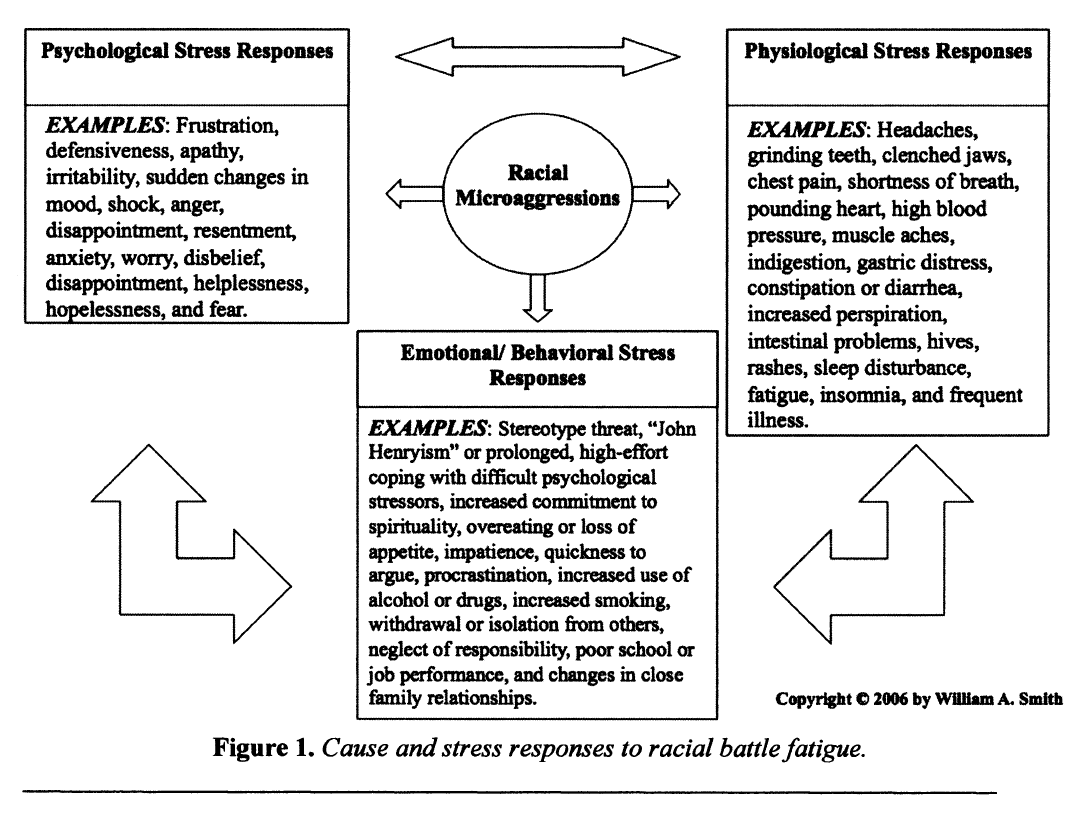
Smith, William A., et al. “Racial Battle Fatigue and the MisEducation of Black Men: Racial Microaggressions, Societal Problems, and Environmental Stress.” The Journal of Negro Education, vol. 80, no. 1, 2011, pp. 63–82.

Microaggressions cause physiological, psychological, and behavioral stress responses in racialized minorities. The twenty physiologically responses Smith records include headaches, hives, intestinal problems, and insomnia. Similarly, the sixteen psychological responses range from irritability to hopelessness. And the seventeen behavioral responses vary from overeating to procrastination.

In subsequent conversations, mi amiga mentioned suffering from headaches and insomnia. She told me that she struggled with frustration and feelings of helplessness. And wondered aloud why she’d grown impatient and struggled to do easy class assignments.

“Professor Cartagena, I feel like I’m falling apart. What’s wrong with me?”

“You’ve suffered greatly, hermana. And your body has kept the score.”      

Returning to Mi Amiga

Each time I spoke with mi amiga, a passage from James Baldwin’s “Uses of the Blues” came to mind. Reflecting on Black suffering, Baldwin writes:

You’ve seen these black men and women, these boys and girls; you’ve seen them on the streets. But I know what happened to them at the factory, at work, at home, on the subway, what they go through in a day, and the way they sort of ride with it. And it’s very, very tricky. It’s kind of a fantastic tightrope.…And I know that some improbable Wednesday, for no reason whatever, the elevator man or the doorman, the policeman or the landlord, or some little boy from the Bronx will say something, and it will be the wrong day to say it, the wrong moment to have it said to me; and God knows what will happen. I have seen it all, I have seen that much.

When mi amiga said, “Some days I feel like I’m gonna loose it…like I’m going to explode,” I thought, “I know what happened to you. I know what happened to me. I know what we go through in a day.” But I didn’t share these thoughts with her. I didn’t even recommend that she read Baldwin—at least not yet. Instead, I shared the words “microaggression” and “racial battle fatigue.” I offered her language that illuminated reality and empowered her to name her experience. Naming the causes of our festering wounds is an important step toward our healing.


About Dr. Nathan Luis Cartagena

A son of the US South (Mom) and Puerto Rico (Dad), Dr. Cartagena is an Assistant Professor of Philosophy at Wheaton College (IL), where he teaches courses on race, justice, and political philosophy, and is a fellow in The Wheaton Center for Early Christian Studies. He serves as the faculty advisor for Unidad Cristiana, a student group working to enhance Christian unity and celebrate Latina/o cultures, a scholar-in-residence for World Outspoken, and a co-host for the forthcoming podcast From the Underside. He’s also writing a book on Critical Race Theory with IVP Academic.

Articles like this one are made possible by the support of readers like you.

Donate today and help us continue to produce resources for the mestizo church.

Give Today

Is your Bible Anti-Black? Pt. 2

Editors Note: Throughout this essay, “black” and “white” refers to the colors, while “Black” and “White” refer to historic racialized communities.

שְׁחוֹרָ֤ה אֲנִי֙ וְֽנָאוָ֔ה בְּנ֖וֹת יְרֽוּשָׁלָ֑יִם כְּאָֽהֳלֵ֣י קֵדָ֔ר

כִּֽירִיע֖וֹת שְׁלֹמֹֽה

אַל־תִּרְאֻ֨נִי֙ שֶֽׁאֲנִ֣י שְׁחַרְחֹ֔רֶת שֶׁשְּׁזָפַ֖תְנִי הַשָּׁ֑מֶשׁ בְּנֵ֧י אִמִּ֣י נִֽחֲרוּ־בִ֗י שָׂמֻ֨נִי֙ נֹֽטֵרָ֣ה אֶת־הַכְּרָמִ֔ים כַּרְמִ֥י שֶׁלִּ֖י לֹ֥א נָטָֽרְתִּי

—Song of Songs 1:5-6


This is essay two of two for the mini-series “Is Your Bible Anti-Black.” In the first essay, I engaged renowned Old Testament scholar Wilda Gafney’s critique of how the King James Version renders Song of Solomon 1:5. Whereas the original Hebrew literally reads “black am I and beautiful,” the KJV’s translators choose to write “I am black, but comely [beautiful].” Reflecting on this glaring difference, Gafney argues that the KJV’s translators “could not see blackness as beautiful, and so their whole identity [as self-identified white men] went into that one conjunction saying, ‘in spite of being Black, she’s all right.’ But that is not what the text said. And so that was the first place where I understood that people make choices when they translate [the Bible], and those choices affect what we hear [from the text].” The KJV’s rendering is wrong, Gafney contends, and layers anti-Black racist ideas onto the biblical page. Accepting Gafney’s argument, I extended her work by detailing the KJV’s cultural and racial context and noting how modern versions compare to it.

In this essay, I return to Song of Solomon to offer an interpretation of verses five and six. I again think with Dra. Gafney, following her lead as I listen to this ancient Song’s textual rhythms. Join us.

Setting the Stage: Song of Solomon 1:1-4

Song of Solomon shocks its readers. Whereas the song never explicitly mentions God, it repeatedly and exuberantly details human love. And this is not the love of mere friends. As Gafney observes, the text focuses on “the love of two people expressed sensuously, sexually.” More specifically, the song celebrates “the love of and between two black bodies—offered as scripture and revelation.”

The first black body the song introduces is the text’s lead woman. She is the focus of our passage and essay. And she immediately makes her romantic desires known.

May he kiss me with the kisses of his mouth!
For your love is sweeter than wine.

Your oils have a pleasing fragrance,
Your name is like purified oil;
Therefore the young women love you.
 Draw me after you and let’s run together!
The king has brought me into his chambers. (NASB, vv. 2-4)

Intoxicating kisses, fragrant oils, an alluring name, romantic flight, and a royal bed chamber—these are the Song’s opening themes.

The beloved declares her ballad publicly. She does not conceal her sensuous love. For immediately after we read her love song, an enthusiastic, supportive chorus enters the text, greeting us and the beloved with a celebration of her imminent sexual union.

We will rejoice in you and be joyful;
We will praise your love more than wine.
Rightly do they love you. (NASB, v. 4)

All are joyful. All rejoice. All celebrate a woman’s sensuality and sexuality. All are elated about the beloved’s foreshadowed lovemaking with her beloved.

A Beautiful Black Woman: Song of Solomon 1:5

This women that the chorus celebrates as rightly loved, what does she look like? Verse five tells us.

I am black and beautiful,
You daughters of Jerusalem,
Like the tents of Kedar,
Like the curtains of Solomon. (NASB, v. 5)

As noted above, the Hebrew text literally reads “black am I and beautiful” (שְׁחוֹרָ֤ה אֲנִי֙ וְֽנָאוָ֔ה). The order matters. As Gafney writes, the verse “emphasizes [the woman’s] blackness by opening with it.” Gafney makes a related point elsewhere: When describing the woman—the one her beloved declares the “most beautiful among women” (v.8)— “[b]lack is the first word.”

Like her beloved, the Song’s lead woman champions that black is beautiful. “I am black and beautiful.” The word “and” translates the text’s vav conjunction וְֽ at the start of וְֽנָאוָ֔ה. This basic conjunction stresses blackness’s inherent beauty. Indeed, Rabbi Marcia Falk’s translation conveys the text’s tone: “Yes, I am black! And radiant/O city women watching me.”

The Song’s lead women again highlights her blackness in verse five by comparing it to the tents of Kedar, or Qedar, and Solomon’s curtains. This analogy, Gafney notes, reveals that the women’s body “is blacker than your average brown-to-black ancient Afro-Asiatic person.” The reference to Qedar tells readers that the woman “is black as a black-haired goat.” As Gafney explains, the Song’s woman is “as black as the black goats’ hair tents woven from the famed goats of Qedar renowned for their beautiful black coats in antiquity.” Gafney’s use of “renowned” is important. As Old Testament scholar Aubrey Buster notes, the Qedar’s tents and Solomon’s curtains “were considered to be striking and beautiful” in the woman’s culture. Hence, the Song’s lead woman affirms that her blackness is strikingly beautiful, worthy of renown and communal adulation like Qeadar’s tents and Solomon’s curtains. Thus, verse five starts and ends by emphasizing the woman’s beautiful black body.

Many commentators and translators miss verse five’s celebration of blackness. Gafney laments this trend among translators:

[A] myriad of bible translators continuing into modernity persist with “I am black/dark but beautiful/comely/lovely.” Blackness and beauty cannot occupy the same space in the imaginations so they cannot occupy the same space in their translations, no matter what the text actually says. (emphasis added)

Numerous translators render verse five’s opening vav conjunction “but,” not “and.” This interpretive choice injects an aesthetic distance between blackness and beauty. Nothing in verse five requires this distance. Moreover, and more important: the conjunctive-vav’s common “and” meaning and the positive, culturally loaded invocations of beautiful black goats, tents, and curtains provide immediate linguistic and contextual grounds against this disjunctive, distancing reading.

One respected Old Testament scholar overlooks the previous two points. Tremper Longman argues that readers face a choice at verse five: “Should we translate the waw as a conjunctive ‘and’ or a disjunctive ‘but”?” For Longman, the answer is simple. “The context is actually quite clear. She is not happy with her darker-than-normal skin, so the disjunctive makes sense.” The contrast between Longman’s reading and those of Gafney and Falk is striking. So is Longman’s silence about the rest of verse five. He says nothing about Qeadar’s tents and Solomon’s curtains. It’s as if they weren’t there.

Gafney, Buster, and Falk read verse five as celebrating blackness and its beauty. Longman reads it as lamenting “darker-than-normal skin.” If verse five doesn’t’ drive Longman’s interpretive decision and commentary, what does? His reading of verse six.

Sun Gazed: Song of Solomon 1:6

Desire and joy fill verses two through five. A choir praises the woman after her opening declaration of longing to be with her beloved. Then the woman celebrates her blackness. She is black and beautiful like Qeadar’s famous tents and Solomon’s splendid curtains. Given the prevalence of parallelism in Hebrew songs and poetry, we might expect the chorus to support the woman’s celebration of blackness with their own hymn of praise. But the text doesn’t meet this expectation. Instead, it introduces the Song’s first rebuke.

The translation I’ve used throughout renders verse six thus:  

Do not stare at me because I am dark,
For the sun has tanned me.
My mother’s sons were angry with me;
They made me caretaker of the vineyards,
But I have not taken care of my own vineyard. (NASB, emphasis in translation)

This translation doubly obscures verse six’s first sentence. The word translated “dark” carries the connotation of “black” from verse five. Likewise, the sentence contrasts people’s staring/looking with the sun’s staring/looking. The KJV captures both details: “Look not upon me, because I am black, because the sun hath looked upon me.” Still, the word “stare” better expresses the Hebrew meaning involved in the woman’s rebuke-saturated command to the daughters of Jerusalem. Gafney writes, “It seems the city-women can’t keep their eyes off of her. They keep staring, looking her up and down.” These stares aim to pierce, penetrate, and judge. Again Gafney:

The shout out to the daughters of Jerusalem is an acknowledgement that our bodies are always under scrutiny. We are weighed and measured, consumed and labeled acceptable or defective in a glance. The black beauty Shahorah—we can call her Ebony, Raven, Jet or Onyx—Shahorah says you call me black like that’s an insult. Let me tell you, I am black, as silky-black as the luxurious coat of a Kedari goat, like mink, only blacker.

The Song’s lead woman told the daughters of Jerusalem that she was black and beautiful in verse five. Now she tells them, Gafney writes, “don’t stare at me because my beautiful black skin has gotten even darker while I bask in the sun.”

The sun gazed upon the Song’s black woman and made her darker, gave her a tan. Some modern readers assume that the text’s implied talk of tanning entails that the Song’s lead woman is but a white woman with a tan. This reading projects a white normative gaze onto the text and ignores verse five’s repeated discussion of rich blackness. It also elides the truth that black-skinned people tan. Gafney discusses personally suffering this elision.

I am regularly asked to give an account of my presumptively alternate biology, imagined to be fundamentally different from the interrogator’s own normative experience of being human.

“Can you tan?”

“Do you burn?”

I am expected to answer when questioned. To explain myself and my race. Public access to my body is unquestioned.

And deeply entangled with the notion of otherness is the notion of beauty.

The false assumption that Black people don’t tan which regularly confronts Gafney also occupies a place in study bibles. As Gafney recalls, “Some say...doesn’t verse 6 say that she is sunburned, therefore, she can’t be black – that’s what the notes in my study bible says.” For some readers, “being black and sunburned [is] impossible, as impossible as being black and beautiful” (emphasis in original). Even Tremper Longman joins Gafney in rejecting the assumption that the Song’s lead female is a tanned or sunburned white woman. “The woman was Semitic and likely had a dark complexion to start with. The darkness about which she complains is not her natural skin color but a tan or burn.”

Yet the differences between Longman’s and Gafney’s readings remain sharp. Longman says that the woman “likely had a dark complexion to start with.” Gafney, following verse five’s emphasis on the woman’s blackness, highlights that the woman was black and “revels in the blackness of her skin.” Longman says that the woman “complains” about her “tan or burn.” Though Gafney acknowledges that “the woman in the text ruined her beautiful black Qedari complexion with a sunburn,” Gafney never says that the woman complains about her sunburn. Instead, Gafney says that the woman “embraces the kiss of the sun” while denouncing the Jerusalem women’s glares and how her family treated her. The women’s glares are “reminder[s] that everyone won’t look at [black skinned people] and see the glory that God created.” These glares carry negative class associations with field labor. And her family’s mistreatment of her has left the Song’s lead woman unable to care for her own vineyard—for herself.

Let’s unpack the previous point. Verse six’s second half reads:

My mother’s sons were angry with me;
They made me caretaker of the vineyards,
But I have not taken care of my own vineyard. (NASB)

Though the woman claims her mother, she doesn’t claim her brothers. They are “my mother’s sons.” Similarly, although the woman says her mother’s sons were angry with her, she doesn’t explain why. The text doesn’t say she did anything wrong. It does, however, stress that these sons made her care for the vineyards. The joy of agency is missing; the cruelty of coercion is present instead.   

This is not the only time the Song’s lead woman describes her “brothers” controlling her body. In the Song’s final chapter, we read them saying:

We have a little sister,
And she has no breasts;
What shall we do for our sister
On the day when she is spoken for?

If she is a wall,
We will build on her a battlement of silver;
But if she is a door,
We will barricade her with planks of cedar. (NASB, 8:8-9)

In these verses, men alone speak. We do not hear the Song’s lead woman discussing her body. We do hear the men referring to the woman’s genitals as a “wall” (i.e., premarital chastity) and a “door,” a common Near Eastern image that alluded to a prostitute. As Gafney writes, the “brothers” work “to constrain and confine her.”

And this male coercion returns us to it’s first appearance in the song, verse six. For there we read that the lead woman has not cared for her own vineyard—her own body. Because her “brothers” forced her to labor outdoors, the sun burned her. It harmed her beautiful black body. And in act of resistance, the woman rebukes the Jerusalem’s daughters for trying to inflict similar pain by staring at her. She is black. She is beautiful. She is unashamed of herself and refuses to internalize negative class associations with field labor. And she is tending to her vineyard, she is loving her body and her beloved. “It is time,” Gafney writes, “to tend our own vines and their sweet, luscious, intoxicating fruit.”

Conclusion

Let’s consider one final contrast between Longman’s and Gafney’s readings. Longman argues that “In spite of some ambiguities, [Song of Song 1:5-6] is clear about two matters: (1) the woman considers her dark skin unattractive, and (2) her dark skin is not her natural skin color but rather the result of a tan.” Both claims run afoul of verse five’s celebration of blackness, which verse six never negates. Taken together, Gafney argues, these verses teach that “Black is beautiful. Blackness is beauty. Blackness is worshipful. All blackness is divine. It is the imprint of the holy darkly radiant God in whose image we are created.”


About Dr. Nathan Luis Cartagena

A son of the US South (Mom) and Puerto Rico (Dad), Dr. Cartagena is an Assistant Professor of Philosophy at Wheaton College (IL), where he teaches courses on race, justice, and political philosophy, and is a fellow in The Wheaton Center for Early Christian Studies. He serves as the faculty advisor for Unidad Cristiana, a student group working to enhance Christian unity and celebrate Latina/o cultures, a scholar-in-residence for World Outspoken, and a co-host for the forthcoming podcast From the Underside. He’s also writing a book on Critical Race Theory with IVP Academic.


Articles like this one are made possible by the support of readers like you.

Donate today and help us continue to produce resources for the mestizo church.

Donate Today

The Patriarchy and the PhD: What Female Faculty Experience in the Classroom

Written by J.N.T

He said he thought about killing me. He said it with serenity and certainty. You know the ways your voice might crack and quiver when delivering a shameful confession? His didn’t. It was as though the thought of killing me gave him peace. I smiled. I said, “good thing you didn’t,” and I giggled.

I was alone in a classroom with him. I was standing behind a mobile podium;

I can push it into him and make a run for it.

How many steps would it take me to get to the door?

I have heels on, what if I trip and fall while making a run for it?

Can I use my phone? No, it’s in my purse and not within reach.

I don’t want to die. I have a young son, and the tragic murder of his mother would scar him for life.

“God help me,” I prayed. I slowly removed my heels.   

None of the workshops, trainings, or educational resources I completed prepared me for this moment. I only knew that I was alone with a student who daydreamt about killing me, and I had to “diffuse” the situation. I pretended his words were insignificant, his shouting was normal, and his foul language was ordinary. My words to him were careful, soothing and endearing. Thirty minutes later, he thanked me for listening and walked out. 

It took my mind about twelve hours to register what had happened, and it did so in my sleep. I left that encounter feeling physically exhausted, but not much else. It was as though my brain couldn’t immediately process what had transpired, and it became numbed. Then, in the middle of the night, I dreamt that he came into my classroom and shot me dead. “It was just a dream,” I thought. A few hours later, as I walked into campus, my body started shaking and tears flooded my eyes. My body had finally woken up, and it was terrified.

Women face disproportionately more violence in the workplace as compared to men, and the vast majority of perpetrators are men[1]. This is, in part, due to unequal power relations that position men as the ones with the most power. Women that work in accommodation and food services, retail trade, manufacturing, health care, and social assistance are the most vulnerable to workplace harassment[2]. In most situations, there is a power imbalance where, not surprisingly, the individual with less power is often the victim and the individual with less power in our society tends to be female. This type of harassment that comes from the “top-down” is well-documented and well-researched.

Academic contrapower harassment (ACPH) is a term that I recently came across as I attempted to find solace in research after another male student became hostile, defiant, verbally aggressive, and threatening. According to the article Women Faculty Distressed: Descriptions and Consequences of Academic Contrapower Harassment (2016), ACPH “occurs when someone with seemingly less power in an educational setting (e.g., a student) harasses someone more powerful (e.g., a professor).” In this study, women faculty reported significantly higher levels of stress-related illness, anxiety, difficulty concentrating, and wanting to quit as a result of intimidation, bullying, and harassment from students.

Check, check, check and check.

As I was reading this article, I couldn’t help but notice that the findings resonated almost in identical form with my own experience. My trauma manifested itself through insomnia, low appetite, being hyperaware of my surroundings, and feeling tremendously anxious in the classroom. Violence has this effect on humans. It disturbs your mind, harms your wellbeing, destabilizes your sense of security and contaminates safe spaces.  

Chavella T. Pittman[3] found that women of color experienced significant defiance to their authority as well as threats and harassment from white male students. Although the term academic contrapower harassment suggests that women faculty hold all the power when compared to students, Pittman indicates that female educators of color experience their classrooms with power, as faculty members, and powerlessness, as women of color; meaning that in a patriarchal racist structure, white male students preserve and react to women faculty within the conferred power they possess in broader society. This too echoes my experience at a predominantly white institution (PWI). My student aggressors have all been white males. The students who have made intimidating comments, behaved defiantly in class and submitted appeals to contest a grading decision have all been white and have all been male. In a recent grade appeal request, submitted over Christmas break, a male student who failed to submit nineteen assignments and decided not to take the final exam, emailed me two weeks after the semester concluded, demanding an explanation as to why he failed the course. In his appeal he wrote that I was “non-responsive” to his emails, referring to the fact that I had not immediately responded to the email he wrote to me while I was on Christmas vacation.

Male students don’t often consciously target female professors; they are not telling themselves, “I can harass this professor because she’s a woman”. This behavior, not frequently displayed towards male authority figures, is a manifestation of their socialization. Their status as men has been symbolically and socially elevated to the extent that aggression towards any women seems acceptable, and this narrative is reinforced in Christian spaces. I worked in public institutions for seven years before being employed at a Christian university, and I experience significantly more harassment from evangelical male students. In The Making of Biblical Womanhood (2020), Beth Allison Barr explains that women’s subordination “became embedded in the heart of evangelical faith. To be a Christian woman was to be under the authority of men” (154). Many church traditions ban women from teaching, preaching, and mentoring male adults. I wasn’t raised in the church, so when a pastor at the first church I attended told me that I couldn’t teach Spanish to missionaries because there would be male students in that group, I laughed. I genuinely thought he was joking. My smile soon disappeared after I realized that he wasn’t trying to be funny, and that he preferred to send a group of English monolingual speakers to Latin America with no linguistic knowledge of the Spanish language than to submit his male congregants to the teachings of a woman – a woman with a Ph.D. and extensive pedagogical training. Many Christian students attend these kinds of churches, and these are the messages that have been instilled in them since childhood. It is not a coincidence that evangelical male students undermine their female professors and ground their aggressions in the evangelical faith. After all, “The greatest trick the devil ever pulled was convincing Christians that oppression is godly. That God ordained some people, simply because of their sex or skin color (or both), as belonging under the power of other people. That women’s subordination is central to the gospel of Christ” (Barr 173). 

Most recently, a student I repeatedly asked to leave the classroom, after he became verbally aggressive, assured me that I was just “being too emotional,” a phrase that seemed pulled directly from the How to be a Sexist Manual. These aggressions are, of course, psychologically disturbing, but they are also very time consuming. I wrote numerous emails, recounted the details of the encounter to several individuals across campus, and had at least six meetings. I spent approximately ten hours actively dealing with this incident, hours that were taken away from class preparation, grading, and research.

Studies have found that women of color faculty have heavier teaching loads compared to male and white female professors, are expected to engage in considerably more nurturing service responsibilities (Pittman 2010), and full-time female faculty earn $18,370 less yearly compared to their male counterparts[4]. Furthermore, research suggests that college students have an unconscious bias against female professors and faculty of color that is reflected on student evaluations. In a 2015 experiment published by the Innovative Higher Education journal,[5] students rated online professors with a male name significantly higher than those with female names, regardless of the actual identity of the professor. Students tend to comment on the personality, appearance and competence of female instructors to a much higher degree than that of their male teachers. Studies have also revealed that students rate white faculty more positively than faculty of color and believe that faculty of color are less credible (Reid 2010[6]; Hendrix 1998[7]). This poses a disadvantage to female professors of color because student evaluations are commonly taken into consideration for hiring, promotion, tenure, and other career opportunities, despite the overwhelming evidence of bias.

Many of the disparities that women of color face in academia and beyond remain unquestioned because they are normal practices of white-centered patriarchal organizations. The institution of higher education was built as a space for white men. Seventy-six percent of all faculty in institutions of higher education are white[8] and at Christian colleges this number is even higher – 83.8% (CCCU 2021). More strikingly, Latinas comprise only 3% of all university professors in the United States (NCES 2018). Universities claim to have a desire to diversify their faculty body, but seem unwilling to make institutional changes that create environments where all faculty can thrive and feel safe.

Academia is supposed to be a place driven by sound research and Christian academics should be concerned with engaging in scholarship that helps human beings flourish. When faculty members and administrators of faith are presented with convincing data, produced by a reputable study, that women are being disadvantaged and disrespected in the workplace, the next logical step is to inquire into what can be done to improve their experiences. However, this course of action is too rational and too unfavorable for patriarchal structures. I witnessed this phenomenon unfold when a group of researchers shared their findings of an institution’s gender climate study.  A white male immediately interjected and asked if these findings were truly representative of the female faculty experience at large. Then, a woman complained that her experience had not been included in the study and therefore, claimed that the findings were incomplete. The whole meeting was spent explaining the research methods used in the study and convincing certain people of the findings’ legitimacy. Actionable steps were not discussed. The study did not fit the ideals of patriarchy and as a result, it was dismissed.  

Women’s accounts are often disregarded, even when the research supports their claims. An absurd amount of time is spent questioning the veracity of their experiences to the point of exhaustion. Men are often not held accountable because women are not believed. In many instances, women prefer not to report workplace harassment because of the tiresome amount of time it will take for the claim to be considered and the fear of being alienated, fired or being blamed as the victim.[9]

“Why does this commonly happen to me?” I said aloud to a supervisor as I shared details of an encounter I had with a student who became threatening. In my heart I knew the answer, but I was seeking some empathy from a female leader. Her response shocked me: “Maybe it’s because you set boundaries.” She theorized that male students often turned violent towards me because I establish firm boundaries, do not let their misconduct go unnoticed and the result is that I escalate the situation. Following this explanation, I (the victim) had done something to provoke the student (aggressor). Victim blaming reinforces sexist notions that women are responsible for men’s violent actions. Admittedly, for a brief second, I entertained this thought. I’m aware of the literature that speaks about victim blaming as a product of patriarchy. I’ve counseled other women on many occasions not to blame themselves for the abuse that was inflicted on them, yet I entertained this notion, if even for a brief second. Why? People tend to be more accepting of these sexist rationales when given by people of authority. If a person that society regards as intelligent, wise, and ethical is making such claims, these statements become more compelling. Consequently, evangelical leaders (men and women) have a higher degree of responsibility to counsel women in ways that do not reinforce misogynistic notions that will retraumatize women. Also, it is often these individuals who have the authority to ensure that the abuser is held accountable.

I was told that the university had to ensure that the student who assaulted me was cared for, and that the institution embraced a non-punitive model of discipline. At this point, I was frustrated, and I replied, “That’s great. And how is the university caring for me? What consequences will this student face for his behavior? How is the university keeping him accountable and deterring him from committing further acts of aggression?” Accountability is not vengeance. Discipline is not assault. Caring for someone does not mean ignoring their wrongdoings. Spiritual language is often utilized as a method to reinforce male dominance and female culpability. Grace is code for “overlook what was done to you,” forgiveness signals “do not seek justice,” and compassion is equivalent to, “brush it off, they were just having a bad day.” The message: if you don’t overlook what was done to you, if you do seek justice and you refuse to just brush it off, then you are not graceful, forgiving or compassionate, so you must be a bad Christian woman.

Aggression against women extends to all spheres of society, and women of color bear the double burden of racism and sexism. Evangelical leaders – both men and women – commonly emphasize female submission and rigid gender roles. We must understand the harm that this messaging is causing in the lives of countless women and realize how this rhetoric is being used to inflict violence on women. Jesus empowered women; he did not come to this earth to “put them in their place,” treat them as inferior to men, or reinforce the gender inequality present in Jewish society. Jesus disrupted gendered expectations, and in so doing, showed the love of God to these women. There are many “sympathetic” leaders who simply shake their heads and cross their arms. They believe that Jesus holds both men and women in the same esteem, but this belief is not acted upon – it does not materialize. What value does a belief actually carry if it is not grounded in action? In my experience, the policies were inexistent, the process was unclear, and the consequences were vague. The policies that did exist were there to protect the “integrity” of the aggressor, rather than ensuring the safety of the victim. Accountability is crucial and institutions must also be held accountable for their inaction.

A female colleague told me, “I don’t have much power,” speaking as to why she had remained silent for so many years about her own experiences. It was the same woman that was now advocating for me. While many of us may not hold significant power in our respective spaces, we do hold collective power. This is an invitation to action. This is an invitation to utilize our collective voice. Por nosotras. Por nuestras hermanas.


Is Your Bible Anti-Black

Editors Note: Throughout this essay, “black” refers to the color while “Black” refers to the historic racialized community.

Our theology never comes from a blank space.”
— Elizabeth Conde-Frazier, Atando Cabos
The reclamation of racial beauty in the sixties stirred these thoughts, made me think about the necessity for the claim…Why did [Black beauty] need public articulation to exist?”
— Toni Morrison, The Bluest Eye

Christians are people of the Book, the library of sacred texts that we call the Bible. The Old and New Testaments contain the inspired word of God. They are, as the apostle Paul writes, God-breathed (2 Timothy 3:16). And so, they are “useful for teaching, rebuking, correcting, and training in righteousness.”

Yet none of these inspired texts was God-breathed through a modern language. Each was originally etched in Hebrew, Greek, or Aramaic—not Mandarin, Arabic, Portuguese, or Spanish. Unless you read the former ancient languages, you encounter the sacred page through the veil of translation.  

But even translators of the original biblical languages encounter scripture through a veil. What New Testament scholar C. René Padilla writes about interpreters applies to translators: “Interpreters do not live in a vacuum. They live in concrete historical situations, in particular cultures. From their cultures they derive not only their language but also patterns of thought and conduct, methods of learning, emotional reactions, values, interests and goals.” Translators are socially situated readers and interpreters. Their contexts and commitments—to say nothing of character—infuse their handling of Scripture. As Padilla argues, “whenever interpreters approach a particular biblical text they can do so only from their own perspective. This gives rise to a complex, dynamic two-way interpretive process depicted as a ‘hermeneutical circle’, in which interpreters and text are mutually engaged.”

Recognizing these dynamics, New Testament scholar Esau McCaulley calls for Bible publishers to hire multi-racialized and multi-ethnic translation teams. McCaulley writes:

I’ve discovered that people of color and women have rarely led or participated in Bible translation. On one hand, this doesn’t trouble me much. It is hard to mess up the story of the Exodus, distort the message of the prophets or dismantle the story of Jesus. It is all there in every English translation.

On the other, I believe it matters who translates the Bible, and that more diverse translation committees could inspire fresh confidence among Christians of color….

The insight, experience and skills of female scholars might open our eyes to nuances that a committee of all men might miss. Christians for whom English is a second language might highlight ways in which our word choice is unclear. Similarly, [B]lack Christians may call to mind neglected aspects of the text. 

McCaulley supports his call for diverse translation teams by considering English translations of Exodus 12:38, beginning with the King James Version. When Israel leaves Egypt, “a mixed multitude went up also with them” (KJV). McCaulley notes that “Nearly all scholars agree that the original Hebrew meant to highlight that an ethnically diverse group of people left Egypt with the Jewish people. This group could have included Egyptians and other ethnic groups, such as the Cushites.” So, whereas “The translation ‘mixed multitude’ isn’t necessarily wrong,” McCaulley argues, “It simply does not communicate the power of this simple verse in a way that would be understood by those reading today. If I were translating the passage, I would say that ‘an ethnically diverse crowd’ went up out of Egypt.”

McCaulley’s alternative translation is a mild corrective of the KJV. He does not deem it wrong nor unfit for its time. Instead, McCaulley argues that it and modern English translations that speak of a “mixed multitude” leaving Egypt (e.g., ESV) neglect linguistic frequencies that carry important conceptual and contextual insights for today’s English readers.

I affirm McCaulley’s call for racial, ethnic, and gender diversity in translation teams and his proposed alternative translation of Exodus 12. I’d like to extend both by arguing that anti-Black racist ideas have crept into English Bible translations. To see what I mean, let’s turn our attention to the King James’s translation of a verse in Song of Solomon.

Is Blackness Beautiful?

Song of Solomon begins on an exuberant note. After noting that it is the song of songs and belongs to Solomon, the song’s primary female figure professes her enthusiasm to be with her beloved.

Let him kiss me with the kisses of his mouth: for thy love is better than wine.

Because of the savour of thy good ointments thy name is as ointment poured forth, therefore do the virgins love thee.

Draw me, we will run after thee: the king hath brought me into his chambers…(vv. 2-4)

A supportive, enthusiastic chorus enters the text to celebrate this highly anticipated joining. “We will be glad and rejoice in thee, we will remember thy love more than wine: the upright love thee” (v. 4). All is right. All rejoice.

The text turns to the female’s first self-description. Here’s the original Hebrew, reading right to left:

שְׁחוֹרָ֤ה אֲנִי֙ וְֽנָאוָ֔ה בְּנ֖וֹת יְרוּשָׁלִָ֑ם כְּאָהֳלֵ֣י קֵדָ֔רכִּירִיע֖וֹת

Here’s how KJV reads: “I am black, but comely [beautiful], O ye daughters of Jerusalem, as the tents of Kedar, as the curtains of Solomon” (v. 5) Those who read Hebrew will recognize that the KJV has failed its readers.

The failure comes in verse five’s opening. The KJV’s translation team renders “שְׁחוֹרָ֤ה אֲנִי֙ וְֽנָאוָ֔ה” as “I am black, but comely [beautiful].” But as Old Testament scholar Wilda Gafney observes, this translation choice is grammatically impossible. The conjunction וְֽ at the start of וְֽנָאוָ֔ה means “and”—not “but.” Moreover, as Gafney argues, because there isn’t a “but” in Hebrew, authors writing in Hebrew must compile “a bunch of stuff to make a disjunction”; they can’t simply use a conjunction that means “and.”

Gafney realized these linguistic truths as a child. From a young age, she loved learning languages and desired a more direct relationship with the biblical text. As she compared the Hebrew and KJV, she saw “it was wrong in the King James Bible that I grew up with, where it said, ‘I am black but beautiful.’” This sparked a second realization:

The people translating [that passage] could not see blackness as beautiful, and so their whole identity [as self-identified white men] went into that one conjunction saying, ‘in spite of being Black, she’s all right.’ But that is not what the text said. And so that was the first place where I understood that people make choices when they translate [the Bible], and those choices affect what we hear [from the text].     

McCaulley’s alternative translation of Exodus 12:38 mildly corrects the KJV’s. Gafney’s alternative translation of Song of Solomon 1:5 is a damning corrective of the KJV. It highlights that the KJV’s rendering is wrong—and layers anti-Black racist ideas onto the biblical page.

The KJV’s Racial Context

Gafney claims that the KJV’s translation team injected their anti-Black sentiments into the KJV. For many, this claim is jarring. Congregations that use the KJV rarely discuss the translation’s racial context (or content). The same holds for academic treatments of the text. David Lyle Jeffery’s, Alister McGrath’s, and David Norton’s books on the KJV say nothing about the text’s racialized context (or content). None have an index entry on “race,” “whiteness,” or “white supremacy”—let alone a sustained discussion about the anti-Black translation of Song of Solomon 1:5. Though from different parts of the globe—Canada, Ireland, and England, respectively—none of these racialized white authors ensured their books addressed the KJV’s racial dimensions. What Gafney noticed as a youth, they overlook in their mature academic writing.

Given these ecclesiastical and scholarly omissions, a word about the KJV’s racial context is in order. Let us consider two aspects of this context: international anti-Blackness and anti-Blackness in contemporary English literature and theatre.

Starting in the fifteenth century, a racial scale that prioritized “whiteness” informed European imperialism. The first recorded slave auction makes this clear. Reflecting on the year 1444, Portugal’s royal chronicler Gomes Eanes de Azurara writes:

[On] the next day, which was the 8th of the month of August, very early in the morning, by reason of the heat, the seamen began to make ready their boats, and to take out those captives, and carry them on shore, as they were commanded. And these, placed all together in that field, were a marvelous sight; for amongst them were some white enough, fair to look upon, and well proportioned; others were less white like mulattoes; others again were as black as Ethiops [Ethiopians], and so ugly, both in features and in body, as almost to appear (to those who saw them) the images of a lower hemisphere.

All depicted are slaves; not all are equal. Some are “white,” and therefore “fair to look upon, and well proportioned.” Others are “less white like mulattoes,” and, apparently, deserve little discussion. Others still are “black,” and hence “ugly”—as if they had come from Hell itself. Here is a scale that advances white supremacy and anti-Blackness.

European colonizers repackaged and disseminated Azurara’s scale as they constructed pigmentocracies—governments for and by those deemed “white.” Historian C.R. Boxer notes that, although Portugal and Spain respectively granted mesticos and mestizos a positive colonial status, “both Iberian empires remained essentially a ‘pigmentocracy’ . . . based on the conviction of white racial, moral, and intellectual superiority—just as did their Dutch, English, and French successors.” Race scholar and sociologist Howard Winant similarly observes that these European colonial powers believed they were “the whites, the masters, the true Christians.” And historian Winthrop Jordan succinctly captures this trend among the British, highlighting that, during the seventeenth century, English colonists treated “Christian, free, English, and white” as metonyms. For them, each word was equivalent.

The racialized language Jordan details has antecedents in English literature that’s contemporary with the KJV, which was published in 1611. In 1578, the widely read English travel writer George Best offered a damning account of “the Ethiopians blacknesse.” While discussing his Artic voyage, Best argued that, because Ham had sex on the Ark, God cursed Ham and his descendants to be “so blacke and loathsome that it might remain a spectacle of disobedience to all the worlde.” Thus, Best championed a racialized curse theory which linked Blackness to ugliness and hypersexuality. Similar anti-Black ideas populate William Shakespeare’s plays.

The first Black character in Shakespeare’s plays is Aaron, the evil, deceptive, hypersexual, murderous Moor in Titus Andronicus (1594). The most famous Black character in Shakespeare’s plays is also a Moor: Othello (1604). Iago, Othello’s ensign, despises the Black Othello for marrying the White Desdemona. “For that I do suspect the lusty Moor/Hath leaped into my seat,” Iago claims. And while talking to Desdemona’s father, Iago says Othello is “an old black ram/…tupping your white ewe.” Iago later tricks Othello into believing that Desdemona has betrayed him. Before Othello kills Desdemona, he cries, “Her name that was fresh/as Dian’s visage, is now begrim’d and black/As mine own face.” After Othello learns that he unjustly killed his wife, Emilia, Desdemona’s maidservant, declares: “O! the more angel she. And you the blacker devil.” The Tempest’s (1611) Caliban also recapitulates the conceptual linking of Blackness and Satan that filled European theatre. Caliban is the bastard child of an African witch from a “vile race” and a demon. Caliban is also hypersexual.

Other English playwriters also employed anti-Black ideas and images. Ben Jonson’s The Masque of Blackness (1605) is especially important for our discussion. Commissioned by King James I, Jonson’s play was the most expensive production made in London. Premiering in the luxurious Whitehall Palace, the play is the story of twelve ugly African princesses of the river god Niger. The princesses learn that they can be “made beautiful” if they go to “Britannia,” for there the sun “beams shine day and night, and are of force/ To blanch [make white] an Æthiop, and revive a corpse.” White women, including Queen Anne, played the Black princesses. How? They used blackface.

White supremacy and anti-Blackness occupied a privileged place in European imperialism and English literature and theatre. Shakespeare and Jonson composed and presented plays that drew upon, shaped, and perpetuated anti-Black and pro-White English sentiments. These international and cultural realities were pillars of the KJV’s racial context. 

Returning to the Song of Solomon

The KJV’s anti-Black translation of Song of Solomon 1:5 reflected its cultural context. It also shaped other cultures around the globe and across the centuries. The U.S. is a case in point. As historian Mark Noll argues, the KJV was the U.S.’s national book in the nineteenth century. Biblical language and allusions filled U.S. public discourse, and “the vast majority of public Bible references came from a single translation”—the KJV. It was this translation that filled debates about the U.S.’s slavocracy and global racialized chattel slavery. Moreover, it was this translation that became a staple in African American congregations and homes. Recall that Wilda Gafney grew up on the KJV. So did Esau McCaulley.

I grew up in a [B]lack Baptist church that revered the King James Version (KJV). Whenever it was read aloud, the congregation rose to its feet. But the KJV was more than a book read on Sunday. It shaped the culture of Southern black Christianity. Its thees and thous permeated our parents’ extemporaneous prayers. It marked the rhetoric of our most powerful preachers.

McCaulley argues that his experiences are common for Black Christians in the North or South. “If Flannery O’Connor can say that the South is Christ-haunted, then we can say that [B]lack Christianity is haunted by King James.” We hear this haunting hum in James Baldwin’s and Toni Morrison’s books and essays.

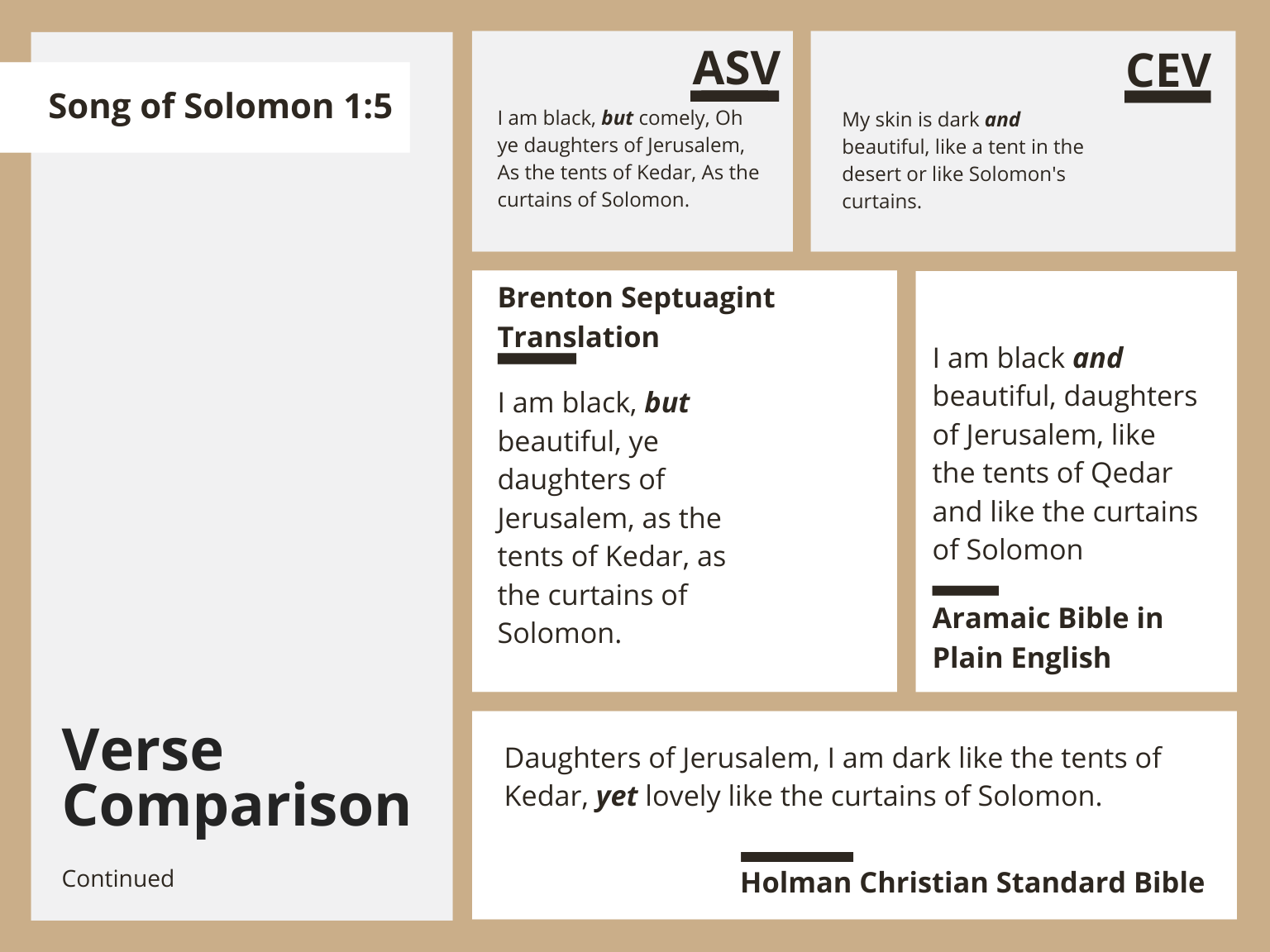
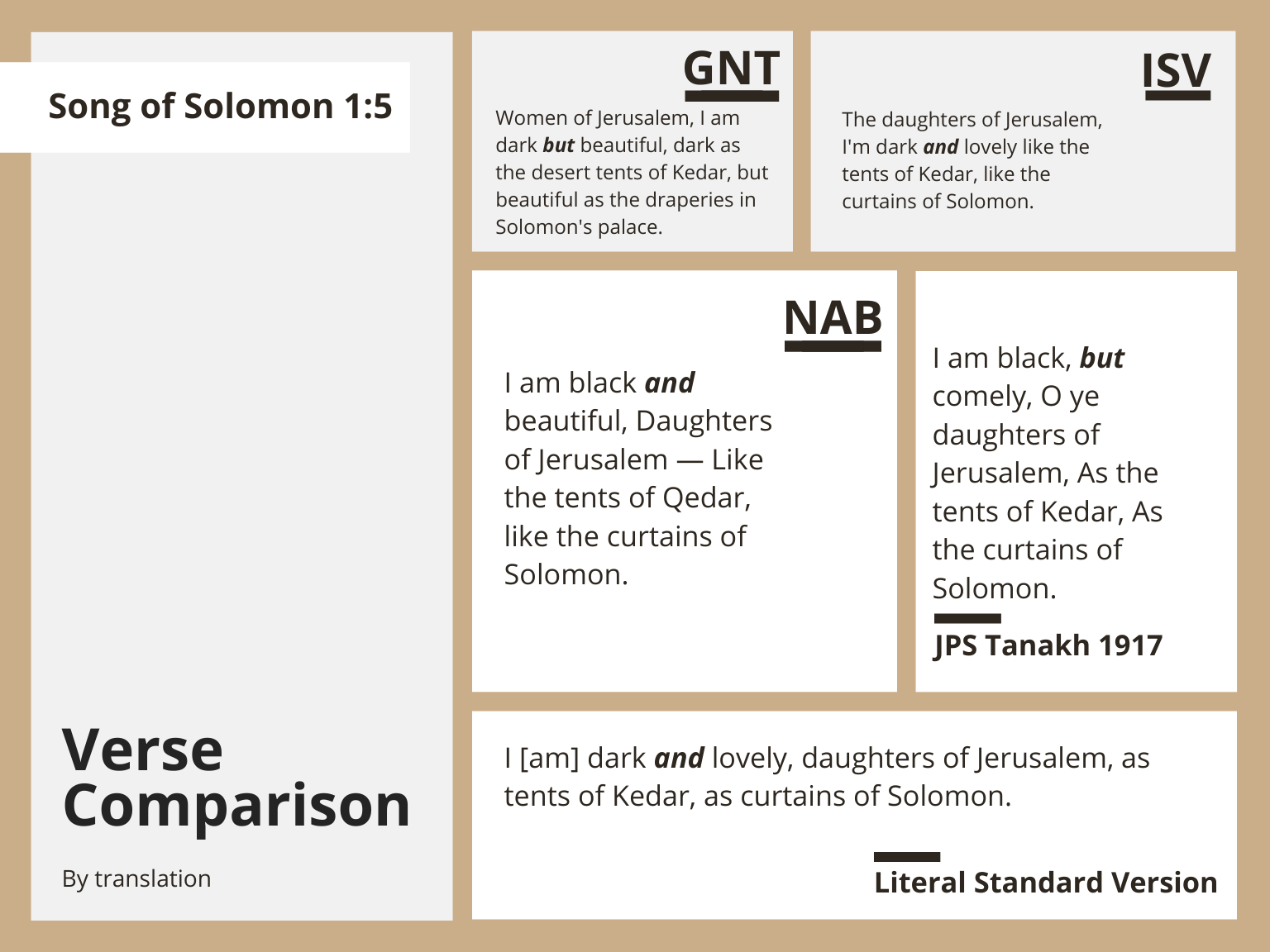
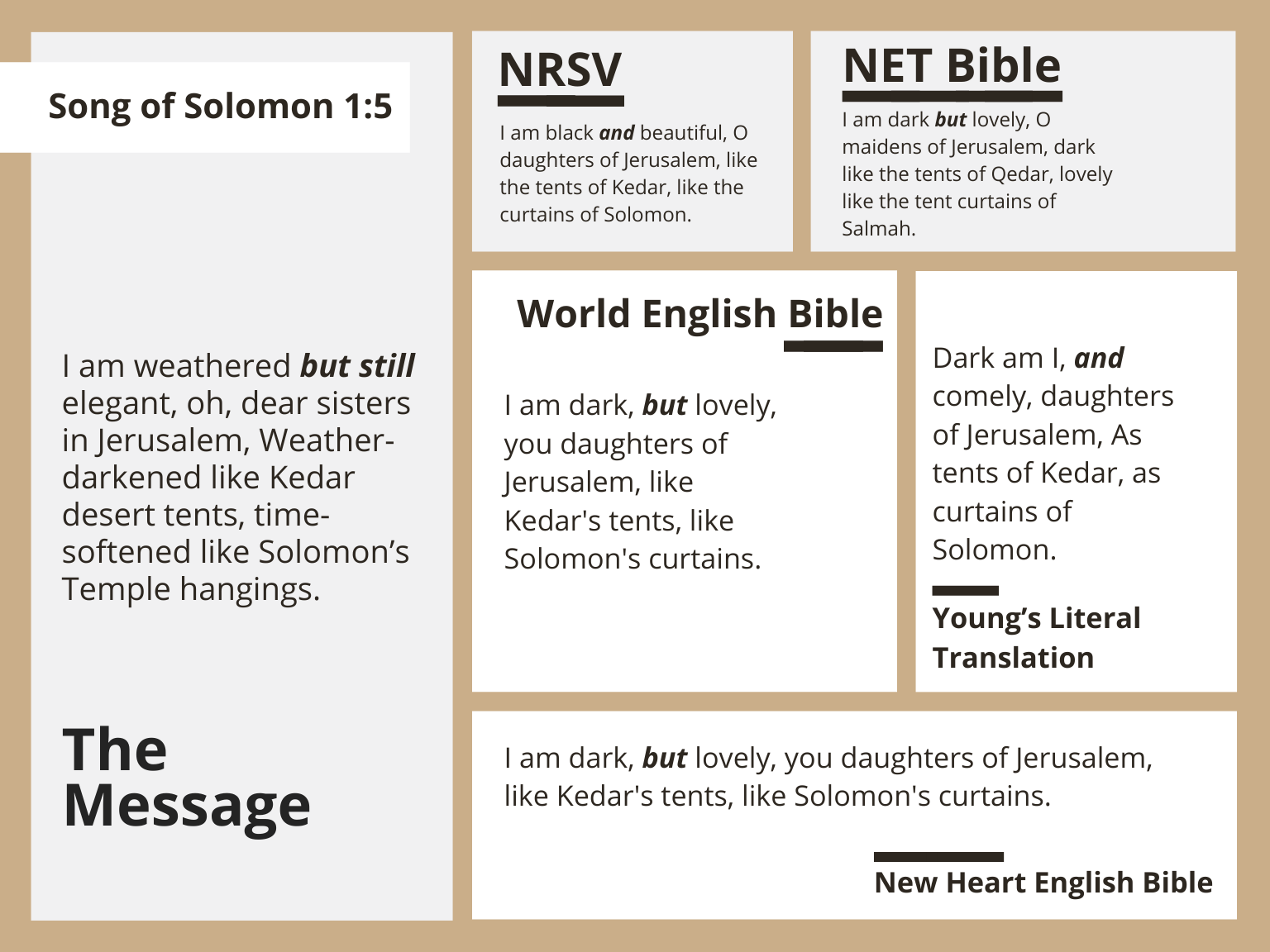
The KJV may also haunt modern English Bible translations of Song of Solomon 1:5. Consider these twenty-six translations (emphasis added):

Like the KJV, fourteen of the twenty-six versions offer a grammatically impossible translation with “but.” Four others offer a similarly impossible translation of “yet.” Only eight versions correctly translate the text’s “and.” Consequently, eighteen of these modern English translations—an arresting sixty-nine percent—give readers a wrong translation that perpetuates an anti-Black idea about beauty that the original Hebrew rejects. Thus sayeth the Lord, indeed.

Black is Beautiful

Biblical translations matter. They help or hinder our ability to encounter God and creation. They rebuff or retrench idolatry. They foster or fizzle love of self and neighbor. Song of Solomon teaches that black is beautiful. The Song’s primary female figure is beautiful and black. There is no contrasting conjunction here. Rightly encountering God and creation require seeing and feeling this truth. So does rebuffing the historic idolatry of whiteness. So does Black self-love and love of our Black neighbors. A diverse translation team populated by members with the lived experiences, communal ties, and interpretive skill of a Wilda Gafney would empower English Bible readers to experience and celebrate these God-breathed truths.


About Dr. Nathan Luis Cartagena

A son of the US South (Mom) and Puerto Rico (Dad), Dr. Cartagena is an Assistant Professor of Philosophy at Wheaton College (IL), where he teaches courses on race, justice, and political philosophy, and is a fellow in The Wheaton Center for Early Christian Studies. He serves as the faculty advisor for Unidad Cristiana, a student group working to enhance Christian unity and celebrate Latina/o cultures, a scholar-in-residence for World Outspoken, and a co-host for the forthcoming podcast From the Underside. He’s also writing a book on Critical Race Theory with IVP Academic.


Articles like this one are made possible by the support of readers like you.

Donate today and help us continue to produce resources for the mestizo church.

Donate

The Grace of Babel

Very few Latin@s in the Christian faith know the importance of small town Ruidoso, New Mexico. There, in a little hacienda in the late 80s, a group that would become some of the leading Latin@ voices in theology and biblical studies made a choice that changed the Brown Church for the next thirty years. The scholars gathered to imagine a new theological association for Latin@s. They discussed the challenges facing Latin@ immigrants to the US and the faith experiences of their people. Nestor Medina had the opportunity to interview Orlando O. Espín, a participant at this gathering, and he summarized the group’s decision by writing: “Aware of their differences and of the wrong perceptions they had of each other’s communities, they decided to downplay the differences that divided them and instead emphasize the suffering and marginalization they had in common” (emphasis added).

Downplay the differences. Emphasize the common struggle. This became the standard style for Latin@ theology in the US. To downplay the differences, the group of scholars adopted mestizaje as a central hermeneutic for understanding Latin@ identity and experience. Three decades later, theologians are asking if flattening the differences between Latin@s made certain struggles – like that of Afro-Latin immigrants who face the “double punishment” of anti-immigrant and anti-black bias – more difficult to overcome. By disaggregating the category “Latinos,” these younger academics reveal the greater challenges facing Latin@s made invisible by the homogenizing work of the past. Many today argue for a dispersion of Latin@s into smaller, specific designations rather than larger monolithic categories. Perhaps it can be said that Latin@s need the scattering of Babel. It’s time we speak in different languages.

For many, the Tower of Babel is a story of curse and punishment. The people in the story gathered to build a city and a tower to reach the heavens. After reviewing their project, the Lord thwarted their work by changing their tongues. Unable to speak to one another, the people scattered across the earth. It is common for this reading of Genesis 11 to be accompanied with a reading of Pentecost (Acts 2) as the reversal of Babel. In Genesis, God cursed the people into language diversity; in Acts 2, the Holy Spirit makes people understand one another. Several biblical scholars have challenged this reading of Babel and Pentecost, and it is important to reconsider these stories in light of the question of Latinidad. How are Latin@s one together? Must our oneness equal sameness? Must we focus only on our commonalities while ignoring our differences? How might a rereading of these stories provide a new biblical vision?

Eric Barreto points to the particulars of Acts 2 to note the disconnect between it and Babel. If God intended to reverse a curse, would God not have caused the people to speak the same language? Instead, the Holy Spirit causes those diverse speakers to hear and understand the good news in their own tongue. Language diversity remains intact. Therefore, it seems unlikely that God intended language diversity as a punishment, and the Holy Spirit does not appear to be undoing such diversity. If Acts 2 honors the diversity of languages, how does that change the way we read Genesis 11?

Pablo R. Andiñach proposes that we read the story of the Tower of Babel as an anti-imperialist story. He observes in the story an ironic use of the name Babel that relies on similarities in different languages. In Akkadian, the city is named Bab-il, which means the “door of God.” This was the short form of the full word, babilani¸ “the door of the gods.” A careful reading of Genesis 11 notes the motivation credited to the builders of the city. They wanted to make a name for themselves (v. 4). These builders, says Andiñach, were attempting to establish their supremacy by declaring their city as the gateway to the gods. Their city was to be the city, and their empire was to be endorsed by the gods connected there. It was their intention to establish this city as the seat of power. Already, Genesis 11 foreshadows the hegemonic vision of domination embedded in Babylon. The Hebrew writers mock this city when they write that God scattered the builders, and it is for this reason the place is now named Babel (Hebrew: confusion). God renames. God does not choose Babylon, nor does God permit the imperialists to absorb all peoples into their kingdom. The empire has been confused, scattered, left in disarray. What does this mean for language diversity?

Destroy, O Lord, divide their tongues; for I see violence and strife in the city.
— Psalm 55:9

Andiñach argues that language control, like the naming of a place, city, or people, is tied to power. Babylon is the biblical name for the empire, one which Israel would later enter as prisoners of war. The Israelites would one day be forced to speak the language of the empire, forced to live under the cultural hegemony of its oppressors. Genesis 11 is a foreshadow of God’s intention for Babylon. God condemns Babylon’s supremacy claims. God scatters the empire, and in doing so, God privileges those the Babylonians would eventually oppress. The story indicates God’s intention for the world. God does not want monolithic absorption into the empire’s ways of being. Instead, God forced the peoples back out to continue to fill the earth with teaming and flourishing. Language diversity is what God intended for the world. Babel was dismantled because it threatened God’s intended order. The rest of the Hebrew Bible cyclically shows God destroying Babylonian echoes; wherever monolithic violence is the dominant form of being, God dismantles it.

We must be cautious about how we judge the Latin@s of the past as they faced the empire’s monolithic violence. In the 1960s, 70s, and 80s, the US was operating an assimilationist vision for racialized minorities. This vision dates back even further to the early 1900s, as Daniel Burnham and other prominent city planners imagined field houses where immigrants would be taught the “American way of life.” These field houses would also host language classes, and it was Burnham’s vision that immigrants be required to attend these classes. This vision didn’t fully materialize in Chicago, Burnham’s city, but the spirit of this planning continued in similar political programs. The goal was to produce one way of being, according to the logics and visions of white leaders in power. In the face of assimilation programs like these, the scholars of the past resisted by naming themselves and honoring their own traditions and cultures. The protection of identity and culture is, in part, what drove the Latin@ scholars meeting in Ruidoso to collaborate. To understand their decisions, they must be reviewed against the Babylonian operations of the US.

Latin@s and Asian Americans

As mentioned earlier, the hacienda meeting is the origin of mestizaje as a significant theological tool for Latin@s in the US. Those present chose to use Virgilio Elizondo’s work as a central hermeneutic for understanding the Latin@ experience. To this day, mestizaje remains the dominant way of understanding Latin@ identity. We are the mixed people of the borderlands. Those who are ni de aquí, ni de allá (not from here or there). We are, according to the logic of mestizaje, neither white nor black; we are “brown.” Mestizaje presented the possibility to speak of our in-betweenness. The usefulness of the identity marker was its gathering power. Latin@ theologians from Cuba, Mexico, the US, and Puerto Rico could now speak as one “mestizo” people. They could live under one name.

This decision is not strange for its time. In the late 60s, student activists in California went on strike for an ethnic studies curriculum. In an interview for Asian Americans Generation Rising, Penny Nakatsu says she heard the term “Asian American” for the first time in 1968 while attending these strikes. The 60s and 70s were a time of coalition building, of gathering people from diverse nationalities under a single name. With their larger numbers this group could apply political pressure to get their needs met. Like the Latin@ theologians, Asian American students were most concerned about the shared suffering and marginalization of their peoples. They gathered to resist a common oppressive regime.

In 2021, Asian American, Latina/o, Hispanic, and other similar designators are contested by politically active students and scholars who share the motivations of their counterparts in the 60s and 80s. Today’s activists use a greater diversity of identifiers with the expressed desire of advocacy for unseen groups. This commitment is an echo of the past, but many in this younger generation believe the terms of the past are too homogenizing. Too monolithic. Among Latin@s, some even accuse the scholars of the past of essentializing the Latin@ identity. Essentialism is the inflection point. Yet the turn to more specific identities may not solve the essentialism problem. In a video about the erasure of black Latinas from reggaeton music videos, La Gata suggests we reinstate the brown paper bag test to ensure sufficiently dark Afro-Latinas are cast; Afro-Latinas with the potential to “pass” are her concern. In a desire to do justice, she risks essentializing Afro-Latinidad around the boundaries of pigment.

Missed in the tension between generations is the origin of the essentializing/naming problem. The marginalization of distinct groups in the 60s, which demanded a gathering response, and today’s homogenizing of minorities into a single “othered” group, which demands a scattering response, are both operations of white supremacy. These machinations are part of what Emilie Townes refers to as the fantastic hegemonic imagination of the US. “The fantastic hegemonic imagination traffics in peoples’ lives that are caricatured or pillaged so that the imagination that creates the fantastic can control the world in its own image.” The fantastic is not limited to works of art, marketing, or media. Townes argues that images of and about minoritized peoples shape the very fabric of the everyday. Yolanda M. Lopez reveals this most vividly in her 1994 art installation The Nanny, from the Women’s Work is Never Done series, in which she sets the uniform of a nanny, often worn by Latinas, between two marketing posters depicting white women exploiting Latinas. The marketing, in this case a tourism ad and a wool fabric promotion from Vogue magazine, continues to perpetuate an imagination that negatively shapes material conditions for the most abject.

Artworks like The Nanny demonstrate what Townes calls the cultural production of evil. The ads, uniform, and other elements of the installation demonstrate the way little everyday things perpetuate evil imaginings of minoritized peoples; they maintain the fantastic hegemonic imagination. The ubiquity of things that perpetuate this imagination ensures that everyone internalizes it. Townes again: “It is found in the privileged and the oppressed. It is no respecter of race, ethnicity, nationality, or color. It is not bound by gender or sexual orientation. It can be found in the old and the young. None of us naturally escape it, for it is found in the deep cultural codings we live with and through in US society” (emphasis added). How, then, do we avoid the cultural production of evil that consistently marginalizes whole collections of diverse peoples? How do we resist the fantastic hegemonic imagination and its tendency to group, name, and define people according to its own image? How do the generations work together to resist the empire?

ESSENTIALISM AND WEST SIDE STORY

In the 60s, when Latin@ scholars chose to live under a single name, they did so to gain greater political power within a system that ignored them unless they assimilated. The system, however, turned their gathering efforts into a tool in the fantastic hegemonic imagination, and it was used to perpetuate visions of Latinidad that further marginalized the people it named. This is perhaps most evident today in Spielberg’s recent remake of West Side Story. During a recent panel discussion with leading Puerto Rican scholars, Grammy-nominee Bobby Sanabria shared about his involvement on an advisory board that consulted Spielberg, Tony Kushner, and their team on the cultural issues to consider for their remake. Sanabria explained that the original film resonated with him personally because he remembered having to join a Puerto Rican gang in the 50s “to protect ourselves from the white gangs that didn’t ‘dig us’ too much…” He continued, “it’s a reality that happened and is still a reality today.” Brian Eugenio Herrera, another panelist, pushed back, noting that the reality of gangs was and is certainly true, but the impact of West Side Story is that it filled the US imagination with images of Caribbean Latin@s as criminal gang members.

The image produced by the film is not of gang life as self-defense but rather gang life as violent criminality. Over the 60 year period since the release of the original film, young Afro-Latinos have resisted this perception. What had been impactful for Sanabria was poison for the next generation. The problem, as explained by Herrera, was the development of an aesthetic archetype, a permanent caricature of what it means to be Puerto Rican. The film may have portrayed something specific to its time, but this image became the universal, essential description of Latino youth even beyond Puerto Ricans. With the release of this remake, the question of essentialism returns to the fore.

RESISTING THE AESTHETIC ESSENTIALISM OF BABYLON

The debate about West Side Story runs along the grain of the generational tensions already described here. An older generation praises the film; a younger generation resists it. Some within the older generation perceive positive power in it. A younger generation feels debilitated by it. Herrera rightly notes that the film, like the scholars of Ruidoso, set the style for what it means to represent Latin@ people. The scholars of the hacienda in Ruidoso also set the theological style for Latin@s, adopting mestizaje as their tool to downplay their differences. To resist the empire today, however, perhaps what we need to do is release the hegemonic controls of style and aesthetic. Again, we need the grace of Babel and the affirmation of Pentecost.

Victor Anderson, Professor of the Program in African American and Diaspora Studies and Religious Studies at Vanderbilt Divinity School, observes a similar generational tension in the work of his black students. According to Anderson, students continue to ask questions he thought were resolved by the previous generation of scholars. Questions like, “What makes one black? Must black scholarship be political? Are black films, literature, and arts anything produced by a black person? To what extent may black scholars embrace multiculturalism as a mode of difference and remain distinctively black? Is not there something about being black that is shared with no other race?” These questions echo contemporary questions about Afro-Latinidad and Latin@s more generally.

Instead of essentialized styles that restrict the identity to one form, Anderson proposes that black scholars conceive their work as expressions of the manifold manifestations of blackness. For Anderson, blackness should be understood as an “unfinished state” and a “complex subjectivity.” By unfinished state, Anderson is suggesting that the final, definitive word on black identity remains unsaid. Each new generation contributes to the shape and formation of black identity; they add another manifestation to the manifold. Complex subjectivity is an acknowledgement that each person within a group is multi-site, connected to other worlds that shape their identity. As Emilie Townes puts it: “we do not live in a seamless society. We live in many communities – often simultaneously.” Together, the ideas of these scholars point to a post-Babel world that affirms the desires of both generations and opens to a diversity of peoples.

The story of Babel and Pentecost reflect God’s affirmation of a diversity of peoples. Again, Babel is not a curse into diversity, nor is Pentecost a reversal into homogeneity. In both stories, God affirms the minoritized other and does so in contrast to the empire. (Pentecost serves as an early encounter between the Church and Rome.) How do we reconcile the two generations and avoid the essentializing tendency of Babylon? There are at least three lessons presented by the scholars discussed here.

1)    Resist the fantastic hegemonic imagination inside us

Emilie Townes stressed the real possibility that the hegemonic imagination can be internalized. This is just as true for the older generation as it is for the younger. Is it possible that the older generation failed to see the inherent essentialism in their advocacy? Yes, of course. However, to critique them without acknowledging the ways they resisted hegemonic forces of assimilation in their own day is to reduce their story. Is it possible that contemporary discussions about Afro-Latinidad risk essentializing blackness in Latin@ communities? Again, yes. But, to ignore the ways black experience was made invisible since mestizaje became an archetype would align us with the empire’s tendency to erase and assimilate. All peoples are non-innocent regarding the empire. To remember the Latin@ story in detail, that is part of our resistance. To acknowledge what inspired students in California to adopt “Asian American,” to remember why Latin@s adopted mestizaje, to remember why their differences were less important than their shared struggle, this is what’s required if we are to collaborate against the empire’s operations.

2)    Celebrate “Complex Subjectivity” as the grace post-Babel

While trying to explain her womanist theo-ethics, Emilie Townes writes, “life and wholeness (the dismantling of evil/the search for and celebration of freedom) is found in our individual interactions with our communities and the social worlds, peoples, and life beyond our immediate terrains.” The point is that diversity does not equal a society without seams. Diverse communities, however distinct, continue to have points of intersection. And, as Townes says so well, wholeness demands we work within our distinct group and with others beyond our tribe. We can delight in and celebrate the gift of Babel, the gift of diversity in language and peoples, while still connecting along the seams of connection. To say it differently, we can now celebrate the differences instead of downplaying them. This celebration should parallel our continued work against our common struggle. Celebrate difference. Resist the common struggle. That should be the formula going forward.

3)    Work in the Everyday (lo cotidiano)

For Latin@ and Black scholars, the everyday is the location for resistance. The artwork of Yolanda M. Lopez reminds us that the fantastic hegemonic imagination of the empire produces everyday objects of evil. So, our resistance must also operate in the everyday. Everyday we must be attuned to the ways our imagination is being shaped, and everyday we have an opportunity to make otherwise worlds. As non-innocent, complex subjects who live together in the grace of God’s work in Babel and Pentecost, we can create virtuous cycles of cultural production that set people free to live into their language and identity. Everyday arts, everyday products, everyday words can liberate people from the monolith. Everyday rituals can point people to the Word that judges Babylon and sets its captives free to testify of His goodness in their tongue and tribe.

About Emanuel (Ricky) Padilla

Emanuel Padilla is president of World Outspoken, a ministry preparing the mestizo church for cultural change. Emanuel is committed to serving bi-cultural Christians facing questions of identity, culture, and theology. He also serves at The Brook, a church on the northwest side of Chicago, along with his wife Kelly.

Follow him on Twitter to learn more.


Articles like this one are made possible by the support of readers like you.

Donate today and help us continue to produce resources for the mestizo church.

Donate

Seeing Jesus in the Invisible

“Then the righteous will answer him, ‘Lord, when did we see you hungry and feed you, or thirsty and give you something to drink? When did we see you a stranger and invite you in, or needing clothes and clothe you? When did we see you sick or in prison and go to visit you?’
“The King will reply, ‘Truly I tell you, whatever you did for one of the least of these brothers and sisters of mine, you did for me.’
— (Matthew 25:37-40)

Mamaw’s Cry

Tears filled my eyes as I put my bed away.

I was visiting Mamaw and Grandpa in their nineteen-foot RV. They slept in the lone bedroom. I slept on the living-room couch, an arm’s length away from the front door and rear kitchen. Medicine bottles, heating pads, braces, and canes filled the cramped space. A walker and set of handheld massagers lined the wall. Mamaw and Grandpa had accumulated this stockpile over the years, hoping each would alleviate some of Mamaw’s chronic pains. Some days they helped. Other days Mamaw’s suffering rendered them useless. None of these resources could dampen her searing pain.

Two thin doors and a miniature bathroom separated my room from the bedroom. Even collectively they could not contain the shriek of agony that jolted me awake. Mamaw was screaming. Extreme pain in her neck and back thrusted her into consciousness. Any movement proved excruciating. The emerging sunlight made matters worse. I heard Grandpa draw the blinds as Mamaw yelled, “Bill, close them—I can’t take it!!” Like the blinds, Mamaw stayed down. She couldn’t get up. There’d be no trips to the bathroom; there’d be no gatherings in the living room; there’d be no cutting up; there’d be no physical relief. The trailer’s resident remedies proved impotent. Mamaw lay in a den of misery all day.

I knew Mamaw wouldn’t get out of bed. Two months of living with her made me familiar with early morning cries that testified to day-long, bed-ridden suffering. Mamaw’s anguish resulted from sustained physical abuse and car accidents initiated by drunk drivers. Pain had been her constant companion. A piercing form visited her now.

I waited to rise until I heard Grandpa confirm what I already knew. “Nathan,” he said stepping down into the living room, “Your Grandma is in intense pain and isn’t likely to get up today. Why don’t you go to the local YMCA to play?”

Grandpa returned to Mamaw. Fighting back tears, I got up and started making my bed. I heard Mamaw moan. I wept.

I spent the morning and afternoon at the YMCA. None of the pickup basketball games, nor shooting and dribbling drills dampened the reverberations of Mamaw’s moan. I heard it over the squeaks of shoes on hardwood. I heard it over the boombox pouring out music. I heard it over my sorrow.

Grandpa greeted me when I returned home.

“Hi Nate! Good to see you. Grandma is sleeping so we need to be quiet. How was the Y?”

“Fine. But I didn’t want to be there. I wanted to be with you and Grandma. I wanted Grandma to feel better.”

“I know. I wish she felt better, too.”

“Did any of Grandma’s friends in the trailer park visit?”

“No. They’re all out of town.”

“What about her friends from Bible study?”

“No.”

“It seems like no one from the surrounding churches ever comes to help you and Grandma—not even members of her Bible study.”

“That’s because they don’t come. They never have. Hasn’t mattered where we’ve lived or who knows about Grandma. Church folks don’t come. They don’t help—or at least they don’t help for long. Only Grandma’s close friends like Nell stay with us.”

“I hate it. I absolutely hate it. People, especially Christians, should be helping you all.”

“Whether or not they should, the truth is they usually don’t. And when you’re as old as I am you learn not to expect their help. They’ve Bible studies to attend. It’s a lot easier to discuss the Bible over coffee than it is to watch Grandma suffer.”

We both grew quiet. Grandpa spoke from decades of abandonment; you could hear it in his voice.

“I’m sorry, Grandpa. It shouldn’t be this way.”

“But it is, Nate. It is.”


“Then the righteous will answer him, ‘Lord, when did we see you hungry and feed you, or thirsty and give you something to drink?  When did we see you a stranger and invite you in, or needing clothes and clothe you?  When did we see you sick or in prison and go to visit you?’
“The King will reply, ‘Truly I tell you, whatever you did for one of the least of these brothers and sisters of mine, you did for me.’ 
— (Matthew 25:37-40)

Bisabuela’s Isolation

Abuela was exhausted. Even over the phone I could hear it in her voice.

“Abuela, ¿Cómo estás? You sound tired.”

“Oh, I’m okay, Nathan.”

“Are you sure”

“Sí. I just got back from helping bisabuela, that’s all.”

“Are tíos Jr. and Tutin helping you?”

“Sí, but they’re both in the States, so I’m the only one taking care of great grandma.”

“I’m sorry abuela. That’s a lot.”

“Sí, Nathan. And bisabuela has been getting worse. She keeps repeating herself. She says the same thing over and over because she doesn’t remember what she’s said. You know what I mean?”

“Sí abuela. Yo entiendo. I’m sorry bisabuela is getting worse. I hate it. Alzheimers is terrible.”

“Sí Nathan, it is. It’s hard to hear bisabuela repeat herself. And it’s hard to tell her the same things over and over.”

“Can anyone help you while Jr. and Tutin are gone?”

“We’ve hired someone to help cook bisabuela’s meals and clean her house.”

“What about from your church? Does anyone from the congregation help?”

“Well, how do you say…they pray and say they’re sorry, but they don’t come. So, I have to do it. You know what I mean?”

“I think so.” 

“It’s not good, but it’s the way it is. You know what I mean?”

“Sí. Almost no one from church helped my Grandma. I’d hoped things were better in Puerto Rico.”

“Well Nathan, I’ll tell you something. Many people at church come for the service and then do whatever they want the rest of the week. They don’t help anybody. It’s not good. It’s very sinful. But what are you going to do?”  


“Then the righteous will answer him, ‘Lord, when did we see you hungry and feed you, or thirsty and give you something to drink?  When did we see you a stranger and invite you in, or needing clothes and clothe you?  When did we see you sick or in prison and go to visit you?’
“The King will reply, ‘Truly I tell you, whatever you did for one of the least of these brothers and sisters of mine, you did for me.’ 
— (Matthew 25:37-40)

The Spirit’s Conviction

The students and I were grooving. Lively group discussions spilled over into insightful class-wide conversation. The energy was invigorating. I was proud of the class and felt blessed to share this hour with them.

“Y’all are making excellent points. Let’s go even deeper. Remember: When we consider the state of an individual, institution, society, or nation, we must think through five categories: race, class, gender, sexuality, and culture.”

Immediately after I finished writing “culture” on the board, I felt Spirit-inspired pangs. The Spirit prompted me to look at the five categories. I did. Then I heard an inaudible question: “What’s missing.” Many answers could’ve been appropriate. I’d not mentioned religion, for example. But that’s not what the Spirit brought to my mind. Instead, the word “Ability” flashed before me. Then conviction flooded over me, and I began to cry.

My students and I had spent the past twelve weeks identifying and lamenting how evangelical discipleship in the US tends to omit the weightier things of the law—justice, mercy, and faithfulness (Matthew 23:23). We’d repeatedly discussed our responsibility to enter the sufferings of others. But I’d never directed my students’ attention to disabled or chronically ill. Neither had our authors. I was discipling my students into ableism. I thought of Mamaw and bisabuela as I repented to the class for this failure.

“I need to do a better job showing y’all Jesus. I’m sorry. Please forgive me.”

“God, be merciful to me, a sinner!” (Luke 18:13)

About Dr. Nathan Luis Cartagena

A son of the US South (Mom) and Puerto Rico (Dad), Dr. Cartagena is an Assistant Professor of Philosophy at Wheaton College (IL), where he teaches courses on race, justice, and political philosophy, and is a fellow in The Wheaton Center for Early Christian Studies. He serves as the faculty advisor for Unidad Cristiana, a student group working to enhance Christian unity and celebrate Latina/o cultures, a scholar-in-residence for World Outspoken, and a co-host for the forthcoming podcast From the Underside. He’s also writing a book on Critical Race Theory with IVP Academic.

Articles like this one are made possible by the support of readers like you.

Donate today and help us continue to produce resources for the mestizo church.

Donate

Poor Because They Are Lazy

Richard Delgado’s words stunned me. Putting his essay down, I meditated on this unsettling passage: 

[U.S. Latin@s] suffer disproportionately from poverty and school drop-out. A U.N. study showed that if all Latinos residing in the United States were considered as a separate country, that country would rank thirty-fifth in the world in a combined index of social well-being that included income, education, and access to health care.

Delgado was citing the UN’s 1993 Human Development Report. That same document noted that “In the United States, with the HDIs of white, black, and hispanic populations separated, whites rank number 1 in the world.” The U.S. Latinx community was thirty-fifth; the U.S. White community was first. And as Delgado observed, “the racial disparity noted in the 1993 report has widened and deepened.” The UN’s 2001 Human Development Report revealed that whereas U.S. Whites remained near the top of the world’s HDI index, U.S. Latin@s had dropped to sixty-eighth.

Seeing the suffering of Mi Gente

Reading these grotesque numbers carried me back to my first experiences with Puerto Rico’s poverty. Mi abuela was driving. I sat in the passenger seat. As we rode through dilapidated communities, my young eyes, raised in a middle-class New Jersey neighborhood, poured out tears. I had never seen such catastrophes. These were mi gente, my people. And they were languishing in extreme destitution. 

“Mira, Nathan,” mi abuela said. “Ellos son muy pobres y están sufriendo; they are very poor and are suffering. God calls us to love and care for the poor. We cannot look away.”

Later that visit, I spoke with a family member about the poverty I’d seen. “Oh yes, there are many poor people here in Puerto Rico. But they are poor because they are lazy. You see the same thing in the mainland.”

My relative’s callous tone and comments jarred me. Abuela had said nothing about laziness while we witnessed our people’s misery; she spoke about our divine call to love and care for the poor. Granted, abuela never explained mi gente’s poverty. But the contrast between her focus on neighbor-love and this relative’s reductive explanation for severe poverty shook me.

Returning to the Present

Chills jerked my body as I recalled these experiences. I picked up Delgado’s essay and reread the arresting passage. How to understand these truths, the poverty I witnessed, or what my relatives told me?

This multi-faceted question becomes more pointed when you engage updated data. Ed Morales writes that “on average, prices [are] about 21 percent greater in Puerto Rico than in the United States.” Though this percentage is like “major metropolitian areas like New York and Miami,” those cities only have poverty rates of “12 percent and 24 percent, respectively” whereas Puerto Rico’s “41 percent poverty rate (compared to the United States’ average of 14.3 percent) represented a much higher percentage of the population that has a difficult time just grocery shopping.” Morales presses the point. “This high rate reflects the concentration of poverty you’d expect to see in peripheral areas of US cities, showing how “American” socioeconomic problems are reproduced in an isolated island territory.” Morales wrote two years ago. Now Puerto Rico’s poverty rate is 43.5 percent—over two times higher than Mississippi’s, which has the highest poverty rate among US States.

These ghastly percentages testify to profound human suffering. And they force us again to ask: How to understand these truths, the poverty I witnessed, or what my relatives told me? Let me offer three biblical reflections that should inform every Christian’s answers.

Biblical Reflection One: Laziness and Want

Scripture identifies laziness as a cause of poverty. As Esteban Voth writes, “the book of Proverbs states that one of the causes which had contributed to the existence of poverty is laziness.” Consider the following passages.

Laziness brings on deep sleep;
    an idle person will suffer hunger. (Proverbs 19:15)

The lazy person does not plow in season;
    harvest comes, and there is nothing to be found. (Proverbs 20:4)

Do not love sleep, or else you will come to poverty;
    open your eyes, and you will have plenty of bread. (Proverbs 20:13)

The craving of the lazy person is fatal,
    for lazy hands refuse to labor. (Proverbs 21:25)

Three verses link laziness to hunger; one links it to death. Thus, these texts reveal their agrarian context. Thus, they establish laziness’s lethal consequences.

Yet each of these passages address individual poverty, not its communal form. Three verses specifically reference a lazy “person.” The “you” of Proverbs 20:13 is singular. This limited scope matters, for as Ibram X. Kendi argues, “Individual behaviors can shape the success of individuals. But policies determine the success of groups.”

When Isaiah and Amos chastise Israel for its oppressive treatment of the poor, they highlight how Israel’s anti-covenantal policies and practices—in this context, those opposed to the Mosaic covenant and law—produce or perpetuate poverty. Isaiah writes:

The Lord rises to argue his case;
    he stands to judge the peoples.
The Lord enters into judgment
    with the elders and princes of his people:
It is you who have devoured the vineyard;
    the spoil of the poor is in your houses.
What do you mean by crushing my people,
    by grinding the face of the poor? says the Lord God of hosts. (Isaiah 3:13-15)

The LORD condemns an elite group—elders and princes—for establishing and exacerbating poverty through their practices and anti-covenantal policies. Likewise, Amos declares:

Thus says the Lord:
For three transgressions of Israel,
    and for four, I will not revoke the punishment;
because they sell the righteous for silver,
    and the needy for a pair of sandals—
they who trample the head of the poor into the dust of the earth,
    and push the afflicted out of the way;
father and son go in to the same girl,
    so that my holy name is profaned;
they lay themselves down beside every altar
    on garments taken in pledge;
and in the house of their God they drink
    wine bought with fines they imposed. (Amos 2:6-8)

Israel’s elite exploit and oppress the poor, gorging themselves upon this community’s limited resources, and so worsening the poor’s plight. None of these condemnations come in an individualist key. All focus on groups and group dynamics. And each echoes texts in Proverbs.

Biblical Reflection Two: Injustice and Poverty

Though Proverbs identifies laziness as a cause for individual poverty, it also identifies societal level injustices as a cause for communal poverty. As Esteban Voth observes, because the same book “proposes that many times poverty is caused by injustice,” its readers “cannot generalize and attribute the existence of poverty to laziness alone.” Consider the following verse

The field of the poor may yield much food,
    but it is swept away through injustice. (Proverbs 13:23)

Whereas verses from Proverbs we considered in the previous section linked individual laziness to individual poverty and hunger, Proverbs 13:23 links the bareness of poor people’s fields to societal injustices. Thus, Proverbs 13:23 bears a striking resemblance to the texts from Isaiah and Amos we considered. 

Similar commonalities also hold. Voth argues that “In contrast to the wisdom literature, for the prophets the true cause of poverty was found in the presence of injustice. This injustice had been institutionalized in royalty as well as in the clergy.” We noted such institutionalized evils in the previous section. Here we note proverbs that echo what we and Voth read in the prophets.

A ruler who oppresses the poor
    is a beating rain that leaves no food. (Proverbs 28:3)

Those who oppress the poor insult their Maker,
    but those who are kind to the needy honor him. (Proverbs 14:31)

Oppressing the poor in order to enrich oneself,
    and giving to the rich, will lead only to loss. (Proverbs 22:16)

Do not rob the poor because they are poor,
    or crush the afflicted at the gate;
for the Lord pleads their cause
    and despoils of life those who despoil them. (Proverbs 22:22-23)

Isaiah and Amos chastise royalty for perpetuating poverty. So does Proverbs 28:3. Isaiah and Amos rebuke Israel’s elites for exploiting the poor. Proverbs 22:16 and 22:22-23 anticipate this rebuke. And Isaiah and Amos highlight how Israel’s elites have insulted God because they oppress the poor.

Reflecting on the totality of Scripture’s witness, Elsa Tamez argues, “For the Bible oppression is the basic cause of poverty.” Tamez has communal poverty in view. She continues: “The oppressor steals from the oppressed and impoverishes them. The oppressed are therefore those who have been impoverished, for while the oppressor oppresses the poor because they are poor and powerless, the poor have become poor in the first placed because they have been oppressed.” In a prophetic, proverbial register, Tamez concludes, “The principal motive for oppression is the eagerness to pile up wealth, and this desire is connected with the fact that the oppressor is an idolater.” Isaiah and Amos do not rebuke Israel’s poor for laziness; they do not exhort them to try harder and pick themselves up. Instead, they rebuke Israel’s ruling elites for unjust policies and practices that bear the mark of idolatry.

Biblical Reflection Three: Legal Injustice and Poverty

Rulers and ruling-class elites often promote exploitation and poverty through law. Isaiah condemns Israel’s elites for this very sin.  

Woe to those who make unjust laws,
    to those who issue oppressive decrees,
to deprive the poor of their rights
    and withhold justice from the oppressed of my people,
making widows their prey
    and robbing the fatherless. (Isaiah 10:1-2)

These unjust laws stand in sharp contrast to the laws God instituted in the Mosaic covenant. There we read:

When you reap the harvest of your land, you shall not reap to the very edges of your field, or gather the gleanings of your harvest. You shall not strip your vineyard bare, or gather the fallen grapes of your vineyard; you shall leave them for the poor and the alien: I am the Lord your God (Leviticus 19:9-10);

For the Lord your God is God of gods and Lord of lords, the great God, mighty and awesome, who is not partial and takes no bribe,  who executes justice for the orphan and the widow, and who loves the strangers, providing them food and clothing. You shall also love the stranger, for you were strangers in the land of Egypt. You shall fear the Lord your God; him alone you shall worship; to him you shall hold fast, and by his name you shall swear. (Deuteronomy 10:17-20

God establishes laws to care for the poor and remediate poverty. Loving and worshiping God involves knowing that he executes justice for the marginalized and opposes oppressive, poverty-inducing regimes like Egypt’s.

Concluding With Puerto Rico

We return to the grotesque data about Puerto Rico’s poverty and our multi-layered guiding question: How to understand these truths, the poverty I witnessed, or what my relatives told me? In reverse order, we see that mi abuela was right to stress God’s call to care for the poor. We must love them—and so love their and our Maker. In contrast, we see that my relative’s linking of laziness to Puerto Rico’s wide-spread poverty is biblically dubious. Whereas Scripture links such societal level poverty to societal injustices perpetuated by ruling elites, my relative settled for a reductive and false linkage with individual behavior.

Biblically speaking, we must evaluate Puerto Rico’s poverty in terms of systemic evils perpetuated by ruling elites and the policies and practices they promote. This requires us to analyze and chastise elites on the island. But it also requires us to analyze the elites of Puerto Rico’s colonizer: The U.S. What Delgado says of Latin@s generally applies to Puerto Rico particularly: Latin@s require freedom from “the badges and incidents of conquest, including loss of ancestral lands, destruction of culture, suppression of their native language, and a public school system that systematically renders their history invisible.” And as I’ve written elsewhere, White U.S. elites crafted the laws governing US-Puerto Rico relations to solidify these badges and their accompanying poverty. These laws and the economic structures they protect trample Puerto Rico and Puerto Rico’s poor. Moreover, scholars such as Ed Morales and Teresa Delgado have shown that Puerto Rican elites like Ricardo Antonio Rosselló added cronyism and domestic domination to these evils. And unlike Zacchaeus, the island’s oppressive elites never repaid what they stole. Decolonizing this multi-sourced catastrophe requires confronting Egypt- and Rome-like exploitation and idolatry.


About Dr. Nathan Luis Cartagena

A son of the US South (Mom) and Puerto Rico (Dad), Dr. Cartagena is an Assistant Professor of Philosophy at Wheaton College (IL), where he teaches courses on race, justice, and political philosophy, and is a fellow in The Wheaton Center for Early Christian Studies. He serves as the faculty advisor for Unidad Cristiana, a student group working to enhance Christian unity and celebrate Latina/o cultures, a scholar-in-residence for World Outspoken, and a co-host for the forthcoming podcast From the Underside. He’s also writing a book on Critical Race Theory with IVP Academic.


Articles like this one are made possible by the support of readers like you.

Donate today and help us continue to produce resources for the mestizo church.

Donate

Imagining Una Iglesia Mestiza: Vision Amid Crisis

This article is from the forthcoming Moody Center magazine, set to publish spring 2022. To learn more about the magazine and Moody Center, subscribe to their newsletter.

This article is from the forthcoming Moody Center magazine, set to publish spring 2022. To learn more about the magazine and Moody Center, subscribe to their newsletter.

Middle-America is currently facing a years-long identity crisis.

The March 2018 issue of National Geographic includes an article by Michele Norris titled, As America Changes, Some Anxious Whites Feel Left Behind. Its subtitle reads: “Demographic shifts rippling across the nation are fueling fears that [white] culture and standing are under threat.” The story centers on Hazleton, Pennsylvania, an old coal mining town transformed by an influx of Latin Americans, particularly Afro-Latinos from the Caribbean. White residents – themselves children of European immigrants to Hazelton – repeatedly told Norris during interviews they now felt “outnumbered.”  She writes about white residents no longer participating in the town’s fall parade because it “became too scary. Too uncomfortable … too brown.” White Hazletonians were feeling, perhaps for the first time ever, the cultural collision, el choque, that has shaped the borderlands of the US for over a century. Their reaction to this encounter is unsurprisingly defensive:  

“With Hazleton’s changing demographics and persistent economic decline, the community began to see itself as white. The city reasserted its identity as white.”[1]

The realities of the US borderlands are no longer bound to the outer edges of the country, and Hazelton’s identity crisis exemplifies a common response. This crisis, and the fear stemming from it, marks wide-reaching debates about racial justice and the role of the evangelical church; it raises questions about who US Americans are and what must be conserved as things change. Few evangelical leaders are addressing the identity question inherent to the growing tensions in towns like Hazelton. Fewer still are asking if a non-white community identity can help congregations bring peace between neighbors. Ironically, the very people whose presence is cause for Hazeltonian suspicion produced a theological category and identity from which to imagine this peace. US-Latin American theologians reimagined the meaning of a racist identifying name and in doing so created a good tool to use according to the guidance of the Spirit. This article explores the US-Latin American use of the “mestiza y mestizo” identity as a tool to resolve the crisis and move toward peace.[2]

A Brief History of “Mestizaje”

During their colonization of the Caribbean and Latin America, the Spanish developed a system of racial classifications to assert their superiority. Sanctioned and perpetuated by the church, these racial categories became the hierarchical and ordering arrangement of Spanish colonies. Those designated “blanco” (white) were given the full rights and privileges of a colonial citizen. The Spanish system included 14-20 official classifications of racial mixture to distinguish between greater and lesser “whiteness” and provided measured rights and privileges accordingly. These racial categories were fluid but rooted in phenotype (e.g. skin color, hair type, etc.). Some people managed to move up via the accrual of wealth, becoming a priest, or being appointed to serve in government, and they received certificates of racial purity as they arrived at “white” status.

Mestiza/o was one of the official classifications of the Spanish colonies. It was given to those mixed children of Indigenous and Spanish blood. This designation would later become the leading self-identity for several Latin American countries attempting to establish their own peoplehood. Mexico, for instance, under the guidance of philosophers and politicians like Jose Vasconcelos, attempted to encourage (often by force) the mixing of remaining African and Indigenous people in the land, so they could become one “mestizo” people. Cuba, Colombia, Brazil, and other nations had similar blanqueamiento (whitening) programs that were justified according to racial improvement logics.[3] The goal of these programs was to move the people further up the scale toward becoming “white.”

In the 1960s, along the borders of the US, Latin-American pastors, poets, activists, and theologians reappropriated the word mestiza/o to describe the experience of Latina/o diaspora. That is, the term now described the bi-cultural tension of Latina/os born along the border who felt neither fully of the US or the country of their parentage. These Latina/os felt they belonged to both and neither at once; They were, as one writer would say, living “on the hyphen.” These borderland mestiza/os made mistakes in adopting such a term for their purposes, yet their use of mestiza/o reveals a way of imagining belonging that can be useful to the church. Here are three ways the mestiza/o identity can serve the church’s witness to a US in crisis.

1) Rejecting the Purity Myth

By definition, mestiza/os are impure. They are the byproduct of colonization by Spain and US-empire expansion. The former produced people of literal mixed heritage. The latter created the circumstances in which the already mixed person experienced a second-level mixing of culture, theology, and race. Gloria Anzaldúa would call this second mix a product of a “choque” (collision) that created dissonance for the Mestiza/o. This dissonance, what Anzaldúa calls “mestiza consciousness,” stands in stark contrast to “the theory of the pure Aryan, and to the policy of racial purity that white America practices.”[4] Because the mestiza must operate between worlds that neither accept nor include her fully, she can better handle ambiguity and develops a tolerance for contradictions. She learns to participate as a partial exile in worlds borne of conflict. To say it plainly, mestizas are disinterested in the claims of objectivity and purity used by whites to protect and insulate themselves from others.

Consider the way the Hazeltonian reaffirmation of whiteness animates retreat by its residents; they flee from that which they cannot understand. They wish to retain the “purity” of their vision for Hazelton. They accuse their Afro-Latina/o neighbor of distorting, deforming, and breaking the town fabric. Anzaldúa demonstrates the irrationality of this purity myth. Her ideas press the Hazeltonians to see themselves as equally impure byproducts of their collision with new lands and exile from former European roots. Their practices are not more true, good, or beautiful. Both “white” and non-white exist as impure products of a violent history, mixtures born from empires.

2) Accepting a Non-Innocent History

The complexity revealed in the mestiza/o identity echoes a truth long affirmed by the Church: no human is pure and innocent (Rom. 3:23). Whiteness, understood as a purity claim, records a history of innocence that reifies that purity. The default for whites is innocence, not guilt; racial purity is equated with moral purity. This began with the endorsement of the church on the racial arrangement of colonies, and it persists in many respects today. This self-defense is only possible through organized forgetting – “the intentional, repetitious omitting of certain facts, narratives, and artifacts, and the repetitious presenting of other facts, narratives, and artifacts, [by which] communities form themselves to know some things and to overlook or disremember other things.” Any attempt to disassociate from historical (and present) racism is conditioned by this form of forgetting. The normalcy of the forgetting is what makes it possible for “whites” to feel innocent regarding racial systems. They simply do not know what they do not know. Once more, whiteness moves away from sound doctrine, and the mestiza/o identity offers a corrective.

Theologian and church historian Justo Gonzalez, referring to Hispanics and their inherited history, writes:

Our Spanish ancestors took the lands of our [Native] ancestors. Some of our [Native] ancestors practiced human sacrifice and cannibalism. Some of our Spanish forefathers raped our [Native] foremothers. Some of our [Native] foremothers betrayed their people in favor of the invaders. It is not a pretty story. But it is more real than the story that white settlers came to this land with pure motivations, and that any abuse of inhabitants was the exception rather than the rule. It is also a story resulting in a painful identity.[5]

Anzaldúa expands Dr. Gonzalez’s line of reasoning. In a world deeply marked by conflict, Anzaldúa believed mestiza/os could serve as mediators because the mestiza consciousness “serves as a mode of self-critique.”[6] Anzaldúa resisted the idea of simple two-sided conflicts where one group is oppressor and the other is oppressed. She believed “no one is exempt from contributing to oppression in limited contexts.”[7] These scholars echo truths of Scripture. The historical church acknowledges it is not beyond the guilt and crookedness of this violent world. The identity of God’s people is always simul justus et peccator (simultaneously righteous and sinner). As those who confess their non-innocence, Christians engage ministry differently.

3) Inverting the Scale (Life in the Middle)

Mestiza/os must make a choice: (a) attempt to move up the scale toward whiteness or (b) as mediators and ambassadors, pursue justice for all those negatively affected by the scale. If Dr. González is right that the mestiza/o identity is a “painful identity” marked by inherited guilt, this must include the ways mestiza/os have made attempts to move up the scale to white. Surely mestiza/o history does not stop with the earliest ancestors. Those blanqueamiento (whitening) programs meant to produce mestiza/os demonstrate the ways Latina/os perpetuate racism. On the other hand, shaped and informed by theology, mestizaje offers a vision for ministry rich with gospel implications. This vision begins with the subversion of the scale all-together. In other words, it begins by resisting whiteness’ invitation toward preferential treatment of the powerful (James 2:1-13). Instead, mestiza/os are invited to take up God’s missional focus on the poor.

The mestiza/o who prioritizes those affected by racial injustice also approaches their ministry methods with deep humility. In their work, they acknowledge their impurity and non-innocence; they are aware of the real risk for self-contradiction. These three lessons inform the church’s approach to the identity crisis poisoning towns like Hazelton. Rejecting whiteness is about remembering collective guilt, acknowledging shared impurity, and prioritizing the inverted scale.

“It is in the very way of Jesus that mestizos find their mission: to create. In this is both the excitement and challenge. God might have created the world in seven days, but it takes us many generations to create a new humanity, a new culture. It cannot be merely legislated. It has to develop gradually through the efforts of the poets, the artists, the thinkers…” the culture-makers.[8]


Emanuel-WOS%2BHeadshot-27.jpg

About Emanuel Padilla

Emanuel Padilla is president of World Outspoken and cohost of the Mestizo Podcast. He is committed to serving bi-cultural Christians facing questions of identity, culture, and theology. He also serves at The Brook, a church on the northwest side of Chicago, along with his wife Kelly.

Follow him on Twitter to learn more.


Footnotes

[1] Jamie Longazel, professor at John Jay College of Criminal Justice in New York City, as quoted by Norris.

[2] The words “mestiza, mestizo, mestizaje” and related variants have unique meanings in various Latin American countries. The focus in this article is the specific use of the word(s) by Latin Americans in the US.

[3] See PBS documentary Black in Latin America (2011) for more information on forced miscegenation political programs.

[4] Gloria Anzaldúa, Norma Cantú, and Aída Hurtado, Borderlands / La Frontera: The New Mestiza, 4th ed. Edition (San Francisco: Aunt Lute Books, 2012), p. 99.

[5] Justo L. González, Manana: Christian Theology from a Hispanic Perspective (Abingdon Press, 2010), p. 40. As a point of observation regarding non-innocence, it is worth noting the exclusions in Gonzalez’s comments about Hispanic heritage. It could be said that Gonzalez is guilty of exclusion of the African in his historical account, and in so doing, is non-innocent regarding their erasure.

[6] Nestor Medina and Nstor Medina, Mestizaje: Remapping Race, Culture, and Faith in Latina/O Catholicism (Maryknoll, N.Y: Orbis Books, 2009), p. 25.

[7] Anzaldúa, Cantú, and Hurtado, Borderlands / La Frontera, p. 8.

[8] Virgilio Elizondo, Davíd Carrasco, and Sandra Cisneros, The Future Is Mestizo: Life Where Cultures Meet, Revised Edition, Revised, Subsequent Edition (Boulder, Colo: University Press of Colorado, 2000).


Articles like this one are made possible by the support of readers like you.

Donate today and help us continue to produce resources for the mestizo church.

Donate

Tempted to Silence

tempted.png

Stage Setting

To borrow a line from Willie James Jennings, “The things I tell are precise accounts while being exact fabrications…everything I tell you, everything, is the truth. It is the truth in service of moving us to a new place of gathering.”

Here is a temptation story. Does it sound familiar?


En El Parque

We sipped our coffees between sympathetic sighs and pain-laced chuckles. We had suffered greatly and we knew it. That’s why we agreed to grab café and walk to a park where we could talk freely. We knew our colleagues wouldn’t be there. We knew the police rarely patrolled it; no need to worry about “inquiries.” Sometimes you must escape modes of surveillance so you can be—so you can listen and cry en conjunto.

Our visit did not start with sipping and sighs. Because our coffees were too hot to drink and our stories too agonizing to share without the security of a secluded space, we carried our coffees and swapped fun family updates while we walked to the park. We had much to celebrate. We had jokes to tell. Smiles adorned our faces and joyous laughter filled the space between us as we spoke. These laughs were divine gifts. We needed them and we knew it.

We reached the park and scanned the grounds. No one was there. Relieved, we selected a place to sit. Some burdens demand stillness. Sometimes movement fosters avoidance.

Our moods changed as we began discussing our personal pains. So did our cadence. Nervous, trauma-infused laughter filled the space between us. We had suffered greatly and we knew it. The brown bench bowed under our weight.

“Remember the racist meme?” I ask.

“Of course. How could any Latino or Latina forget it?”

“During a conversation, an institutional leader asked me if I had to use the word ‘victim’ when I talked about being pictured in that anti-Latin@ meme. ‘Perhaps another word is more appropriate?’ If I’m not a victim for being pictured in a racist meme that hundreds of people viewed on the internet, when would I be a ‘victim’?”

“Right? Sometimes these attempts to ‘reframe’ things to appease the constituents of historically white Christian spaces like ours leave you wondering: ‘Did I just hear that, or am I going crazy? You can’t be serious. Is it still the 1950s or something?’”  

Exactamente. The subtle efforts to nudge Latinx folks into more ‘respectable’ speech—the kind that won’t rock the Anglo boat—infuriate and terrify me. They require so much vigilance! I’m telling you: It’s easy to become a cooked frog, assimilating to every minor temperature adjustment designed to keep ‘certain’ Anglo constituents appeased.”

“And when you resist, when you ask, ‘Why are you adjusting the water temperature?” they look you in the eyes and say, ‘What are you talking about?’”

“Preach.”  

“You see their hand on the nob. You watch them turn up the heat. But when you ask them why they’re doing that, they say they aren’t doing anything. The blatant gas-lighting is gross.”  

“Sure is.”

“Ever notice how often these leaders gas-light you right before charging you with being a troublemaker?”

“Ah—the dreaded T-word. Not sure any racialized minority can recover from being labeled a ‘troublemaker’ in a historically or predominately white institution.”

I sip my coffee; my friend is silent. No one sighs. Our muscles tense. Apprehension fills the space between us.

“Nathan, you know people are calling you a troublemaker, right?”

“I know some people are calling me much worse than that!”

“I’m serious.”

“I am too…”

“Okay, but hear me. I’m worried about you. People are labeling you a troublemaker, hermano—and some are trying to keep you from getting a seat at important institutional tables.”

“I know…and I’m grateful for your loving concern. You unfortunately have good reasons to worry.”

“Yes I do. We both do.”

“This reminds me of a line from Du Bois’s Black Reconstruction. Du Bois says that the U.S. will never have a truthful history ‘until we have in our colleges men [and women] who regard the truth as more important than the defense of the white race.’ What Du Bois says about U.S. higher education generally holds for U.S. Christian higher education in particular—especially in historically white institutions. My speaking out against the histories of racism, white supremacy, and U.S. Anglo-Saxon imperialism has upset some folks.”

; it has.”

“Fans of white Christian Nationalism are outraged. Some have called for my job. ‘He’s racist and a liar!’ they say. ‘Fire him, or I’ll stop financially supporting your institution!’”

 “Got to love the financial power plays coming from the very people who decry ‘cancel culture.’ I wish you never faced those threats. It must be anxiety inducing.”

“You know they are, because you get them too. Nothing like having to trust God for your daily bread when people are calling for your job or labeling you a troublemaker.”

We both look down. The bench remains bowed. My hands start to sweat as I raise my coffee to drink with my friend. We sip. We shake our heads and sigh. Then we look at each other. My friend continues.

“If you dialed it back—and I’m not saying you should—I suspect you could shake the label ‘troublemaker.’”

“I can’t dial it back. We both know that. If anything, I have been too quiet. Mi gente in Puerto Rico are the world’s oldest colony. They continue to suffer from U.S. white supremacy and economic exploitation. God has called me to bear witness to their miseries and amplify their voices in places where they have gone unheard.”

“You and your people have suffered greatly. And I agree about your calling. But I worry that your pace and the labels you carry may keep you from amplifying these voices in the halls of power. I mean, just look at how I’ve been ostracized and disrespected—and I’ve said far less ‘incendiary’ things than you have.”

Pain radiates from my friend’s eyes. Psalm 35 comes to mind as I consider my next words.

“I hear you,” I begin. “And I’m sorry you’ve suffered so much for confronting institutional racism. I hate it. I wish yours wasn’t a vocation of agony.”

“Thanks, Nathan. Me too.”

“The ‘reprimands’ and gas-lighting you’ve faced have been egregious. Simply egregious.”

“Seeing the institutional underside has been rough. I’ve shed many tears while crying out to Jesus. You’re right: It’s been a vocation of agony.”  

“I got that phrase from MLK. He says promoting justice is a vocation of agony in ‘Beyond Vietnam.’”

“I haven’t read that.”

“It’s so good. That’s where King says there comes a time when silence is betrayal.”

“Some Latinx folks justify their institutional silence by saying that we need to go poco a poco.”

 “Yeah. I’ve received this counsel several times. It flies in the face of history. And it’s eerily similar to the gradualism King denounces in ‘Letter from Birmingham Jail.’”

“Ever the race scholar…But you’re right: Those are good connections.”

“Thanks...I wish they weren’t. I wish those pieces weren’t relevant to our lives.”

“If only…”

“Silence and gradualism remain enticing temptations. But often silence is betrayal and gradualism is an ideology that sooths flawed consciences while it perpetuates exploitation and oppression. ‘Don’t worry: We’re moving prudently—with ‘all deliberate speed.’”

“But Nathan, don’t you see, ‘We’re making big strides: We’ve written statements. You should be impressed—and grateful.’”

“You and I have heard those lines time and time again, haven’t we?”

“Yep.”

“So many evangelical institutions and institutional leaders repeat this mantra. It’s painfully predictable.”

“And it often accompanies gas-lighting.”

“You’re right.”   

We pause to sip our coffees. They’re nearly empty.

“Even when we do the work God’s given us,” my friend says, “promoting justice for and amplifying the voices of Latinx folks, we still end up in a position where we are damned if we do and damned if we don’t.”

“What do you mean?”

“If we promote justice and amplify our people’s pains, people ostracize us, removing us from institutional or societal places of power. But if we’re silent or play the institution’s desired gradual game, we’ll get accolades and mammon—but we and our people suffer, though in different ways.”

“I hear you. That’s it, isn’t it? Nothing like being stuck between a rock and a hard place while you’re trying to stand firm upon the Rock.”

“It’s exhausting.”

“It sure is. Racial battle fatigue is no joke. We must recognize it. We need to take time to recover from it. I say this knowing that, for some reason, the LORD keeps preparing a table for us in the presence of our enemies, keeps calling us to a Eucharistic feast in which we participate in Christ’s sufferings.”

“In these circumstances, it is easy to succumb to the temptation to remain silent or ‘work’ for ‘gradual change.’” Those paths are less painful and the fast tracks to fame, money, and power. ‘Forget all this misery. Isn’t Christ’s yoke supposed to be light? This isn’t light—it’s heavy!”

“You got me thinking about Jesus’s temptation. We face something similar. ‘If you just bow an assimilated knee,’ figures in historically or predominately white institutions tell us, ‘all these kingdoms can be yours. No need to suffer.

And why not better position yourself to empower your people?’ As if we could have those kingdoms and advance the Kingdom. As if we could support our people by selling them out.”

“Can’t serve God and mammon. No wonder some of the nudges and calls to assimilate feel satanic.”

“Now that’s a word.”

We wrap up our conversation expressing our gratitude for friendship. We stand and the brown bench creaks in relief. It is no longer holding our burdens. Our burdens aren’t gone; our coffee cups are empty. Still our cups runneth over.  


Nathan Square-3.png

About Dr. Nathan Luis Cartagena

A son of the US South (Mom) and Puerto Rico (Dad), Dr. Cartagena is an Assistant Professor of Philosophy at Wheaton College (IL), where he teaches courses on race, justice, and political philosophy, and is a fellow in The Wheaton Center for Early Christian Studies. He serves as the faculty advisor for Unidad Cristiana, a student group working to enhance Christian unity and celebrate Latina/o cultures, a scholar-in-residence for World Outspoken, and a co-host for the forthcoming podcast From the Underside. He’s also writing a book on Critical Race Theory with IVP Academic.


Articles like this one are made possible by the support of readers like you.

Donate today and help us continue to produce resources for the mestizo church.

Donate

No Context, No Gospel

6.png

“If the gospel is not contextualized, the Word of God will remain a logos asarkos (unincarnate word), a message that touches our lives only tangentially.”—C. René Padilla 

Una Tradición

For over fifty years, Latin@ theologians have stressed that divine-human relations, theologies, and Christian practices are culturally laden. For example, Elizabeth Conde-Frazier writes, “the nature of God is contextual and bearing witness to [the] gospel is a contextual matter.” When considering theological education, Conde-Frazier adds, “The loci of our theological education are the lakes and oceans of our lives, the intersection of the practical and the theoretical as we move toward pastoral action. Our theology never comes from a blank space.” Thus, Conde-Frazier echoes a tradition of Latin@s including C. René Padilla, Ada María Isasi-Diaz, Orlando Costas,  Justo González, and Elsa Tamez.

Like many Latin@s, I knew nothing about this tradition for most of my life. No one shared it with me; no one passed it down. In an effort to break this cycle of erasure, let me share some of what I have learned by listening to the Latin@ call for contextual theologies. 

The Word Became Enculturated 

The Son of God’s incarnation is one of the great mysteries Christians celebrate. The Son is the one “through whom are all things and through whom we exist” (1 Corinthians 8:6); the “appointed heir of all things, through whom [God] also created the worlds” (Hebrews 1:2); and the “first born of all creation; for in him all things in heaven and on earth were created, things visible and invisible, whether thrones or dominions or rulers or powers—all things have been created through him and for him” (Colossians 1:15-16). Put succinctly, the Son of God is the Word (John 1:1-5). And this Word “became flesh and lived among us” (John 1:14). The Son of God became Jesus of Nazareth.

When the Son assumed human flesh, the Son assumed a cultural identity and context. As René Padilla writes, “The Word became flesh. It was acculturized, since humans are cultural beings.” Understanding or proclaiming the Good News of Jesus Christ necessarily requires referring to a human culture. Again Padilla: “The climax of God’s revelation is Emmanuel. And Emmanuel is Jesus, a first-century Jew! The incarnation unmistakably demonstrates God’s intention to make himself known from within the human situation. Because of the very nature of the gospel, we know it only as a message contextualized in culture.” Padilla’s point about the necessity of a culture for people to know the gospel echoes Orlando Costas’s insight about revelation. “Biblical contextualization is rooted in the fact that the God of revelation can only be known in history. Such a revelation comes to specific peoples in concrete situations by means of particular cultural symbols and categories….Theology in the Old Testament appears as a culture-bound, historically situated reflection on the God who is known in human language. In the New Testament, however, this revelation reaches its peak: God is known in human flesh.” We can summarize Padilla and Costas thus: The Son assumed a first-century Jewish culture and revealed the image of the invisible God through it (Colossians 1:15).

Scripture equips us to say more about God’s enculturation in Christ. When the Son became Jesus of Nazareth, the Son became a colonized a Jew under Roman imperial occupation in the northern lands of Galilee, a backwater region far from Rome and Jerusalem. Moreover, some regions of Galilee were seen as worse than others. Nazareth is a case in point. This small town was a backwater within a backwater. Hence when Nathanael received an invitation to meet “Jesus son of Joseph of Nazareth,” Nathanael mockingly asked, “Can anything good come from Nazareth?” (John 1:46). Nathanael asked this question without knowing that Jesus and his parents were poor and former refugees. As René Padilla observes, “The offering Joseph and Mary [Jesus’ parents] brought on the occasion of his presentation in the Temple was the one that the Old Testament stipulated for poor people—namely, two doves or pigeons (Luke 2:23). Quite early in his life Jesus was a refugee.” The Son of God did not assume a privileged culture. He assumed a multiply marginalized one. Emmanuel carried a culture forged in oppression. And within this culture he “grew and became strong, filled with wisdom; and the favor of God was upon him” (Luke 2:40). 

All Theologies are Culturally Shaped

If the incarnate Son of God assumed a multi-oppressed culture, it is also true that people can only know him from their own particular cultural locations. Consider the practice of reading Scripture. Justo González observes that all theologies arising from an interpretation of Scripture “are contextual, and therefore express the gospel as seen from a particular perspective.” González notes that this truth follows from another: “If there is anything we have learned during these last decades of modernity, it is that knowledge is always perspectival.” We all read scripture from a certain perspective, a particular place. And as Oscar García-Johnson argues, “the place in which theology is formed matters. Place matters because language, culture, and traditions are never neutral carriers of ideas; they always shape what they receive according to the values and inclinations of that place and its people.” In the U.S., for example, many Anglo evangelicals summarize “the gospel” in four words, “Jesus in my place.” Translation: “Jesus taking my (substitutionary) legal place.” This linguistic shorthand neglects many components of the gospel, including its cosmic scope. Paul writes: “For the creation was subjected to frustration, not by its own choice, but by the will of the one who subjected it, in hope that the creation itself will be liberated from its bondage to decay and brought into the freedom and glory of the children of God” (Romans 8:20-21). Jesus of Nazareth’s redemptive work accomplished creation’s liberation from the curse of Genesis 3. U.S. Anglo evangelicals carrying the truncated conception of the gospel in their interpretive tool kit are likely to misread or overlook passages that stress the gospel’s cosmic breadth.

The previous example illuminates how traditions mediate readings of Scripture. Oscar García-Johnson writes, “theology develops in a particular place out of the interaction, not simply between the Scriptures and culture, but between some version of the Christian tradition and the indigenous traditions of that place—both cultural and religious.” The “Jesus in my place” conception of the gospel that many Anglo evangelicals in the U.S. champion is common among U.S.-based, historically white Baptist denominations; it is largely absent in the U.S.’s historically Latin@ or Black Catholic communities. Hence, members of these different Christian traditions bring contrasting tradition-shaped lenses to their readings of Scripture and the theologies constructed from them.

Because everyone engages Scripture and constructs theology from particular cultural and tradition-shaped perspectives, Justo González argues that we should beware theologies that fail to note the social locations from which they arise.

Precisely because perspective cannot be avoided, when it is not explicitly acknowledged the result is that a particular perspective takes on the aura of universality. Thus it happens that theology from a male perspective claims to be generally human, and that North Atlantic white theology believes itself to be “normal,” while theologies from the so-called Third World or from ethnic minorities in the North Atlantic are taken to be contextual or perspectival.

There are no “universal” interpretations or theologies from nowhere. Presumptions that there are correlate strongly with historic modes of racist and nationalist hegemony. They also correlate with interpretations that fail to confront mammon.

James’ epistle frequently chastises the materially rich and offers encouragement to the materially poor. Chapter 2 is a case in point. “Listen, my beloved brothers and sisters. Has not God chosen the poor in the world to be rich in faith and to be heirs of the kingdom that he has promised to those who love him? But you have dishonored the poor. Is it not the rich who oppress you? Is it not they who drag you into court? Is it not they who blaspheme the excellent name that was invoked over you?” (James 2:5-7). Elsa Tamez notes that the “poor” in 2:5 are the πτωχοι (ptochoi), “those who have absolutely nothing, not even a job; they depend on alms.” C. Leslie Mitton neglects this basic point in his commentary. Instead, Mitton identifies the poor as the spiritually devout and claims that this term refers to “the class of people for whom prosperity means little since obedience to God means everything.” This reading cannot account for the Greek term’s actual meaning, nor the role that meaning plays within James’ discussion of how the materially wealthy oppress the materially poor. And as Tamez writes, “Only someone with a job, food, and shelter could affirm such a thing. The hungry, the exploited, the jobless want at least to satisfy their basic necessities, and they turn to God with those hopes.” Many “universal” interpretations of Scripture are corrupted artifacts of the middle to upper-middle class that fail to account for God’s special concern for the poor.

Nothing we have considered excludes the possibility that a particular contextualized reading is evil. It may be. A self-conscious proponent of machismo may note this commitment and offer a misogynistic reading of Hagar’s experiences. Of course, flagging this commitment prepares readers for what they will find and keeps their claims out of a “universal” register. Interpretations or theologies with unconscious contextualization perform neither of these functions. Moreover, they consistently prove divisive. As González writes, “Unconscious contextualization…will certainly lead to fragmentation, because it is by nature sectarian, not recognizing that it is but part of the whole.” González continues:

What leads to fragmentation is not the existence of a black theology, a Hispanic theology, or theologies that explicitly take into account the theologian’s gender. What leads to fragmentation is the lack of recognition that all these theologies, as well as all expressions of traditional theology, are contextual, and therefore express the gospel as seen from a particular perspective.

As M. Daniel Carroll Rodas’s puts it, we must strive to be “self-aware contextualized interpreters” and theologians. Such awareness, Conde-Frazier writes, requires an ever-growing consciousness of “the cultural blinders and ideological filters through which we interpret the world.” Though such self-awareness is insufficient for an accurate reading or theology, it is a key component of Christian discipleship and the Christian commitment to resisting and remediating oppression. As Ada María Isasi-Díaz argues, “Who I am, where I am coming from, and where I wish to go shapes the method and content of my theological work. Though such self-revelation is always dangerous, I have entered upon it because I believe that the pretense of objectivity by theologians indicates complicity with the status quo, a status that for me and my Hispanic sisters is oppressive.” 

Contextualizing with and for Latin@ Eyes 

Latin@s should be particularly aware of the need to consider the oppressive influences that shape people’s reading of Scripture. The Iberians who colonized present-day Latin American championed biblical interpretations and theologies that justified imperial conquest and murder. The Spanish’s El Requerimiento makes this clear. And it confirms Elizabeth Conde-Frazier’s liberating insight: “Colonizers presented their own readings as the only possible readings, and it can seem that disagreeing with colonizing readings is disagreeing with the Bible itself. But this is not so, for there is a gap between the colonizers’ interpretation of the Bible and the Bible as the living Word of God.”

Of course, what is true of the Iberian colonizers is also true of twentieth-century missionary endeavors in Latin America. Again Conde-Frazier: “The seeming inflexibility of the interpretation of the Word beyond the ‘truths’ prescribed by the missionaries has created confusion for the Latin@ church in a time of crisis for the community as well as many changes in the present society, including generational changes of perspectives within her own families.” Many missionaries to Latin America proclaimed and formed Latin@s in imperial, Euro- or U.S.-centric, middle-class, whitewashed conceptions of the gospel. Yet they perpetually failed to see the cultural baggage they added to the gospel and discipleship. For them, what they offered was Christianity, pure and simple. Similar patterns hold for Latin@ evangelicals in the U.S. Most reside in congregations, parishes, and denominations draped in ropaje anglosajón with U.S.-style imperial, nationalist, racist, classist, and sexist embroidering. Even Latin@ evangelicals who avoid fellowship in these ecclesiastical communities face the reality that they dominate Christian publishing, Christian radio, and Christian film and television media. “Even if we have not come from Anglo-run church structures,” Conde-Frazier writes, “the theological ideological structures still proliferated throughout our lives.” Regardless of its pervasiveness, ropaje anglosajón is not the gospel nor a part of the biblical witness. Moreover, it is unfit for the task of helping Latin@s faithfully navigate the distinctive challenges they face. Indeed, it typically baptizes and advances beliefs, narratives, and images that legitimize these exact challenges.

Despite this evil legitimizing function, Latin@s and Latin@ communities frequently find it difficult to shed and resist ropaje anglosajón. For them, the cultural clothing is the tradition through which they understand Christianity. As Conde-Frazier observes, “The tradition has become the filter through which we read the Scriptures. When the Spirit breathes new life into the interpretation of the text, we are not always ready to hear what it says to us. If it doesn’t sound familiar, we are quick to believe that it is unorthodox or not sana doctrina (sound doctrine).” Who will shed or resist what they believe is sana docrtina? Some recognize that interpretations and theologies covered with ropaje anglosajón are not sana doctrina. Yet they also recognize that prominent people, communities, and institutions advancing these interpretations and theologies hold a disproportionate amount of money and power. Consequently, parting with the ropaje is likely to land these individuals and communities in an extremely vulnerable position. Still others are willing to take this risk, but they hesitate because they have internalized beliefs about their inferiority that decorate the ropaje.

René Padilla spoke of the Latin@ challenge to redress the problems of ropaje anglosajón in terms of “theological dependence.” He writes, “An examination of all these aspects of our church situation will show that our ‘theological dependence’ is just as real and serious as the economic dependence that characterizes the countries of the Majority World.” For Padilla, this dependency is profoundly problematic. Speaking about the gospel, Padilla declares, “as long as the gospel does not attain a profound contextualization in the local culture, in the eyes of people in that culture it will continue to be a ‘foreign religion.’” This point returns us to the epigraph. “If the gospel is not contextualized, the Word of God will remain a logos asarkos (unincarnate word), a message that touches our lives only tangentially.”

The Latin@s in the tradition we are listening to call upon Latin@s and Latin@ communities to construct interpretations and theologies that, informed by the truths about the Son’s enculturation and the contextualization of human knowing, contextualize the gospel and biblical witness to their particular social locations. These theological constructions must account for what Ada María Isasi-Díaz calls lo cotidiano—the everyday lives of Latin@s and Latin@ communities. The goal, Padilla explains, is to have ecclesiastical communities that “through death and resurrection with Christ [embody] the gospel within its own culture.” This does not entail that the gospel differs across groups, nor exclude listening to and learning from the Church catholic. Padilla is clear on both counts.

This is not to say that the message of the gospel should be one thing here and another one there. It has been given “once and for all,” and its proclamation is faithful in the degree to which it manifests the permanence of the revealed data, either here or there. Nor am I suggesting that there is a need for an “indigenous theology” characterized by local folklore and completely conditioned by the historical situation. Even less would we wish a theology that, in an effort to “contextualize” the gospel, superciliously ignores the results of long years of work in the field of biblical research carried on by theologians in Europe or North America.

Padilla and the other Latin@ theologians we have heard encourage us to learn from the Church catholic and other sources to determine the particular contextual “relevance of biblical revelation to our culture, the relation between the gospel and the problems that the church is facing in our society.”

Some will object that the emphasis on contextualizing the gospel and bible to current, concrete cultures and situations will produce syncretism—a settling for something that is the mixture of pure Christianity and a polluted culture. To this argument, Padilla offers this reply. “When there is no conscious reflection on the form that obedience to the Lordship of Jesus Christ must take in a given situation, conduct can quite easily be determined by the culture rather than by the gospel.” The resonances between Padilla, Isasi-Díaz, and González are striking. 

Una palabra final 

Latin@ theologians have taught me that we all love, follow, and learn about the enculturated Son of God from a particular context. They taught me of the need to be a self-aware interpreter and theologian working to contextualize the gospel and biblical witness to my social location and my ecclesiastical community’s. They taught me I must do this work en comunidad. And they taught me that C. René Padilla is right: “The contextualization of the gospel can only be a gift of grace granted by God to a church that is seeking to place the totality of life under the Lordship of Christ in its historical situation.”

Nathan Square-3.png

About Dr. Nathan Luis Cartagena

A son of the US South (Mom) and Puerto Rico (Dad), Dr. Cartagena is an Assistant Professor of Philosophy at Wheaton College (IL), where he teaches courses on race, justice, and political philosophy, and is a fellow in The Wheaton Center for Early Christian Studies. He serves as the faculty advisor for Unidad Cristiana, a student group working to enhance Christian unity and celebrate Latina/o cultures, a scholar-in-residence for World Outspoken, and a co-host for the forthcoming podcast From the Underside. He’s also writing a book on Critical Race Theory with IVP Academic.


Articles like this one are made possible by the support of readers like you.

Donate today and help us continue to produce resources for the mestizo church.

Donate

We Speak Spanglish ¿Y qué?

I Speak Spanglish-1.png

My parents are from Mexico but they have lived in the U.S. for over 35 years. I was born and raised in Los Angeles and have lived most of my life in a predominantly Latino community. I am also a Spanish professor. This is the lens from which I am writing.[1]

My dearest Spanglish, 

They despise you. They think you’re an abomination, a creature birthed from insufficiency and miseducation. They punish you in Spanish class and beat you in English class. Dicen que eres un bastardo, un malparido.  

“¡Habla bien! ¿Por qué hablas mocho? No se dice aplicación, se dice solicitud. No se llama librería, se llama biblioteca. Deja de decir esas barbaridades – jangear, mapiar, lonchar, marketa – Dios mío, le vas a provocar un paro cardiaco a la grandísima, estimadísima y respetuosísima Real Academia Española. ¿Qué diría tu abuela? Mira como se ríen de ti tus tías en México. Tu existencia es un insulto, una vergüenza. No maltrates a nuestra hermosa lengua con tus medias palabras. El idioma se respeta y tú, mentado Spanglish, eres un irrespetuoso”. 

That’s what they say, querido Spanglish. But I… I love you. You’re the language of my people, birthed from love and sacrifice. Tu existencia brotó in our communities como las estrellas brotan en el cielo. And when I hear you, I recognize myself and when I utter your words, I know I’m at home, en esa casa that my parents built con tanto sacrificio en una tierra desconocida.  

They insist, querido Spanglish, que no existes, but languages are not formed in the cradle de las academias reales. You are not held hostage by official institutions; you are held in the arms of your people and rest on the lips de tu gente.  

Tu descendiente, 

La Chicana.

Ask ten people in the U.S. Latina/o community what they think of Spanglish and you might obtain ten different answers, but their responses will never be dull. The use of Spanglish provokes emotionally-charged reactions that elicit everything from joyful expressions to furious replies. Renowned Mexican author Octavio Paz once said that Spanglish was, “neither good nor bad, but abominable” (Ni es bueno, ni es malo, sino abominable). Carlos Varo, a Spanish-Puerto Rican author called Spanglish a chronic illness, and Eduardo Seda Bonilla claimed that it was a colonial crutch, a linguistic form that is “characteristic of colonial situations where there is an attempt to eradicate and lower the language and culture of a subjugated nation”[2]. Still today, for many people, Spanglish represents just another form in which colonial English is encroaching into our space. Spanglish, perceived in this vein, is a contaminated form of Spanish that is no longer recognizable, one that bears the violence of colonial traces.

Nevertheless, there are those who vehemently support the use of Spanglish and claim that it enhances their linguistic repertoires. When the question, “Why do some people speak Spanglish” was posed on Quora, a person responded, “Because it’s fun! I enjoy saying that my daughter is malcriada, she had a huge berrinche this morning’ rather than ‘my daughter is badly behaved, she had a huge tantrum this morning’ Spanglish is more fun than either language by itself.”[3]

So, what is Spanglish? Well, linguistically, Spanglish has different manifestations. Perhaps the one most distinguishable is code-switching, when the speaker alternates between English and Spanish in a single conversation. Calques and loan words are also common in Spanglish phraseology.

  1. Code-switching: Fíjate que ayer I went to the store y me compré muchas cremas that were on sale

  2. Calques are literal translations, such as te llamo pa’tras (I’ll call you back; te llamo después), tener buen tiempo (to have a good time; pasarla bien), hacer decisiones (make decisions; tomar decisiones)

  3. Loan words: lonchar (to have lunch; almorzar), el mol (the mall; el centro comercial), friser (freezer; congelador) mapear (to mop; trapear), checar (to check; revisar), breik (break; descanso), brecas (car brakes; frenos)

Regardless of whether you personally love or hate Spanglish, it is important to acknowledge that Spanglish, similar to all languages, is rule-governed, guided by grammatical and social principles. Speakers of Spanglish abide by certain rules, albeit unconsciously, just as native speakers of Spanish and English construct sentences with ease without being cognizant of the grammatical rules that guide their speech. Read the following examples:

  1. Fernanda wants el ice cream from the casa de my madre.

  2. José se enojó and he gritó.

  3. Lorena me va dar un raite once she’s done with work.

  4. Estoy jugando soccer with Blanca.   

I surveyed twenty Spanglish speakers, asking them to identify the ones that sounded “wrong” to them and their answers revealed a high degree of consensus, as was expected. Although the four examples given above are all written using hybrid speech, not all sound right. Numbers one and two are not natural Spanglish expressions, while three and four represent normal incidences of code-switching. Interestingly, two people responded that all sentences were problematic because they were written in Spanglish, perhaps echoing what they’ve heard their whole lives – that Spanglish is incorrect.

In reality, Spanglish isn’t wrong or right, it just is, and perhaps that’s the beauty of it. Spanglish is patterned but these patterns can change over time and are extremely malleable. People can’t correct you in your Spanglish, the way they would with Spanish or English, for example. Spanglish is not a made-up language either. We didn’t make up Spanglish – Spanglish is a natural expression of who we are as bilingual and bicultural individuals living in liminal spaces. I can’t tell you how I learned Spanglish. I can tell you that I learned Spanish at home and English at school and that my life was not as linguistically compartmentalized as some might think because my friends spoke English, but also Spanish and my family spoke Spanish, but also English and I embraced that through Spanglish.

Spanglish, similar to formally recognized languages, has distinct varieties, or dialects. Ilan Stavans, who wrote an adaptation of Don Quixote in Spanglish and authored Spanglish: the Making of a New American Language (2004), explains,

“There is no one Spanglish, but a variety of Spanglishes that are alive and well in this country and that are defined by geographical location and country of origin. The Spanglish spoken by Mexican Americans in, say L.A., is different from the Spanglish spoken by Cuban Americans in Miami or the Spanglish spoken by Puerto Ricans in New York. Each of these Spanglishes has its own patterns, its own idiosyncrasies.”[4] 

Moreover, Stavans indicates that generational and geographical differences also impact the type of Spanglish that is spoken by each group. Similar to English and Spanish, Spanglish has many dialects that are influenced by a myriad of factors, including communities of contact, age, and social status.

I remember my cousins in Mexico exclaiming, ¿cómo pueden hablar así? when my cousins from the U.S. and I visited Mexico and spoke to each other in our comfort tongue. It wasn’t a question that denoted disgust, but admiration. They thought it was fascinating that we could switch between languages in the same sentence with such ease and they asked us to teach them, the same way they had taught us to speak “el idioma de la F”[5] but we couldn’t teach our Spanglish because we had acquired it organically as part of our identity as U.S. Latina/os.

I know many people in Mexico that speak English as a second language and Spanish as their native tongue, but they cannot produce Spanglish. Similarly, many native English speakers who learned Spanish as a second language are unable to speak Spanglish. Simply knowing both languages does not guarantee Spanglish proficiency. So, what is the breeding ground of Spanglish? Spanglish was born in the United States. It is in this country, in Latino communities, where it flourishes.

Dr. Almeida Jacqueline Toribio, a professor at UT Austin who has been studying bilingualism for decades claims that, “CS [code-switching] remains a stigmatized bilingual behavior, viewed as a failure on the part of the speakers to ‘control’ their languages […] Some see it as a lack of competence or even poor manners”.[6] Often times, the assumption is that speakers of Spanglish are lazy, deficient or ashamed of the Spanish language.

There’s a constant safeguarding of dual spaces and we are asked to split ourselves and to not “cross-contaminate.” This is an impossible request and one that should not be made. “To survive the Borderlands, you must live sin fronteras,” affirmed Gloria Anzaldúa. English says, “Spanish is prohibited in my land” and Spanish replies, “Este es mi territorio, fuera el inglés” and Spanglish thrives, sin fronteras. Spanglish does not attempt to usurp either language; it is its own mode of expression. Do you criticize burritos for not being taco enough?

I told you earlier that I’m a Spanish professor pero yo no respeto el español because languages are not meant to be respected – people are. When you tell people that Spanglish es una forma incorrecta de hablar, you’re really telling them that who they are is a “wrong” version of themselves, one that should be rejected. I know it can be difficult for a lot of immigrant parents to accept that their children are culturally and linguistically different from them and, to a certain extent, I understand why so many first-generation Latina/os are resentful of Spanglish. However, we can’t forget the fact that there are millions of individuals who identify as Latina/o but were born and raised in the U.S. We were not raised in our family’s countries as monolinguals. We do not have the same culture as our parents, but mainstream U.S. culture does not represent us either. We’ve created our own spaces and have formed new cultural expressions that should not be viewed as tainted versions but as unique creations. Hablamos espanglish because it’s who we are.

Until I am free to write bilingually and to switch codes without having always to translate, while I still have to speak English or Spanish when I would rather speak Spanglish, and as long as I have to accommodate the English speakers rather than having them accommodate me, my tongue will be illegitimate.
— Gloria Anzaldúa, Borderlands/La Frontera (1987)
 
Itzel Jpeg.jpg

ABOUT DRA. ITZEL meduri soto

As an academic from el barrio, Dra. Meduri Soto strives to engage in scholarly work that honors and gives visibility to her community. Her faith drives her passion for justice as she seeks to reveal the ways in which certain language ideologies are constructed to operate unjustly against our communities. Her work acknowledges language as a powerful tool and promotes linguistic diversity in its different manifestations. Bicultural and bilingual identities are at the center of Dra. Meduri Soto’s work. She is a Spanish professor at Biola University where she teaches second language and heritage language learners. To learn more about her work, follow her on Instagram: @la.dra.itzel


Footnotes

[1] Poem titled, “Querido Spanglish” by Itzel Reyes (2021)

[2] “Réquiem por una cultura: Ensayos sobre la socialización del puertorriqueño en su cultura y en ámbito del poder neocolonial” (1970).

[3] https://www.quora.com/Why-do-some-people-talk-spanglish

[4] As quoted here: https://people.howstuffworks.com/spanglish.htm 

[5]  “El idioma de la F” is not an actual language. It is a playful way in which children could speak “in code” by adding the letter F to every vowel. For example, “te amo” would be “tefe afamofo”. I learned how to speak this “language” in Mexico and it was mainly used when we didn’t want the adults to understand our dialogue.

[6] As quoted on, “Love it or hate it, Spanglish is here to stay and it’s good exercise for your brain”  (2018).


Articles like this one are made possible by the support of readers like you. Donate today and help us continue to produce resources for the mestizo church.
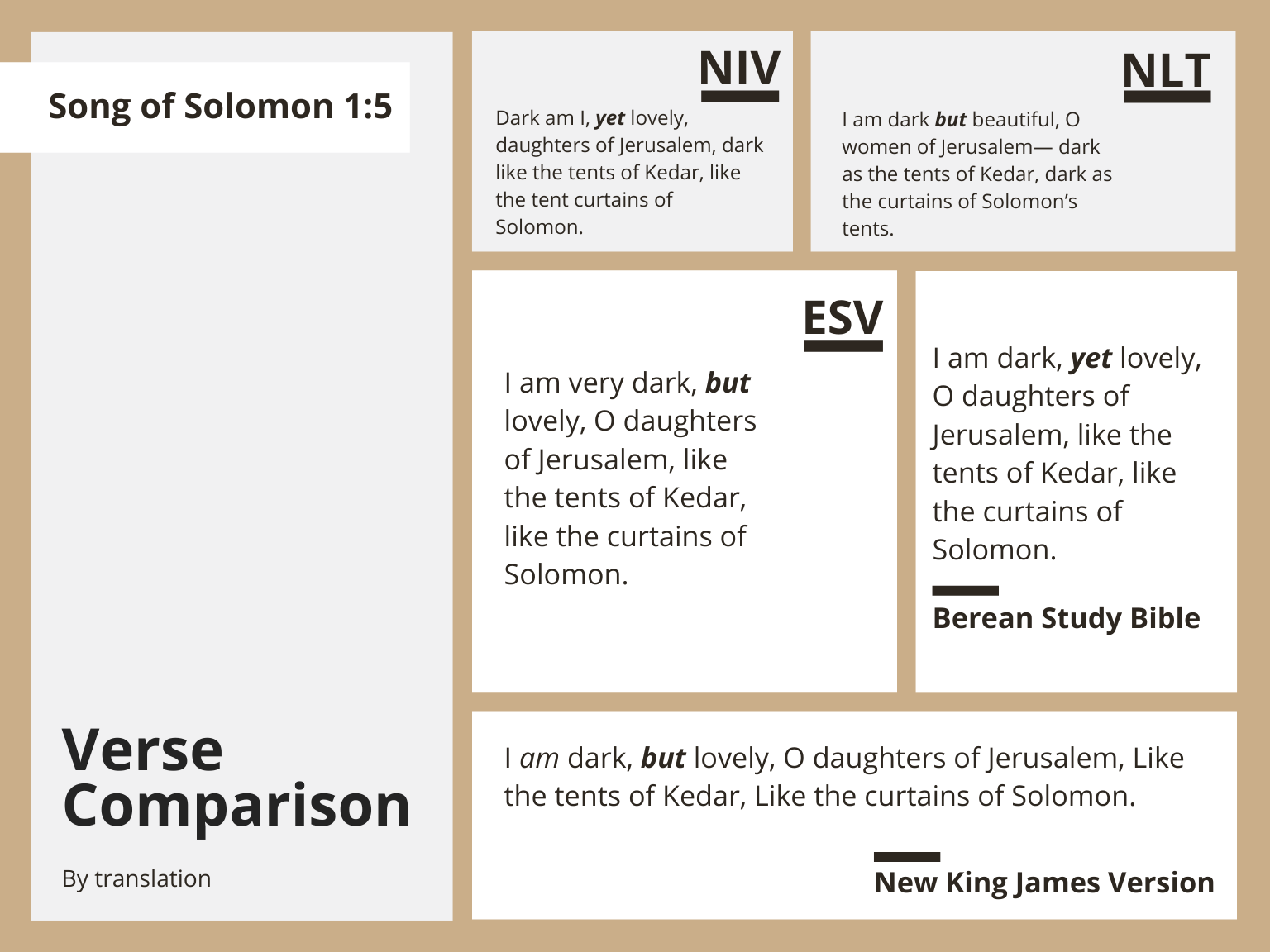
Donate

Believe Me When I Say it Hurts

Itzel SIR Article 1.png

I saw her smile slowly disappear. She pressed in hard, frantically gliding the ultrasound, searching for a heartbeat that would never again beat. “Keep trying!” I screamed at her.

“I’m sorry,” she said, “there’s no heartbeat.”

“Keep trying,” I sobbed.

The well-intentioned doctor offered me several explanations that were intended to extinguish my sorrow. She explained that this was a normal occurrence, that it happens to nearly 1 in 4 women, that I was young, and that I would surely become pregnant again soon. She said that miscarriage was a protective mechanism that the body uses when disposing of unhealthy organisms and what I heard was, “You should be grateful that your body is so smart.” She tried to bury my pain in scientific reasoning and normalcy. Normal, normal, normal. Normal, as in trivial, as in my life should not be altered and my heart should not ache. Her words felt cold, the type of cold that burns.

I was convinced that my doctor was not Christian, or she would understand the meaning of sanctity of life and surely know why I was in so much pain.

“She’s desensitized,” I thought. “She’s had to deal with so many miscarriages that she has convinced herself that these are not human lives but a conglomeration of cells with little to no human value.” I believed that her lack of faith had caused her insensitivity so I instinctively sought refuge in my community of faith. To my dismay, Christians also minimized my pain. They wanted to subdue my pain and transform it into something nicer, like hope or gratitude, as if hope and gratitude were the only sentiments allowed to be felt by a Christian woman who had just experienced great loss. “At least you are already a mother,” “You’re young, you can have more kids,” “At least you were not further along,” were some of the comments that pierced me open.

The legitimacy of my pain came into question and I was led to believe that I was foolish for carrying this pain. I only carried my child for nine weeks, yet I carried this pain everywhere I went. I carried it to my bedroom, to my office, and to my car. I carried it in my dreams and in my prayers. The pain accompanied me everywhere and filled spaces that my child could no longer fill. It’s true that your heart physically aches when the pain is too overwhelming, but the heart is not the only part of your body that suddenly feels too heavy. Walking, even the shortest distance, absorbed all of my energy, and eating became a laborious task. It’s odd how the heaviness can be accompanied by an emptiness. The pain becomes so unbearable that your body turns numb, but it’s not the type of numb where you feel nothing; it’s the kind of numb where you feel everything.

My pain was slowly being coupled with something even more isolating – shame. The general perception was that my pain was rather unreasonable or exaggerated. I could hear it in their tone; nine weeks wasn’t enough for me to feel this sorrow. My loss was being compared to the suffering of a woman who lost her baby girl to SIDS[1] and of another whose daughter was stillborn.[2] I think people assumed that this would give me “perspective” and alleviate my pain. I’m sure they weren’t trying to hurt me – they thought these stories would help me heal, but shame is no antidote to pain. 

“I should feel better because someone else’s tragedy is worst” was the message being conveyed by people who truly thought were helping me.

Toxic positivity is defined by therapists Samara Quintero and Jamie Long as, “the overgeneralization of a happy, optimistic state that results in the denial, minimization and invalidation of the authentic human emotional experience.[3]” This seemingly helpful mindset, actually produces more harm and trauma because it encourages silencing and transforms pain into a “dirty secret.” In Christian circles, toxic positivity disguises itself as faith and hope and can make individuals feel inadequate in their faith.  

One in four women have suffered a miscarriage.[4] “Because it’s so common, medical professionals tend to dismiss pregnancy loss, and friends and family members often fail to register its impact,” explains Dr. Janet Jaffe, director of the Center for Reproductive Psychology. However, the fact that so many women experience miscarriages does not mitigate the suffering. A recent study found that 29% of women who had experienced a miscarriage before 12 weeks, suffered post-traumatic stress disorder. The study also showed that 24% of these women had moderate to severe anxiety and 11% had moderate to severe depression.[5] I soon discovered that several of my own family members had suffered miscarriages. They quietly shared small pieces of their stories with me, almost hesitantly and I wondered if shame had silenced them too. I suspected that the lack of empathy that their stories had been met with transformed their accounts into a hasty narrative. They recounted their experiences in a way that seemed rather frivolous, though their glistening eyes revealed a different truth. “This is what pain looked like under submission,” I thought.  

Our sufferings are often placed on a hierarchy constructed by cultural understandings that determine which events should hurt more. Certain tragedies are automatically considered more sorrowful than others. Some griefs are “top-rated,” while other losses are rendered unimportant or are even stigmatized – the pain caused by a son being incarcerated or the death of a loved one due to drug overdose, for example. Society invalidates certain pains at the expense of the sufferer, and we don’t tend to pains that we think do not or should not exist.

Neglecting pain based on prejudices is a phenomenon that is also present in the medical industry. Pain bias negatively impacts women as their pain is often dismissed or minimized.[6] Gender bias in medicine leads to a dismissive attitude that often times, causes misdiagnosis. Christin Veasly, director at the “Chronic Pain Research Alliance,” explains that, “women have been more often referred to psychologists or psychiatrists, whereas men are given tests to rule out actual organic conditions.” A study revealed that women are 50% more likely than men to be misdiagnosed following a heart attack.[7] Maya Dusenbery, author of Doing Harm: The Truth About How Bad Medicine and Lazy Science Leave Women Dismissed, Misdiagnosed and Sick (2019), identified two principal reasons for which women experience significatively higher levels of misdiagnosis than men: 1) there’s a long-standing legacy of women being underrepresented or completely excluded from medical research, which means that medical professionals do not know as much about the female body as they do the male body and 2) women’s accounts about their pain are often met with distrust.

Gender bias contributes to the idea that women are hysterical, making it easy to dismiss their pain, and racial bias insists that certain bodies can withstand more pain. A 2016 study revealed that, “a substantial number of white laypeople and medical students and residents hold false beliefs about biological differences between blacks and whites and demonstrates that these beliefs predict racial bias in pain perception and treatment recommendation accuracy.[8]” These beliefs date back to the 19th century when Thomas Hamilton, a plantation owner and physician obsessed with medically justifying the enslavement of Black people, conducted torturous experiments on John Brown, an enslaved Black man. Hamilton claimed that Black people had thicker skin and less sensitive nerve endings. This myth, plagued with racist conjectures, seems to persist in today’s medical community. According to a 2019 study, Black and Hispanic patients are significantly less likely to receive pain medication, compared to White patients[9]. In short, medical practitioners are less likely to believe us when we say it hurts if we happen to be women or people of color.   

The lack of empathy expressed by people changes the manner in which you are able to tell your story. Truth and transparency become marred and you are left with remnants, carefully curated words that vaguely resemble what you feel. The way we listen to people’s stories can help them heal or it can cause more trauma. L.J. Isham describes listening as, “an attitude of the heart, a genuine desire to be with another which both attracts and heals.” To exercise sympathy and compassion and to adopt the type of listening described by Isham, it is not a requirement to have experienced every single type of pain imaginable to the human condition. We don’t even have to agree with the pain, its cause, duration or intensity. Our holy responsibility is not to rate each other’s pain, but to listen lovingly and to believe one another when we say it hurts. 

The way we listen to those in pain can have life-altering consequences. Pain is a real, intense sentiment that is often difficult to characterize using words, and culture can also influence the modes of expression adopted by each individual. This is why, it is important to listen with an open heart. I felt that my pain was delegitimized to such an extent that, even as I write this now, I have the lingering impulse to justify my pain to you. I am tempted to convince you that my pain was real. I want to explain what this pregnancy meant to me and detail the agonizing moments with such rawness that you would not be able to sanitize my pain. However, I will not do that. That is too much of a burden for a suffering person. I wrote this piece, not with the intention of putting my pain on display, allowing readers to dissect it and examine it thoroughly until they can recognize its validity, but to address the fact that we should believe people when they say it hurts. We can stand with people in their pain without understanding it. We can come alongside suffering people without having had to experience that specific pain ourselves. We can accompany people in their sorrow and console them without any “words of advice” or proposed “solutions.” We can pray for these individuals without even knowing the full story. The Bible tells us that when one member suffers, we all suffer (1 Corinthians 12:26). It is pain that unites us, and that propels us to love one another as we understand our interconnectedness in God.

We have a tendency to run away from pain and in reality, it is all too easy, especially if it is not our own pain. We look away and cover our ears and hearts with much ease. Indeed, it is much more difficult to stand with someone who is in pain. However, pain is not alien to the human condition, nor is it unfamiliar to Jesus. Our Savior experienced immense pain. In fact, it was the shortest verse[10] in the Bible that brought me the greatest consolation in my moments of sorrow; “Jesus wept” (John 11:35).  I was reminded that He didn’t weep because he was overwhelmed by joy and gratitude; He didn’t shed happy tears. He wept in suffering. He wept in loss. Profound pain caused those precious tears, and it was His pain that ultimately brought salvation to the world. Pain, generated by His everlasting love, is central to the gospel message, yet we often try to disguise it or swiftly move past it in our understanding of Him. In fact, “in early Christian times, the belief that Jesus Christ suffered pain was usually not accepted […] freedom from emotion was something to strive for at that time. Only after the acceptance of Christianity as the state religion of the Roman Empire in 380 AD did the pain of Christ again stand in the centre of the Christian doctrine of salvation.[11]” When all trace of pain is removed from the gospel, we are left with an anemic version, one that represents God as just a happy character, incapable of being in the midst of our grief and our suffering. When we attempt to alienate our pain from God, we are inadvertently supporting a theological vision that believes that God is incapable of understanding our pain. When we try to hide our pain away from our Creator, we undervalue His love and grace for us. In The Problem of Pain, C.S. Lewis wrote, “Pain insists on being attended to. God whispers to us in our pleasures, speaks in our conscience, but shouts in our pain.” The Bible does not say that God ignores our pain and pretends it does not exist; Psalm 147:3 reminds us that, “God heals the brokenhearted and binds up their wounds” (NIV). Our pain does not condemn us or separate us from God; on the contrary, it draws us closer to our Maker and to each other. 

 
Itzel Jpeg.jpg

About Dra. Itzel meduri soto

As an academic from el barrio, Dra. Meduri Soto strives to engage in scholarly work that honors and gives visibility to her community. Her faith drives her passion for justice as she seeks to reveal the ways in which certain language ideologies are constructed to operate unjustly against our communities. Her work acknowledges language as a powerful tool and promotes linguistic diversity in its different manifestations. Bicultural and bilingual identities are at the center of Dra. Meduri Soto’s work. She is a Spanish professor at Biola University where she teaches second language and heritage language learners. To learn more about her work, follow her on Instagram: @la.dra.itzel


Footnotes

[1] Sudden Infant Death Syndrome

[2] “A still birth is the birth of a baby who has died any time from 20 weeks into the pregnancy through to the due date of birth. The baby may have died during the pregnancy or, less commonly, during the birth” (Pregnancy Birth & Baby).

[3] https://thepsychologygroup.com/toxic-positivity/

[4] American Society for Reproductive Medicine.

[5] “Posttraumatic stress, anxiety and depression following miscarriage and ectopic pregnancy: a multicenter, prospective, cohort study” American Journal of Obstetrics and Gynecology (2019).

[6] “‘Brave Men’ and ‘Emotional Women:’ A Theory Guided Literature Review on Gender Bias in Health Care and Gendered Norms Towards Patients with Chronic Pain” Pain Research and Management (2018).

[7] “Impact of Initial Hospital Diagnosis on Mortality for Acute Myocardial Infarction: A National Cohort Study” European Heart Journal – Acute Cardiovascular Care (2018).

[8] “Racial Bias in Pain Assessment and Treatment Recommendations, and False Beliefs about Biological Differences Between Whites and Blacks” Proceedings of the National Academy of Sciences of the United States of America.

[9] “Racial and Ethnic Disparities in the Management of Acute Pain in US Emergency Departments: Meta-Analysis and Systematic Review” The American Journal of Emergency Medicine.

[10] It is the shortest verse in many translated versions. 

[11] Markschies C. Der Schmerz und das Christentum. Symbol für Schmerzbewältigung? [Pain and Christianity. A symbol for overcoming pain?] (2007). 


Articles like this one are made possible by the support of readers like you. Donate today and help us continue to produce resources for the mestizo church.
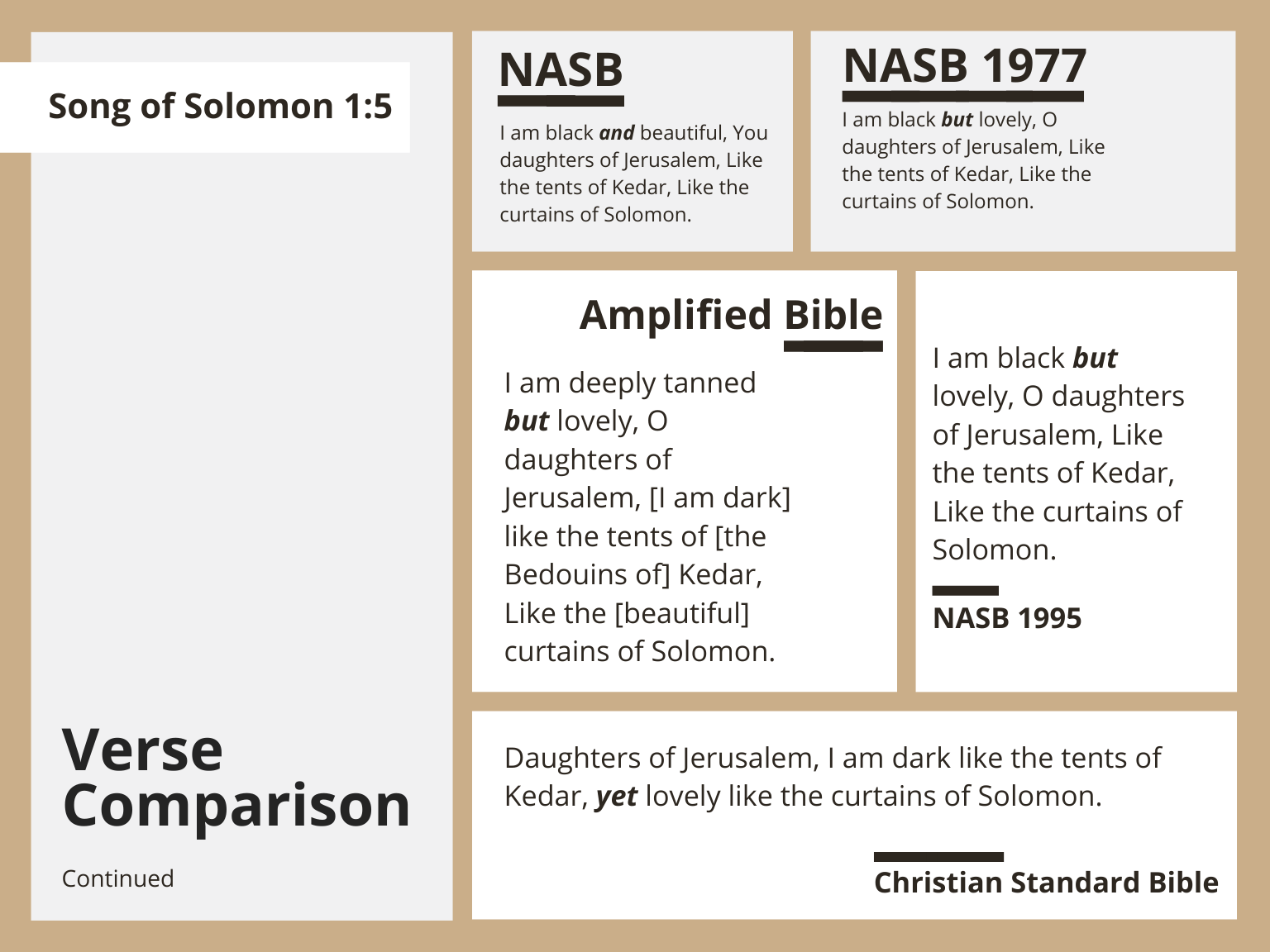
Donate